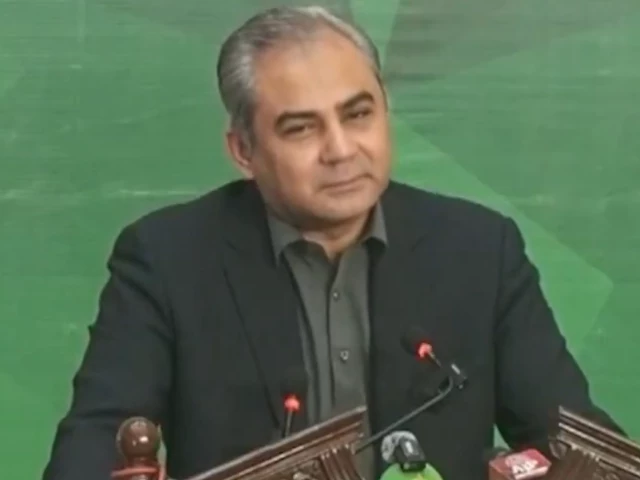

Interior minister also blames India for terrorism in K-P and Balochistan after terrorist attack in Bajaur
Interior Minister Mohsin Naqvi on Tuesday criticised what he described as the politicisation of jailed Pakistan Tehreek-e-Insaf (PTI) founder and former prime minister Imran Khan’s health, accusing certain individuals of “playing politics” over the issue.
Dismissing misinformation circulating on social media, he urged the public to rely on verified reports rather than what he termed “propaganda” that has caused unnecessary anxiety. He said the government and medical teams had acted with full responsibility and transparency in providing treatment to the former premier.
Briefing the media on Imran’s medical treatment and living conditions amid concerns over his eye health, Naqvi said the former prime minister had been taken to hospital for an eye injection under strict medical precautions.

“This was an ordinary procedure that had to be done. Doctors were already conducting check-ups, and everything was there. The injection was done as a precaution at the hospital to ensure no germs or complications,” he said, adding that all prisoners are entitled to medical care.

Read: Medical board says Imran’s vision improving
Naqvi said opposition leaders from the National Assembly and Senate, along with other representatives, visited the Pakistan Institute of Medical Sciences and met the treating doctors for one and a half hours.

He added that the doctors also consulted Imran Khan’s personal physicians by phone for 45 minutes, answered detailed questions, and termed the treatment “excellent” and “the best possible care.”
The minister stated that the medical check-up had been delayed for three days due to opposition and family vetoes, specifically naming Imran’s sister, Aleema Khan.
“Aleema Khan has told her party people that if we agree to everything, then this issue will die down. Because of them, the medical checkup could not be done for three days. On the one hand, they claim sympathy and relationships, and on the other hand, a lot of politics has been played in this,” he said.
Naqvi further alleged that some individuals were seeking political gain by exaggerating the situation. “Political leaders were almost all on board, but Aleema Khan used to veto it. She used to say no to everything. When all the facts came in front of them, they were present, yet the problem is that they want to cash this thing,” he said.
Reiterating his criticism of the politicisation of the matter, the interior minister maintained that Imran’s medical care was being handled in accordance with legal obligations and standard procedures.
Security situation in K-P and Balochistan
Naqvi also highlighted the worsening security situation in the country, citing recent terrorist attacks in Bajaur and Shangla.
“The fire of terrorism is increasing in Khyber-Pakhtunkhwa. Every day there is an incident. The K-P government has to focus a lot on this, and they are doing it. I will not say that the K-P police are not fighting; they are fighting well. But until the political leadership is on board, no fight can be won. All these things are damaging it,” he said.
He also raised concerns about unrest in Balochistan, warning that those attempting to derail governance or incite chaos, particularly via digital platforms, were acting against the public interest. “This is not a normal thing happening in K-P and in the rest of Balochistan. If someone is smart and can see the situation clearly, they should come up with a logical solution,” he said.
The interior minister blamed India for acting as a proxy behind recent terrorist attacks, saying the strategy involved “pretending to be victims while simultaneously carrying out these attacks.” He added that Pakistani authorities are now working on international platforms to expose and counter this tactic.
Naqvi urged political and party workers to prioritise sensible action and avoid unnecessary tensions. “Sensible people are present everywhere, but the problem is that they are not heard. The public and those people have to decide whether they will go with the sensible people or the rest of the people,” he said.
Imran Khan’s health
The developments come amid growing concerns over Imran’s deteriorating eyesight in custody, with the court noting that the PTI founder expressed dissatisfaction with the available medical facilities and specifically sought access to specialist eye doctors.
During the hearing, the chief justice of Pakistan observed that all prisoners, including Imran, must receive equal medical facilities and that health concerns take precedence over other matters.
Following the proceedings, the Supreme Court ordered the formation of a medical team to examine Imran’s eye and directed that telephonic contact with his children be completed before February 16.
Attorney General Mansoor Usman Awan assured the bench that the government would provide access to ophthalmologists and facilitate phone calls with Qasim and Salman.
Meanwhile, reports from Barrister Salman Safdar, acting as amicus curiae, detailed that Imran had suffered a sudden and complete loss of vision in his right eye and had been left with only 15% vision despite prior treatment.
The TTAP sit-in at Parliament House entered its fifth day on Tuesday, with party leaders and family members of jailed PTI founder Imran Khan demanding access amid growing concerns over his health.
TTAP spokesperson Akhunzada Hussain Ahmed Yousafzai said the protest, which began on Friday, aimed to allow at least one family member or party representative to meet Khan and end rumours about his condition.
Aleema reiterated that the family rejected the medical report submitted by jail-appointed doctors and insisted that he be examined at Shifa International Hospital under the supervision of his personal physician, adding that they would hold a press conference after the meeting.