


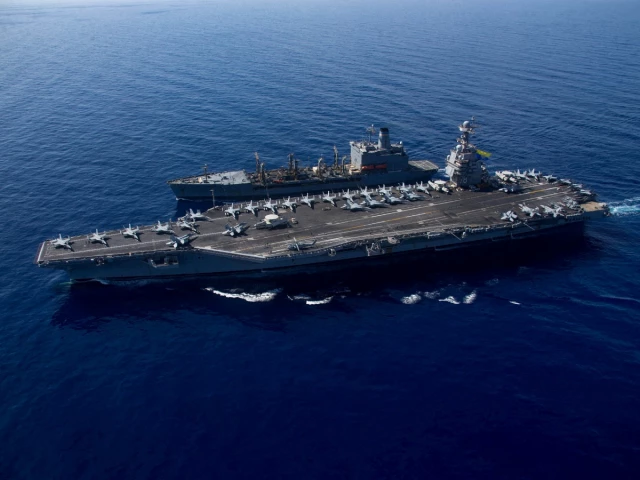

As tensions with Iran escalate, the US Navy has surged two aircraft carriers into the region. One of them, the service’s newest and most expensive supercarrier, is grappling with persistent plumbing failures and the human toll of an unusually long deployment, according to reporting by Gulf News, which cites US media outlets.
The USS Gerald R. Ford (CVN-78), a $13 billion successor to the Nimitz class, has been at sea since June 2025, marking more than eight months underway. Initially deployed to the Mediterranean, the carrier was rerouted in October 2025 to the Caribbean to support operations against Venezuelan leader Nicolás Maduro, including oil-tanker seizures.
In early 2026, the deployment was extended for a second time, with the carrier transiting the Strait of Gibraltar and heading east toward the Middle East to support potential US airstrikes on Iran. If the deployment reaches 11 months, it would set a peacetime record for a US aircraft carrier.
Adding to the strain is the ship’s troubled vacuum-based sewage system. Designed to conserve water and adapted from the cruise-ship industry, the system was never fully tested for the demands of a warship. According to internal Navy documents and sailor accounts obtained by NPR, the system, which serves roughly 650 toilets for a crew of about 4,600, has suffered frequent clogs caused by foreign objects such as T-shirts, rope and loose parts, as well as sludge buildup.

Read: Iran says would respond ‘ferociously’ to any US attack

In one four-day period in March 2025, engineers logged 205 maintenance calls. Sailors reported working up to 19-hour days to fix leaks and restore suction, with problems in a single head capable of disabling an entire section of the ship. Since 2023, the Navy has carried out at least 10 acid flushes, each costing about $400,000, though the procedure cannot be performed while the carrier is underway.
By February 2026, the Navy told The Wall Street Journal the system was averaging about one maintenance call per day and “is improving,” adding that the issues had not affected the carrier’s ability to carry out its mission.
The prolonged deployment has taken a heavy toll on sailors and their families. In a February 14 letter to relatives, the ship’s commanding officer, Capt. David Skarosi, acknowledged the impact of repeated extensions, citing missed vacations, weddings and family plans. “But when our country calls, we answer,” he wrote.
One sailor missed the death of his great-grandfather. Another is thinking about leaving the Navy after almost a year away from her toddler daughter. Two more said the ship had sewage problems.
Life on the USS Ford, w @milanczerny https://t.co/UlHl3klczR
— Lara Seligman (@laraseligman) February 21, 2026
Families have reported missed funerals, births and birthdays, with some sailors facing divorces during the deployment. One sailor’s mother described the extension as “heartbreaking,” while another sailor considering leaving the Navy said the uncertainty of seeing her toddler daughter “hurt the most.” Many younger crew members were described as angry and upset, with some planning to leave the service at the end of the tour.
Meanwhile, the USS Abraham Lincoln (CVN-72) arrived in Middle East waters on January 26, 2026, after departing San Diego on November 21, 2025. The Nimitz-class carrier, flagship of Carrier Strike Group 3, was redirected from Indo-Pacific duties in the Philippine and South China Seas to the US Central Command’s 5th Fleet area of operations.
Carrying Carrier Air Wing Nine, including F-35C stealth fighters, F/A-18 Super Hornets, EA-18G Growlers and E-2D Hawkeyes, the Lincoln is providing additional deterrence and power-projection capability amid the standoff with Iran. Its arrival brings the total to two US carrier strike groups in the region.
The Ford’s plumbing problems first drew widespread attention in mid-January 2026 through reporting by NPR and were later amplified by Sputnik, which highlighted long toilet lines in the context of the Iran mission. The Navy has acknowledged design shortcomings flagged as early as a 2020 report by the Government Accountability Office, though full fixes are expected to take years and cost hundreds of millions of dollars.
While the carrier remains fully mission-capable, the combination of sanitation issues, extended family separation and repeated deployment extensions underscores the growing strain on the US Navy’s carrier fleet as it manages multiple global flashpoints.