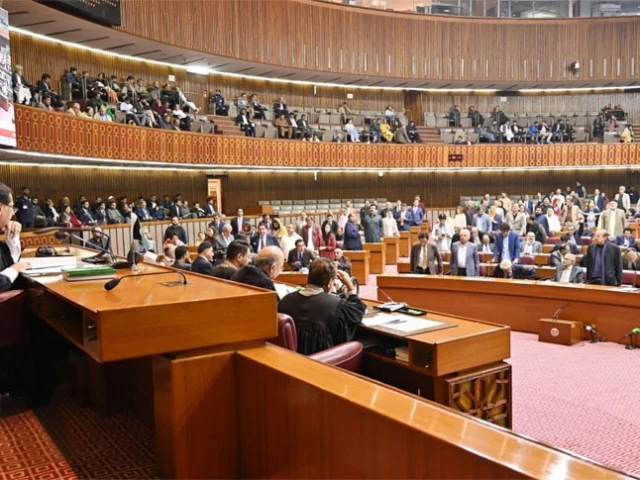

THE assault comes from multiple directions, each more brazen than the last. Consider what happened barely a stone’s throw from Parliament House itself: while legislators debated inside, Shakarparian contractors were busy deforesting a beautiful tract of land within sight of the nation’s seat of power. The trees fell and the earth was cleared, primed for mudslides once the monsoon arrives. Nobody in authority raised an alarm. The symbolism is almost too perfect: as we talk about governance, the very ground beneath our feet is being stolen.
This is not an isolated incident but part of a pattern. The Islamabad Wildlife Board, established precisely to protect the Margalla Hills National Park, has been neutered. Rina Saeed Khan, the champion who stood guard over these hills, now faces harassment through bogus cases, a punishment for the ‘crime’ of doing what the law mandates. When protectors become the persecuted, the capture is complete.
The physical transformation of the city tells the same story. Those cascading contours that once defined Islamabad’s character, giving it a topography distinct from the concrete monotony of other urban centres are being systematically flattened. This destruction is now cascading beyond the capital territory, driven by influential housing societies in the surrounding hilly areas. Contractors fill in these natural undulations to create level plots and farmhouses, erasing in months what nature took millennia to create. The model city is being reduced to just another flat, characterless expanse of development.
The city has been further bifurcated by signal-free corridors that have killed its walkability. Islamabad was designed as a city where I could once move between sectors on foot or bicycle, where neighbourhoods connected organically. Now, massive thoroughfares carve through the urban fabric, making it impossible to cross without risking one’s life. We have prioritised cars over people and speed over liveability, destroying the pedestrian character that once made the city humane.

The capital now appears regularly on pollution indices it once escaped.

Construction in green belts now proceeds with impunity. These areas were once the oxygen veins of the city, meant to ensure that development never became suffocating. Today, we allow construction there and needlessly expand roads, parking lots, and seminaries. Semi-permanent camps for law-enforcement agencies further narrow the spaces that let the city breathe. Each road-widening project claims more green spaces — the very things that made Islamabad different.
We have carved the E sectors out of what was supposed to be the Margalla Hills National Park. These areas were intended as habitats for leopards, pangolins, barking deer and grey goral. Instead, we authorised cricket pavilions, university campuses, golf courses, and private housing, turning ecological corridors into real estate opportunities. The wildlife that once roamed freely now finds itself trapped in shrinking pockets, leading to the conflicts we wring our hands about when a leopard ventures into the encroached areas. We took their home and act surprised when they show up at ours.

Meanwhile, garbage chokes the tributaries of the Lai nullah, and invasive species like paper mulberry are spread in the name of landscaping, driving away indigenous birds which need indigenous trees for nesting, mating and chirping.
The consequences of this reckless development play out in tragic ways. We once took pride in a gravity-based drainage system where every manhole bore the Mohenjo Daro seal, a symbol of inherited excellence in urban planning. Now, the CDA and its approved housing societies have encroached upon natural channels, narrowed nullahs, and built roads over storm-water drains. When the rains come, the water has nowhere to go. The floods in E-11 in 2021 and G-11 in 2025 were the price of denying water its right of passage. This is manufactured urban flooding, and it persists because nobody is held accountable.
While rainwater harvesting is ignored, all sources of natural recharging are being flattened. This run-off adds to pollution, while ad hoc population growth depletes the groundwater, allowing the ‘tanker mafia’ to emerge. Even our ancient heritage is not spared; we allowed encroachments on caves where Buddhist monks once meditated. We cut through the heart of our ecosystem to construct corridors like Alexander Road, ostensibly for connectivity, but really to open up land for developers who see only profit where there should be preservation.
Perhaps the most stunning revelation of the current mindset was the proposal to mortgage F-9 Park for a sukuk bond worth Rs500 billion. The federal government actually considered pledging this 750-acre public park as collateral for debt. Though the proposal was withdrawn after a public outcry, the fact that it was seriously entertained reveals a disturbing truth.
Meanwhile, the air tells its own story of decline. Islamabad’s air was once distinctively crisp, and a part of its identity, as were its tree-lined avenues. That air is gone. Unchecked vehicular emissions, construction dust, and the burning of waste have transformed the atmosphere. The capital now appears regularly on pollution indices it once escaped, joining Lahore in the unenviable club of Pakistan’s toxic cities. Every infrastructure project extracts its tribute; highways and metro extensions demand the sacrifice of mature trees that functioned as carbon sinks. The arithmetic of ‘compensatory’ saplings never adds up to the restoration of a lost ecosystem.
At the heart of the capital sits Rawal Lake, a prize waterbody that is slowly dying. Industrial effluents mix with sewage, and solid waste accumulates at the edges. Expanding irregular housing societies in Banigala, Bhara Kahu, and Chak Shahzad discharge waste into the lake, treating a strategic asset like a dumping ground.
This environmental siege exposes a fundamental disconnect between what we claim to value and what we actually protect. The institutions exist and the laws are on the books, but the political will to enforce them is missing. Islamabad was built as a statement that Pakistan could create a capital worthy of a great nation. That vision is being betrayed through internal surrender. The ‘Asian Geneva’ is becoming just another casualty of unchecked development. Unless accountability is restored and the protectors are themselves protected, the siege will continue until there is nothing left worth defending.
The writer is a climate change and sustainable development expert.
Published in Dawn, January 21st, 2026