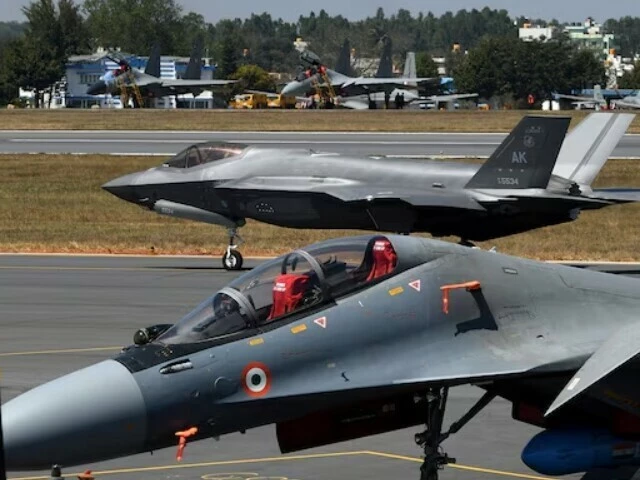

A F-35 fighter jet moves past Indian Air Force’s Sukhoi Su-30MKI fighter jet parked on tarmac during the “Aero India 2025” air show at Yelahanka air base in Bengaluru, India, February 11, 2025. PHOTO: REUTERS
Iran’s Islamic Revolutionary Guard Corps (IRGC) said Thursday that it had struck and “seriously damaged” a US F-35 fighter jet over central Iran.
In a statement, the IRGC said the aircraft was hit by its air defence systems at around 2.50 am early Thursday (5.20 am Pakistan time), adding that “a US F-35 fighter jet was struck and seriously damaged” over central Iran.
It added that “the fate of the aircraft remains unknown and is under investigation,” noting there is a “high possibility” that the jet may have crashed.

The IRGC also said the operation came “following the successful interception of more than 125 US-Israeli drones,” adding that the incident “reflects significant and targeted improvements in the country’s integrated air defence systems.”

Regional tensions have escalated since the US and Israel launched a joint offensive on Iran on Feb. 28, killing so far around 1,300 people, including then-Supreme Leader Ali Khamenei.
Iran has retaliated with drone and missile strikes targeting Israel, Jordan, Iraq, and Gulf countries hosting US military assets, causing casualties and damage to infrastructure while disrupting global markets and aviation.

Kuwait refinery attacked
Al Ahmadi Port Refinery, affiliated with the Kuwait National Petroleum Company, was hit in a drone attack this morning, resulting in a fire breaking out in some of its units.
In a post on X, the Kuwait Petroleum Corporation stated that there appear to be no human injuries sustained, and firefighters are currently on the scene. Several units in the refinery have been shut down to ensure safety.
US launches ballistic missiles from the ground
The United States has begun firing ground-launched ballistic missiles at Iran, according to a report by The Wall Street Journal, marking what it describes as the first combat use of the US Army’s newer long-range missile systems.
The move is a shift in the conflict, which had previously been conducted largely through air power. The missiles, with an estimated range of 200 to 300 miles, would need to be launched from nearby territory, raising questions about the use of Gulf states as firing points.
Read: Gulf states press US to ‘neutralise Iran for good’ as Hormuz crisis deepens
Videos verified by Storyful, a company owned by the Wall Street Journal’s parent organisation, appear to show some launches originating from Bahrain, located roughly 125 miles across the Gulf from Iran.
The report suggests this could indicate the use of Gulf territory despite public assertions of neutrality by countries in the region.
Meanwhile, Iran’s Foreign Minister, Abbas Araghchi, said US forces had targeted Kharg Island, the country’s primary oil export terminal.
He added that the strikes were launched from the United Arab Emirates, though this has not been independently confirmed.
Rising fuel prices as supply chokes in Hormuz
Surging oil prices in physical markets – the trading place for oil on ships, rail cars or in storage tanks – have outpaced the already dizzying increases in benchmark futures markets, as refiners and traders across Asia and Europe are snapping up whatever barrels they can secure to plug the enormous supply gap caused by the US-Israeli war on Iran.
That supply gap is expected to persist following a barrage of attacks on oil-and-gas facilities across the Middle East that have turned into the largest-ever disruption to global energy supplies. Iran has also throttled traffic through the Strait of Hormuz, the critical waterway transited by 20% of the world’s oil and gas, with threats to fire on ships that attempt to sail through the narrow strait.
“It is going to take longer than people realise to bring supply back to the market, even once the strait is reopened, because we would still have a logistics nightmare,” said Dennis Kissler, senior vice president of trading at BOK Financial.
Oil, gas, and refined products are critical to transportation, shipping and manufacturing industries, and energy supply and price shocks can hit consumers, businesses and economies hard, impairing demand for months or years.
Read more: Govt to absorb Rs49/litre oil price surge
Flows of crude and condensate have dropped by about 12 million barrels per day, or around 12% of daily world demand, due to output cuts and export halts by Gulf producers, according to oil shipments tracker Petro-Logistics. Those barrels cannot easily be replaced.
Physical market surges
Futures prices have risen steadily since the US and Israel struck Iran beginning February 28, but the moves in physical cargo prices have been far more dramatic.
Benchmark Brent crude hit a session high of $119 on Thursday, later settling around $109 a barrel. However, the benchmark Middle East Dubai crude price hit a record $166.80 a barrel. If outages persist, Brent is likely to surpass its all-time high of $147.50 reached in 2008, investment bank Goldman Sachs said on Thursday.
Cargoes of European and African crude have risen to $120 per barrel, and even barrels from Russia, which were highly discounted due to sanctions, have bounced back above $100.
The Mediterranean market was calm until the start of this week, but even those prices have risen due to fading hopes of a swift reopening of Hormuz, one crude trader said.
“What we’re seeing in spot differentials suggests a much tighter system beneath the headline price,” said David Jorbenaze, global oil market lead at commodities information provider ICIS.
Middle East benchmark, Dubai crude hit $166.80 a barrel on Thursday, the most expensive ever.
Refiners have looked further afield for substitutes for Middle Eastern supply, which is mainly medium-density and high in sulphur, known in the industry as sour.
Russia’s Urals, a medium sour crude, has been sold at wide discounts to Brent ever since that country invaded Ukraine due to sanctions. But that price has surged, with Urals delivered to India trading premium to Brent earlier this month for the first time.
Also read: Oil prices rise 1% after renewed Iranian attacks on UAE
In the North Sea, Norwegian medium sour crude Johan Sverdrup was bid at a record $11.30 premium to Brent on Thursday, an implied cash price of about $124 a barrel. Sour oil typically trades at a discount to Brent because it requires more refining.
US crude grades have also rallied, though the US market’s relative geographical isolation has opened up a yawning gap between Brent and benchmark West Texas Intermediate, which settled around $96 on Thursday.
However, the benchmark Mars sour produced in the US Gulf of Mexico, a similar quality to oil produced in the Middle East, is more elevated. Mars Sour reached $107.53 on March 9, the highest since July 2008, and on Thursday traded at a premium of about $6 to US crude.
Prices for key transport fuels have risen even more than physical crude. Jet fuel in northwest Europe hit a record of around $220 per barrel, per LSEG data, while European diesel breached $200 a barrel for the first time since 2022. Europe relies on the Middle East for both products.
Asian fuel prices rose as refiners have cut processing rates, with refinery profit margins for gasoil at their highest since June 2022 at over $60 a barrel.
On March 11, the United States and other members of the International Energy Agency announced they would release 400 million barrels from strategic reserves; the US later waived sanctions for Russian oil barrels. Those moves may not be enough, Jorbenaze said.
“The market ultimately runs on barrels moving, not barrels being announced,” he said.