

• Iran parliament speaker says US must decide ‘whether it can earn our trust or not’
• Tehran warns of strong response to any confrontation; calls control over strait ‘non-negotiable’
• Iran demands full sanction lifting; US offers phased approach
• Conflicting claims over $6bn frozen assets; Lebanon another sticking point
• Officials hint at another round of talks
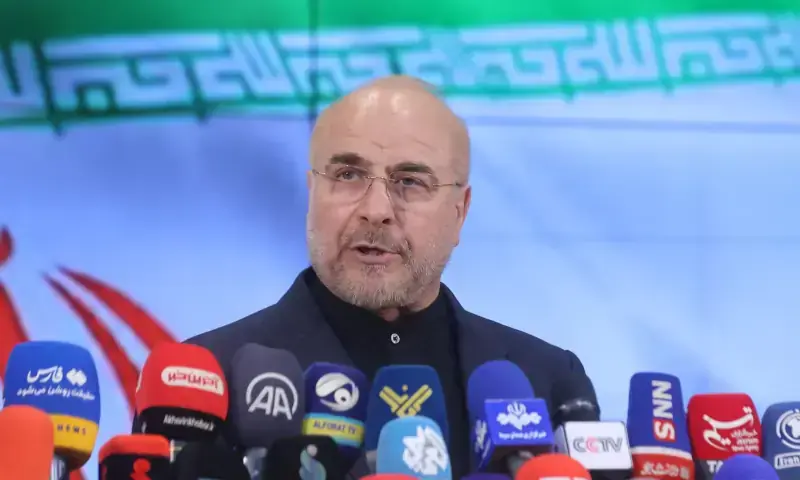
ISLAMABAD: Iran’s Parliament Speaker Mohammad Bagher Ghalibaf, who led peace talks with the United States in Pakistan, says that his country will not give in to threats after US President Donald Trump ordered a naval blockade of the strategic Strait of Hormuz.
“If they fight, we will fight, and if they come forward with logic, we will deal with logic. We will not bow to any threats, let them test our will once again so that we can teach them a bigger lesson,” Mr Ghalibaf told reporters after returning to Tehran from Islamabad, several Iranian news agencies reported.
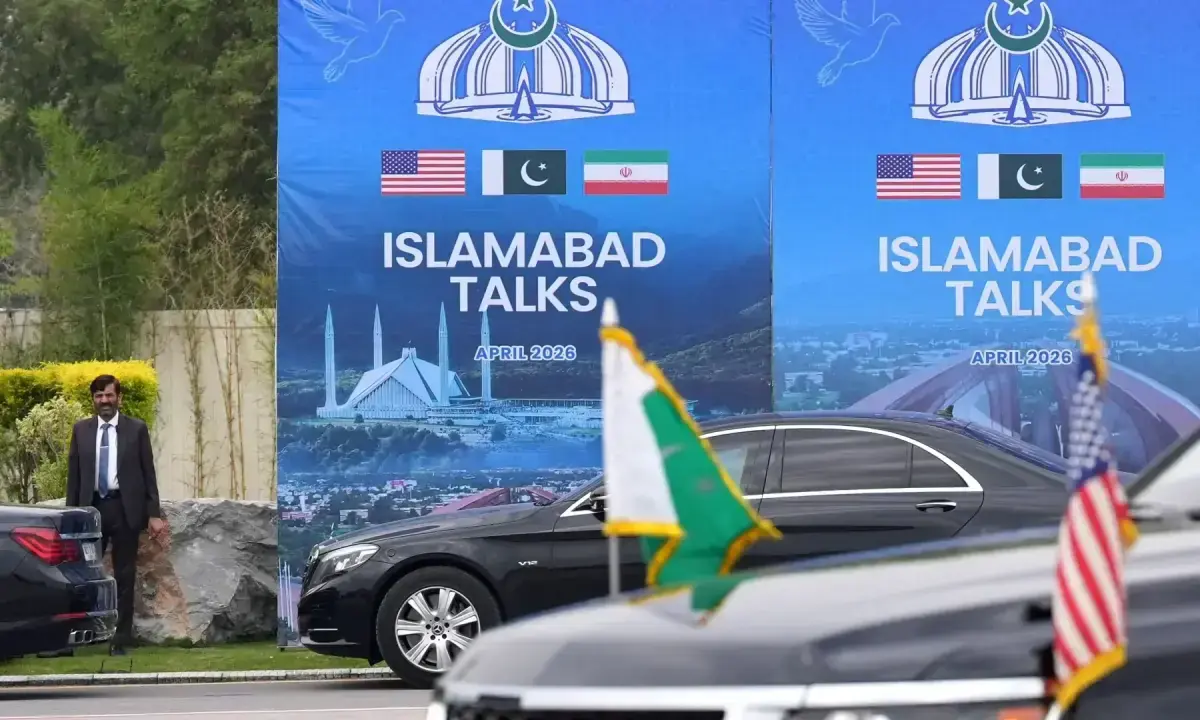
The inaugural round of direct Iran-US dialogue mediated by Pakistan ended early Sunday without any agreement. While no breakthrough could be achieved, officials from both sides indicated that the process could continue.

On the Iranian side, Mr Ghalibaf struck a more pointed tone, saying the opposing side “ultimately failed to gain the trust of the Iranian delegation in this round of negotiations”.

Pakistan, which hosted and facilitated the talks, sought to project cautious optimism. Deputy Prime Minister Ishaq Dar said, “We hope that the two sides continue with the positive spirit to achieve durable peace and prosperity for the entire region and beyond.”
No deal, no breakdown

The outcome, though interpreted varyingly, reflected a delicate balance. Both delegations clearly said that there was no agreement on any of the core issues, but at the same time did not close the door to a follow-up.
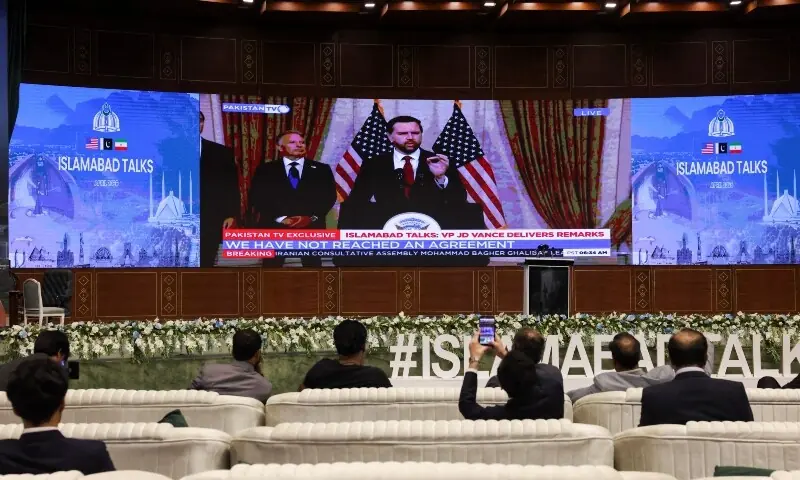
US Vice President J.D. Vance, who was leading the American team, pointed to a “proposal” having been given to Iran, while Mr Ghalibaf, the head of the Iranian delegation, on his part put the ball in the US court, saying, “It is time for it [US] to decide.”
Pakistani officials, speaking on the background, meanwhile, described the engagement as substantive rather than symbolic, with both sides testing positions after weeks of conflict and a fragile ceasefire. They said that “a lot of ground” had been covered, but cautioned that the conflict remained “complex, complicated and enduring”, with multiple divergences and external pressures.
The talks unfolded in stages, beginning with separate meetings of both delegations with Pakistani leadership, including Prime Minister Shehbaz Sharif, Mr Dar and Chief of Defence Forces Field Marshal Asim Munir, before moving into indirect exchanges and eventually direct face-to-face sessions.
The talks went into top gear with a meeting that brought together Mr Vance, special US envoys Steve Witkoff and Jared Kushner, and the Iranian team led by Mr Ghalibaf and Foreign Minister Abbas Araghchi. That session led to expert-level negotiations with working groups on economic, legal and political aspects, deliberating on the details of the disputes and the way out.
According to Iran’s Foreign Ministry spokesman Esmaeil Baqaei, “Discussions were held on various dimensions of the main negotiation topics, including the Strait of Hormuz, the nuclear issue, war reparations, lifting of sanctions, and the complete end to the war.”
The breadth of the agenda underlined the ambition of the process, but also its difficulty.
The two sides had entered the Islamabad talks with differing levels of preparedness.
The Iranian delegation arrived with detailed technical material, including well-crafted proposals and extensive annexes, enabling it to table specific ideas on sanctions relief, sovereignty over the Strait of Hormuz and a regional ceasefire from the outset.
The US delegation, though led at a senior political level, relied mostly on principle-based documents, with greater dependence on real-time consultations and high-level direction. It was also important to note that Mr Vance brought with him the Deputy National Security Adviser, who is fluent in Persian and is seen as the architect of the Trump administration’s foreign policy.
Disagreements
Despite the extensive engagement, the two sides ran into a familiar but deep structural divide.
At the core, a senior Pakistani official told Dawn, was a disagreement over sequencing and trust.
The US delegation pushed for what Mr Vance described as an “affirmative commitment” from Iran that it would not pursue nuclear weapons or capabilities enabling a rapid breakout.
“The simple fact is that we need to see an affirmative commitment,” he said at his post talks presser, adding that Washington had made clear “what our red lines are.”
Iran, however, insisted on trust before any progress.
Mr Ghalibaf, in his comments after the talks, said the US must now decide “whether it can earn our trust or not”, reflecting Tehran’s insistence on assurances before taking irreversible steps.
This inversion of expectations, therefore, also contributed to the deadlock.
But as a matter of principle, according to a source, Iran maintained that, being a signatory to the NPT, it retained an inalienable sovereign right to enrich uranium for peaceful purposes. In line with positions conveyed during earlier indirect and back-channel exchanges, Iran offered commitments to halt future stockpiling beyond civilian reactor needs and to downblend its existing enriched uranium inventories.
The US, however, declined to accept the proposal, instead pressing for a broader, affirmative and open-ended prohibition on enrichment, which Tehran viewed as incompatible with its core security and sovereignty red lines.
Another major sticking point was the Strait of Hormuz. Iran maintained that control over the chokepoint was non-negotiable, while the US pressed for unrestricted navigation. The issue, Pakistani officials said, proved as difficult as the nuclear file.
The Iranian delegation, during the talks, firmly held to its position that the Strait of Hormuz lies under the joint territorial sovereignty of Iran and Oman as the two littoral states, which grants them the exclusive right to determine its management and security arrangements. They emphasised that the waterway is not an open international common subject to unilateral external enforcement.
They, moreover, insisted that continued Iranian operational control was a non-negotiable red line and a core pillar of post-war deterrence.
Sanctions relief and frozen assets formed a third layer of disagreement. While the US side discussed phased relief linked to compliance, Iran demanded comprehensive lifting of sanctions and release of assets as part of any meaningful deal.
The Iranian side also claimed that the release of $6 billion in frozen assets was its precondition for talks, which the US had accepted. Both sides made conflicting claims about progress on the topic.
Overlaying these issues was the unresolved question of a broader ceasefire, particularly in Lebanon.
Iran insisted that any settlement must include a full cessation of hostilities across all fronts. Continued Israeli strikes in southern Lebanon and violence complicated the talks and reinforced Iranian scepticism.
Iran also insisted the war must be formally ended and guarantees delivered before concessions. The US, meanwhile, treated concessions as the prerequisite for any broader settlement. This, an official said, created a circular deadlock.
Pakistani officials said the talks reflected not a failure of process, but the scale of the issues involved and the political constraints on both sides.
Officials indicated that another round, possibly at a lower or technical level, could take place in the coming weeks. The immediate focus, however, is on sustaining the fragile ceasefire that created the space for talks.
Published in Dawn, April 13th, 2026