
• Drone ‘approaching’ aircraft carrier shot down; gunboats approach US-flagged vessel
• White House says talks still on despite skirmishes
• Tehran officials ‘seek change of venue’ after Pezeshkian’s go-ahead for negotiations
• FO says Pakistan also invited to attend dialogue
ISLAMABAD / DUBAI: Tehran has asked for a change of venue ahead of planned talks between US and Iranian officials this week, after President Masoud Pezeshkian confirmed ordering the initiation of dialogue with Washington.
On Tuesday, Pakistan’s Foreign Office also confirmed that it had been invited to participate in the Iran-US talks aimed at de-escalation of tensions between Tehran and Washington.
According to earlier reports, US Special Envoy Steve Witkoff and Iranian Foreign Minister Abbas Araqchi were supposed to meet in Istanbul on Friday in an effort to revive diplomacy over a long-running dispute about Iran’s nuclear programme and dispel fears of a new regional war.

The Reuters news agency, however, reported on Tuesday night that instead of Istanbul, Iranian officials are asking that the talks be held in Oman instead, and that the scope be narrowed to two-way talks on nuclear issues only.
This latest uncertainty followed reports of escalatory moves in the Persian Gulf, where a US warplane shot down an alleged Iranian drone that was said to be approaching the USS Abraham Lincoln aircraft carrier.
Earlier, a US-flagged tanker was approached and challenged by Iranian gunboats in the Strait of Hormuz, before continuing on its way, the British maritime security firm Vanguard Tech said.
However, the White House reiterated that the proposed talks were still on, despite these hiccups.
“I just spoke with special envoy (Steve) Witkoff, and these talks as of right now are still scheduled,” Press Secretary Karoline Leavitt told reporters, adding that they were due to happen “later this week.”
Hectic diplomacy
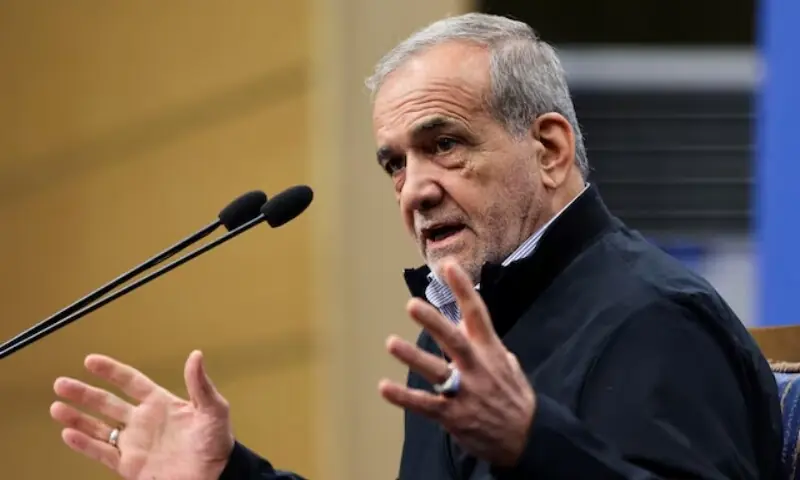
Iran’s president confirmed on Tuesday that he had ordered the start of talks with the US, provided they were free of threats, after his counterpart Donald Trump suggested “bad things” would happen without a deal.
“I have instructed my Minister of Foreign Affairs, provided that a suitable environment exists — one free from threats and unreasonable expectations — to pursue fair and equitable negotiations,” President Masoud Pezeshkian wrote in a post on X.
He added that the talks followed requests “from friendly governments”.
On Tuesday, Qatar’s foreign ministry said diplomacy with Iran was “continuing very intensively”, in “tandem with all our neighbours”.
Earlier, a senior official from the UAE said Iran needed to reach a deal and “rebuild their relationship with the United States”.
“I would like to see direct Iranian-American negotiations leading to understandings so that we don’t have these issues every other day,” said presidential adviser Anwar Gargash.
Iran has repeatedly stressed that any talks should remain focused solely on the nuclear issue, rejecting the possibility of negotiations over its missile programme or defence capabilities.
When asked about the upcoming talks, an Iranian diplomatic source told Reuters they were “neither optimistic nor pessimistic”, adding that Tehran would not negotiate over its defensive capabilities.
Pakistan’s role
“Pakistan has received the invitation for the upcoming talks between Iran and the United States,” FO Spokesperson Tahir Andrabi said while responding to a query on Tuesday.
“Pakistan’s participation is seen as crucial to defusing tensions, as Islamabad has been quietly working to facilitate the talks,” a diplomatic source told Dawn.
The diplomatic source added that Deputy Prime Minister and Foreign Minister Ishaq Dar is expected to participate in the meeting.
The priority of the talks is to avoid any conflict and de-escalate tensions between the two sides, a regional official told Reuters, adding that some regional powers were also invited.
The official, speaking on condition of anonymity, said some of the countries invited to the talks at the foreign ministers’ level included Pakistan, Saudi Arabia, Qatar, Egypt, Oman and the United Arab Emirates.
The person said the format of the meetings remained unclear, but that the “main meeting” would be on Friday.
Last-minute change?
According to Reuters, a regional diplomat said that Tehran wants to change the format of the talks.
“They only want to discuss the nuclear file with the Americans while the U.S. wants to include the ballistic missiles and the activities of Iran’s proxies in the region.”
A source said that Trump’s son-in-law Jared Kushner was due to take part in the talks, along with US Special Envoy Steve Witkoff and Iranian Foreign Minister Abbas Araqchi.
Baqir Sajjad Syed in Islamabad also contributed to this report
Published in Dawn, February 4th, 2026