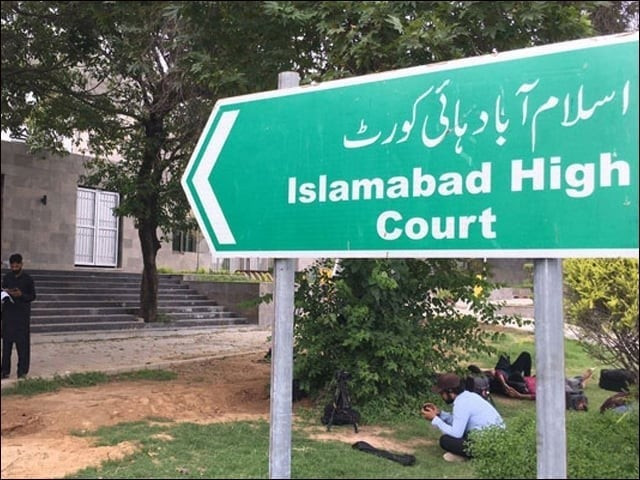
IHC fines NAB Rs100,000 for employing ‘delaying tactics’ in £190m graft case against Imran, Bushra – Pakistan



ISLAMABAD: The Islamabad High Court (IHC) on Wednesday imposed a fine of Rs100,000 on the National Accountability Bureau (NAB) for employing “delaying tactics” in the £190 million Al-Qadir Trust corruption case against former premier Imran Khan and his spouse Bushra Bibi.
The development came as a division bench comprising IHC Chief Justice Sardar Muhammad Sarfraz Dogar and Justice Muhammad Asif presided over the hearing on pleas filed by the couple seeking the suspension of their sentences and appeals against their convictions.
Prior to the hearing, the anti-graft watchdog, in a sharp legal response submitted to the court, had raised a preliminary jurisdictional objection, arguing that the appellants’ application under Section 426 of the Criminal Procedure Code (CrPC) was premature. The bureau contended that the appeals filed by Imran and Bushra had not yet been formally admitted for regular hearing by the high court.
Citing legal precedents, it maintained that the phrase “pending appeal” in Section 426 of the CrPC was authoritatively construed to mean an appeal that had been formally admitted for regular hearing. Therefore, until such admission, the court’s supervisory and interlocutory powers —including the power to suspend sentence —do not stand activated, it said.

However, Wednesday’s hearing was marked by sharp exchanges between the defence and prosecution, with Imran’s legal team raising serious concerns about access to their client and the sluggish pace of judicial proceedings.

Imran’s counsel Barrister Aitzaz Ahsan opened his arguments by detailing the difficulties he faced in obtaining the power of attorney from the incarcerated former premier.
He informed the court that access to his client had been effectively curtailed for four months, a situation he branded a direct violation of constitutional provisions.

“It is a fundamental right of an accused to have unimpeded access to legal counsel,” he argued, demanding action against the Adiala jail administration for obstructing this right.
His sentiments were echoed by fellow defence counsel, Barrister Salman Safdar, who termed it “unfortunate” that the appeals against the convictions were being fixed for hearing after a gap of 14 months.
In a broader critique of the country’s accountability process, Ahsan drew a parallel with the recent military tribunal conviction of former spymaster Faiz Hameed.
“Accountability will not be proven with the conviction of Faiz Hameed. True accountability will only be seen if those army officers who usurped the rights of civilians are also dealt with in accordance with the law,” he said.
Barrister Safdar also pointed to a precedent set by IHC Chief Justice Dogar himself, noting that a few years ago, the judge had provided relief to a condemned prisoner over an eye infection — a remark seemingly aimed at highlighting Imran’s own reported eye ailment.
On the other hand, the accountability watchdog’s prosecutor, Muhammad Rafay, attempted to counter the defence’s urgency, arguing that the plea for suspension of sentence was not maintainable as the main appeals against the conviction had not yet been formally admitted for hearing.
He requested the court to first decide on the admissibility of the acquittal pleas before proceeding further. However, the proceedings took a turn when the court inquired about the absence of NAB’s special prosecutor.
Rafay replied that the special prosecutor was not in attendance because the prosecution wanted a decision on the maintainability application first. When pressed further, he added that the special prosecutor was busy with “religious rituals”, an explanation that drew the bench’s ire.
IHC CJ Dogar remarked that the Supreme Court had already taken cognisance of Imran’s health-related issues, rendering the matter sub judice before the apex court.
Frustrated by what it perceived as stalling by the prosecution, the bench imposed a fine of Rs100,000 on the accountability watchdog for its “delaying tactics”.
Meanwhile, the defence team, including Safdar, urged the court for an early disposal of the petition, requesting a decision before the upcoming Eid vacations.
At the conclusion of the heated hearing, the bench issued a notice on NAB application and adjourned the hearing. The court has directed the anti-graft body to come prepared on the next date of hearing, with the defence team pushing for a swift resolution.
The appeals and suspension pleas have faced numerous procedural hurdles.
The IHC registrar’s office had previously raised objections to the petitions, citing issues such as unsigned pages and the absence of a certificate confirming the case wasn’t being heard elsewhere.
Just last month, on February 26, the high court had cleared these objections and scheduled the March 11 hearing after defence lawyers pressed for an early date, highlighting Imran’s eye condition.
An accountability court in Islamabad had sentenced Imran and Bushra to 14 and seven years in prison, respectively, on Jan 17, 2025, in the £190m graft case, also known as the Al-Qadir Trust case.