How the Iran war is rewriting the economics of power … and why Pakistan must read the signals first


The 2026 war in Iran is the most consequential military laboratory since the Gulf War and like that war, the lessons it is generating will be misread by precisely the institutions that most need to understand them.
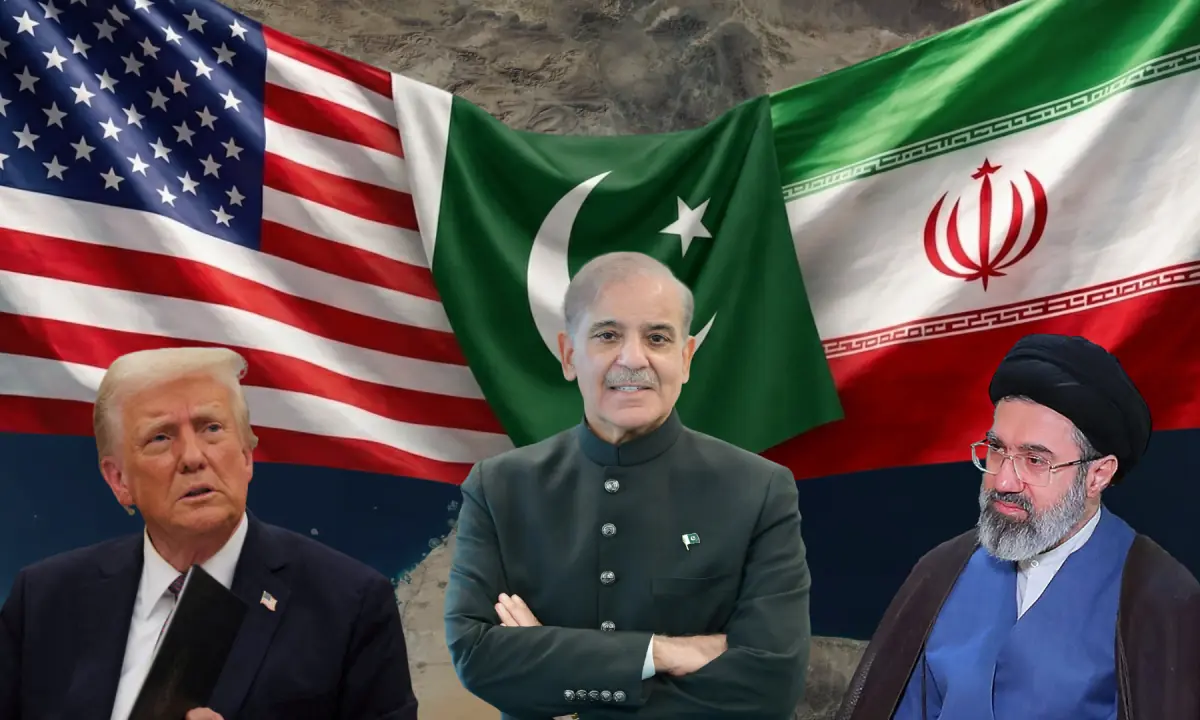
Just over four weeks into Operation Epic Fury, Iran has launched over 500 ballistic missiles and more than 2,000 drones across the region. Oil prices threaten to breach $200 a barrel. The Strait of Hormuz is effectively closed to unapproved shipping. The United States has deployed a reverse-engineered copy of its adversary’s cheapest drone in its first combat use. And Pakistan is no longer merely watching. It is transmitting ceasefire proposals between Washington and Tehran, offering Islamabad as the venue for talks, and positioning itself at the centre of the most consequential diplomatic moment in the Middle East since the end of the Cold War.
The question is whether the same institutional agility now evident in its diplomacy can be applied to its defence procurement.
The unit economics of war
Eisenhower warned of the military-industrial complex in 1961. Today, more than 65 years on, it is worth identifying the specific component of that complex whose product is being tested in Iran: the interlocking ecosystem of Western defence contractors, procurement bureaucracies, and strategic consultancies whose revenue depends on selling air-superiority-first, high-cost, low-volume warfare.

This ecosystem does not merely sell hardware. It sells an entire theory of war, bundled with the platforms that make that theory appear necessary and the sustainment contracts that make those platforms inescapable. Its pricing model has now been tested in real time.

In FY2025, the US produced 22 Tomahawk cruise missiles for the entire year, according to Pentagon budget documentation. This followed 34 in FY2024 and 68 in FY2023 — a trajectory that The Centre for Strategic and International Studies (CSIS) described as burning through 15 years’ worth of stockpile in five years. The February 2026 emergency production agreement between Raytheon and the Pentagon, targeting over 1,000 missiles per year, was an implicit admission that the production base had atrophied to the point of strategic vulnerability. An estimated 400 Tomahawks were expended in the first three days of Epic Fury alone — approximately 10 per cent of the entire US inventory.
Now consider the other side of the ledger. The Shahed-136 drone, produced at scale for between $20,000 and $80,000 per unit depending on variant, has been manufactured at rates exceeding 400 per month at Russia’s Alabuga facility alone. CSIS analysis published on March 10 found that drones constituted approximately 66pc of all Iranian strikes in the first week — not as supplementary weapons but as the backbone of the strike architecture. The UAE alone absorbed 1,440 detected drones and 261 missiles, accounting for roughly 62pc of all recorded strikes.

The cost-exchange ratio is the number that should keep procurement officials awake. A Patriot PAC-3 MSE interceptor costs between $3-4 million. A Shahed, averaging $50,000, runs at roughly one-seventieth the price of the interceptor designed to stop it. Ukrainian interceptor drones cost $2,000 to $4,000 per unit — and Ukraine produced over 100,000 of them in 2025. When the US military deploys the Lucas drone — its reverse-engineered Shahed clone — in combat, the message is unambiguous: the adversary’s cheapest weapon is worth copying. The playbook has no answer for that.
The May 2025 proof of concept
The India-Pakistan conflict of May 2025 validated the same logic in a South Asian context — with implications Pakistan’s defence establishment has an opportunity to capitalise on more fully.
India’s Operation Sindoor triggered the largest beyond-visual-range air engagement since the Second World War. Over 114 aircraft were involved — 60 Indian Air Force (IAF), 42 Pakistan Air Force (PAF) — in an engagement lasting approximately 52 minutes across standoff distances exceeding 100 kilometres. For a force armed with missiles whose engagement range exceeded the adversary’s, 60 aircraft in a confined battlespace presented a target-rich environment — and PAF exploited it accordingly.
The results are broadly established. A high-ranking French intelligence official confirmed evidence of at least three Indian aircraft downed, including a Rafale and a Mirage 2000. A US official assessed with “high confidence,” according to Reuters, that Pakistani J-10C aircraft had shot down at least two Indian jets. India’s Chief of Defence Staff acknowledged aerial losses at the Shangri-La Dialogue. The Washington Post identified three crash sites inside Indian territory.
The engagement was fought almost entirely with Chinese-origin systems — J-10Cs firing PL-15 beyond-visual-range (BVR) missiles in their first combat use. The PL-15’s engagement range exceeded that of Western missiles in India’s inventory. Pakistan’s F-16 fleet was present. The decisive results came from the Chinese fleet. The Harvard Belfer Centre described this as the first significant contest between high-end Chinese and Western military hardware.
Pakistan’s defence establishment demonstrated tactical brilliance under constraint. The No. 15 Squadron — the Cobras, operating from PAF Base Minhas — executed a textbook BVR engagement against a numerically superior force equipped with platforms costing four times as much. Today, the establishment that delivered these results has an opportunity to apply the same institutional energy to the procurement logic that determines which platforms it will fight with next.
The dependency trap
The F-16 remains a capable aircraft. It is also a platform whose cost of ownership includes ongoing American leverage over Pakistan’s sovereign defence decisions.
For example, the Foreign Military Sales (FMS) framework requires US authorisation for upgrades, spare parts, and operational capabilities. In December 2025, the US approved a $686 million FMS package for F-16 sustainment through 2040, with Lockheed Martin as principal contractor. Of that $686 million, $37 million covers major defence equipment. The remaining $649 million — 95 cents of every dollar — goes to sustainment and modernisation services. Not to new capability. To maintenance of the existing dependency.
Consider what $686 million buys in the alternative economy. At $50,000 per unit, it buys 13,720 one-way attack drones. At $4,000 per Ukrainian-model interceptor drone, it buys 171,500 defensive systems. At the production cost of a JF-17 Block III, it buys a squadron.
US Air Force Col John Boyd’s ‘OODA’ loop — observe, orient, decide, act — is typically applied to tactical engagements. It applies equally to strategic procurement. Pakistan observed the results of May 2025: Chinese platforms outperformed Western ones in combat. The orientation is clear. But by December 2025, the decision cycle had produced a $686 million sustainment commitment to the platform that didn’t deliver the decisive results, locked in through 2040. The institutional OODA loop — which has proven it can cycle fast when it needs to, as the March 2026 mediation demonstrates — has an opportunity to apply the same speed to procurement.
Pakistan has been burned by this dynamic before. In 1990, the United States stopped delivery of 28 F-16s for which Pakistan had already paid $658 million, under the Pressler amendment. It took eight years and a settlement involving cash and wheat to resolve. The institutional memory of that episode is alive in Rawalpindi. The structural conditions that produced it have not changed.
The strategic enabler
The May 2025 conflict demonstrated that a partner state’s combat effectiveness can be transformed not through direct participation but through architecture: Intelligence, Surveillance and Reconnaissance (ISR) coverage, weapons systems whose engagement envelopes exceed the adversary’s, and an alliance model that enhances sovereign capability rather than constraining it. The specifics remain contested between Indian, Pakistani, and Western sources. The structural implications do not.
China operates at least 115 ISR satellites and 81 signals intelligence satellites — a network second only to that of the US. Chinese PL-15 missiles outranged Western equivalents in their first combat use. Beijing is fast-tracking J-35 stealth jets to Islamabad. This is an ecosystem that enhances the partner’s lethality and decision-making without extracting sovereignty as the price of admission. The complex does the opposite: it sells capability and embeds dependency into every transaction.
Pakistan does not need to choose between the two on the basis of sentiment. It needs to choose on the basis of what delivered results at Kamra on May 7, 2025 — and invest accordingly.
The Gulf opening — and the clock
The 2026 war has exposed a vulnerability in the Gulf security architecture that represents, for Pakistan, what may be the most consequential strategic opportunity since the end of the Cold War. As of today, that opportunity is no longer hypothetical. Pakistan is already in the room.
Pakistan transmitted the US 15-point ceasefire plan to Iran. Islamabad has offered to host talks. Foreign Policy described Pakistan as “a rare country that has warm ties with both the United States and Iran and is engaged with the highest levels of both governments.” Mediators from Pakistan, Egypt, and Turkey are pushing for in-person talks in Islamabad, with formats under discussion that could include Iran’s Foreign Minister and senior US envoys.
Iran’s five-point counterproposal — a halt to assassinations of its officials, guarantees against future aggression, war reparations, cessation of hostilities, and sovereignty over the Strait of Hormuz — reflects demands Washington will find difficult to accept in their current form.
But the underlying logic is not irrational: a state that was attacked during active diplomatic negotiations, whose supreme leader was assassinated while a breakthrough had reportedly been reached, has reason to demand structural guarantees rather than verbal assurances. Pakistan’s value as a mediator lies precisely in its ability to translate these positions into language both sides can engage with — without endorsing either.
The American security guarantee to the Gulf has been tested and found conditional. The US Embassy in Kuwait was struck and closed. Aramco’s Ras Tanura refinery, Dubai International Airport, and Kuwait International Airport have all sustained damage. Within the first four days, at least one US Gulf ally was running low on interceptor munitions.
India imports over 80pc of its crude oil, much of it from Gulf Cooperation Council (GCC) states. India has far more to lose economically from prolonged Gulf instability than Pakistan does. The 2026 war has demonstrated that this infrastructure is targetable at scale by an adversary whose principal weapons cost less than a Land Rover Defender.
But the window for this opportunity is not open-ended. The Pentagon has ordered approximately 2,000 paratroopers from the 82nd Airborne Division’s Immediate Response Force to the Middle East — a formation that can mobilise worldwide within 18 hours. Two Marine Expeditionary Units, carrying a combined 4,500 Marines and sailors, are converging on the Persian Gulf from both sides of the Pacific. Secretary of State Rubio has told Congress the US may need to physically secure nuclear material inside Iran. The combined deployment brings nearly 7,000 additional ground troops into proximity with Iran — the largest such buildup since the 2003 invasion of Iraq.
Once ground forces are committed, the diplomatic space that Pakistan currently occupies collapses. The mediation window is measured in days, not weeks. The verbal orders should already be issued. The scenarios should already be war-gamed. The question is not whether Pakistan has the strategic position to broker this — the last 27 days have established that it does. The question is whether it can execute at the speed the moment demands.
The strategic dividend
Pakistan’s negotiating position carries additional structural weight through its relationship with Beijing. China’s economic leverage — as Iran’s largest oil customer and a permanent member of the UN Security Council — gives any Pakistan-facilitated agreement a durability that no other mediator can guarantee. A settlement brokered through Islamabad, with Chinese strategic backing, would carry the combined diplomatic weight of two states representing over two billion people. That is not a peripheral contribution to the negotiations. It is the difference between a ceasefire and an architecture.
The state that brokers the peace sets the terms of the security architecture that follows. For Pakistan, successful mediation converts diplomatic capital into tangible strategic returns: security partnerships with GCC states whose infrastructure requires repair and reinforcement, a fundamentally restructured economic relationship with the Gulf, and a position at the centre of the regional order rather than its periphery. The GCC relationship transforms from financial dependency into strategic partnership — with Pakistan as a provider of security rather than a supplicant for aid.
The question that matters
The convergence between India and Israel — accelerated by shared threat perceptions, defence technology transfers, and the realignment of Middle Eastern alliances — represents a genuine medium-term challenge.
The question it poses is not: how many additional fighter squadrons are required? It is more fundamental: is this a conventional military challenge requiring more hardware of the same type — or is it an intelligence, economic, and doctrinal challenge that demands an entirely different response?
Pakistan has lost over 83,000 lives to terrorism-related violence from 2001 to 2022, according to the National Counter Terrorism Authority (Nacta). The entire Kashmir conflict has produced approximately 47,000 fatalities since 1989. Even accounting for the different character of these conflicts, the disparity suggests that Pakistan’s primary existential threat has never been the one its conventional force structure was designed to meet.
The alternative — investing in asymmetric capability, drone production at scale, electronic warfare, indigenous defence manufacturing, and a doctrine designed for the threats Pakistan actually faces — may require some reassessment at the institutional level. The May 2025 conflict provided the proof of concept. The 2026 war is providing the strategic evidence. The March 2026 mediation is providing the diplomatic platform. Pakistan must be willing to act on all three.