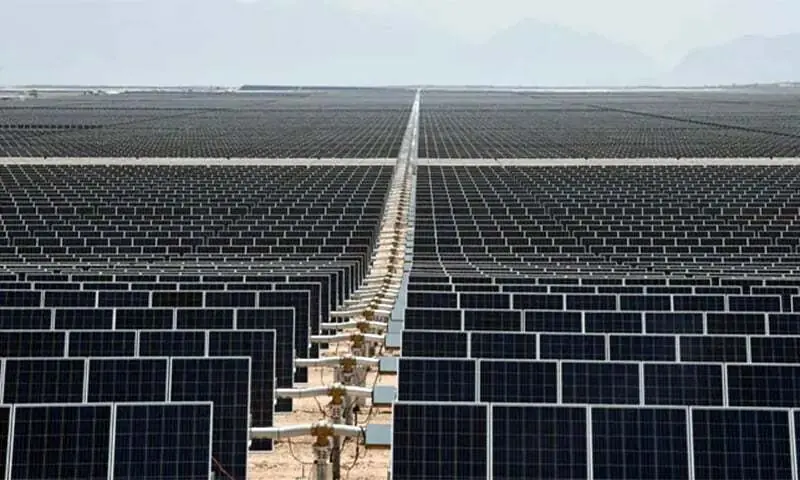

ISLAMABAD: In a new twist to the solar debate, the government on Tuesday conceded that increasing net-metering solarisation has so far not had the negative impact on the national grid that is often claimed.
“Solar generation is increasing, but this does not have a significant impact on the grid,” Central Power Purchasing Agency (CPPA) CEO Rehan Akhtar said while testifying before the National Electric Power Regulatory Authority (Nepra).
Working under the Power Division, the CPPA is the key player responsible for the procurement of electricity from various sources and delivering to all distribution companies and handling their commercial affairs.
He said the energy costs had led to a shift to solar power. “They are now consuming more due to solar availability but their offtake from the national grid has not changed. Their withdrawal from the grid is almost stable. They are drawing the same quantities they were drawing earlier,” he said, adding, however, that the same could not be predicted about the future.

Net metering contribution jumped 173pc to 726m units in 2024
These comments came during the course of a public hearing on CPPA’s request for rebasing of power purchase price (PPP) with effect from January 2026 under the government’s policy directives.
The CPPA presented five different assumptions about the tariff revisions with effect from Jan 1, 2026. These assumptions presented a total average PPP price ranging between Rs25.95 per unit in the best case and Rs26.53 per unit in the worst case of currency devaluation to Rs300-310 from the existing Rs280-290 per dollar.
The existing PPP for FY26 stands at Rs25.98 per unit, showing a general sign of stability.
It was reported that net metering contribution had increased by 173pc to 726 million units in 2024 compared to 266m units in 2023, even though power distribution companies (Discos) showed 1pc growth. On the other hand, K-Electric offtake from the grid increased by 9.4pc as it started drawing the full 2,050MW.
Nepra was told that fuel costs were expected to remain generally stable with a minor risk of a 5pc increase in global prices in a worst-case scenario. Likewise, given foreign exchange reserve vulnerabilities, local currency had been estimated to increase by Rs10 in the first six months and Rs10 in the second half of the next calendar year in one case only. Interest rates were projected at 11pc for the first half and 10.5pc for the second half.
Industrial consumers bemoaned expensive energy costs, making their products uncompetitive. They said the industry was still cross-subsidising other consumers to the tune of Rs131bn, and all tariff reductions announced by the government had already vanished.
They said the CPPA’s calculation that demand will increase was inconsistent with ground realities, because consumption was going down because of high energy prices, the closing of industries and the shift to solar power.
Published in Dawn, November 19th, 2025