Govt mulling not hiking prices of petroleum products further despite increase in global market – Pakistan

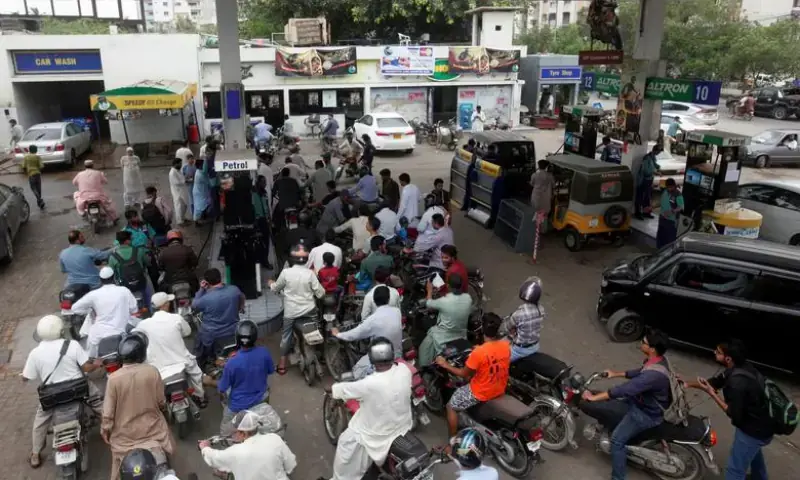

ISLAMABAD: The federal government has banned the export of all petroleum products and is considering not hiking prices further despite a continuous increase in the global market and the drawdown of about Rs389bn in budget allocations for emergencies to absorb the future price shock as much as possible.
The decision comes after the latest estimates, based on existing tax rates and pricing formula, suggest that the price of high-speed diesel (HSD) going up by Rs56 per litre and that of petrol by Rs41. Petrol and HSD are currently sold on the higher side of Rs322 and Rs337 per litre, respectively, at retail.
Likewise, estimates also showed an increase of Rs7 and Rs53 per litre for the prices of kerosene and light diesel oil, respectively.
The next price review is scheduled for March 15 (Sunday) but ministers indicate these could be reviewed on March 13 (Friday).


Highly placed sources told Dawn that Prime Minister Shehbaz Sharif recently told a consultative session — attended by federal and provincial representatives — that he and the military leadership had jointly decided that after the initial increase, there would be no further price hike, at least in the near future, regardless of the prices in the Middle East.
The session, also attended by Field Marshal Asim Munir, was informed that the government would use block allocations for emergencies to absorb further price hikes.

The prime minister told the meeting that no other emergency could be worse than what the whole nation was facing at the moment because of fuel supply disruptions.
However, the sources said the cabinet members were still divided over the prime minister’s announcement and technocrats, particularly those directly dealing with the International Monetary Fund (IMF), opposed disturbing the pricing buffers currently in place.
This was reinforced at a meeting of the Senate Standing Committee on Finance, where petroleum minister Ali Pervez Malik said attempts were being made to manage petroleum prices under the directives of the prime minister and that a decision would be made after reviewing the global prices on Friday.
Minister of State for Finance and Railways Bilal Azhar Kiyani told the meeting that while prices would be reviewed on Friday, the government would make all efforts not to further burden the people. He said international prices showed a rising trend.
“The prime minister has also directed that burden should not be passed on to the people,” he said.
Both the ministers also defended the March 7 decision to increase prices by Rs55 per litre, saying that otherwise there would have been supply disruptions as seen in Bangladesh and India, where people had also attacked retail stations.
Finance Minister Muhammad Aurangzeb, meanwhile, said international oil prices were still going up.
It maybe noted that benchmark Brent prices are generally quoted in the public and social media discourse for comparisons against local retail prices; the former has no direct linkage and fluctuate mostly based on statements from US President Donald Trump, his aides and like-minded think tanks about the conflict in Iran.
Pakistan’s oil imports, more than 95 per cent, originate from the Middle East. Most of its transportation took place via the troubled Strait of Hormuz, notwithstanding a few alternative routes off-late, and are linked to Dubai-based Middle East pricing, which currently stands at $135 per barrel against $105 of Brent. Petrol and diesel are imported separately and their current Dubai prices stand at $120 and $168 per barrel, respectively.
Informed sources also told Dawn that the government had barred oil refineries from exporting furnace oil and naphtha to create a buffer for power generation given the suspension of liquefied natural gas (LNG) imports from Qatar, which declared forced majeure last week after its processing facilities came under attack by Iran.
They said the gas supply to fertiliser plants was being closed and gas rationing would be revived after Eidul Fitr to minimise electricity load shedding as temperatures rise and to conserve foreign exchange reserves.
The sources said that while current petrol and diesel stocks were sufficient for 22-23 days, diesel supplies could face challenges as more than 20 days were required for its import transportation from alternative sources and routes, while Saudi Arabia was extending maximum support and can provide crude supplies for maximum utilisation of local refineries for HSD production. Even then, very large crude carriers (VLCC) rates have jumped around 15 times and cannot reach Pakistani ports. At best, they can anchor at Oman from where feeder ships could carry crude to local ports.
On the positive side, liquefied petroleum gas supplies from informal channels from Iran have almost doubled since the Iran war broke out apparently because of cash needs across the border and supply challenges in formal channels.