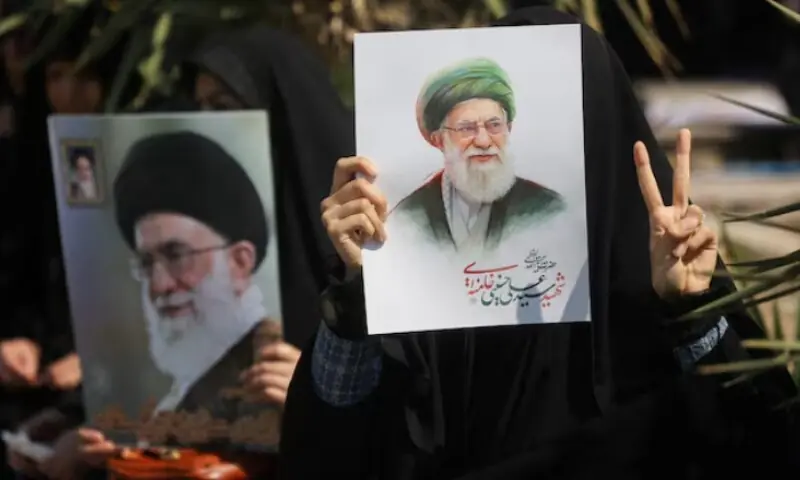

Iranian clerics involved in choosing a successor to Ayatollah Ali Khamenei after his assassination a week ago in US-Israeli strikes say they are close to naming the Islamic Republic’s new supreme leader.
Iran’s revolutionary theocracy has never been in greater jeopardy, and with the clerical body tasked with naming a new leader ready for an announcement as soon as Sunday, it is hard to predict what might happen next.
Israel and the United States have vowed no let-up in their war, promising to kill whoever replaces Khamenei and even those involved in selecting the new leader — a group that may include the clerics who formally make the choice and the Revolutionary Guardsmen and political insiders who influence them.
The following explains how power is meant to operate in the Islamic Republic, how a new supreme leader can be chosen, some of the main candidates, and how the US and Israeli attacks have changed the equation.

What is Iran’s ‘Supreme Leader’?
Iran’s theocratic system dates to the 1979 revolution that ousted the Shah. Ayatollah Ruhollah Khomeini, the leader of the revolution, introduced a new system of rule: vilayat-e faqih, or guardianship of the Islamic jurist.

The theory holds that until the return of the Shi’ite Muslim 12th Imam, who went into occultation in the ninth century, power on earth should be wielded by a venerable cleric.
It means whoever takes over as supreme leader, empowered by the constitution as the ultimate authority guiding the elected president and parliament, will have to be a senior cleric.

Under Khomeini, who died in 1989, and Khamenei, who has ruled since then, the supreme leader has had the last say in all matters of state. But any new leader will have to assert his authority at a moment of enormous rupture — and may struggle to do so.
Who will choose Khamenei’s successor?
The constitution says a new leader must be chosen within three months. Until then, President Masoud Pezeshkian, Guardians Council member Ayatollah Alireza Arafi and Judiciary chief Ayatollah Gholamhossein Mohseni-Ejei have taken charge as a temporary leadership council.
Choosing a new leader is meant to be the responsibility of the Assembly of Experts, a body of around 90 senior clerics who are elected every eight years, many of them very elderly.
With strikes continuing, they have been conducting their consultations online, Iranian officials have told Reuters, and appear close to naming a new leader.
Khamenei never publicly tapped a preferred successor, and in practice, the decision probably rests with the most senior figures in the Islamic Republic who have wielded power under Khamenei for many years. It is their preferred candidate who is most likely to be approved by the assembly.
Among the most important of those senior figures is Khamenei’s veteran adviser Ali Larijani, often seen as Iran’s foremost powerbroker. The Guards will also have a critical backroom voice in the process.
Who are the main candidates?
Khamenei’s son, Mojtaba Khamenei, is widely seen as the most likely candidate after surviving the first salvo of strikes, which killed his wife. Although Iran’s ruling ideology frowns on the principle of hereditary succession, he has a powerful following within the Guards and his dead father’s still-influential office.
The grandson of the revolutionary founder, Ruhollah Khomeini, is another possible choice. Hassan Khomeini is closely associated with the reformist faction that has for decades tried to moderate the Islamic Republic’s stance and may be seen as better able to assuage Western enmity and calm the fury of an embittered population.
Arafi and Mohseni-Ejei are less prominent possibilities who would likely continue Khamenei’s stance. Mohseni-Ejei was responsible for stamping out internal protests following a disputed election outcome in 2009 when he was the intelligence minister.
Assembly of Experts members Ahmad Alamolhoda and Mohsen Araki are also senior clerics with a close involvement in Iranian politics who might be considered. Former president Hassan Rouhani is a senior cleric, but he was distrusted by some of the most powerful clerics, who would have great sway over the choice.
The assembly could theoretically pick an even lesser-known ayatollah as leader. But the ruling system has been so fractured by the strikes that it would be much harder to buttress the position of a newcomer.
What role will the Revolutionary Guards play?
The Islamic Revolutionary Guards Corps had long been expected to play a central role behind the scenes in determining Khamenei’s successor. Unlike the ordinary military, which comes under the elected president, the guards answer only to the supreme leader.
But its top echelons have been hollowed out by US and Israeli strikes over recent years, and it is far from clear how far it will still be able to influence the decision.
The most important Guards leader of recent times was Qassem Soleimani, head of the elite Quds Force unit. He was assassinated by a US strike in 2020.
During the brief summer war last year, Israeli strikes killed other top Guards commanders. And the latest strikes killed its latest top commander, Mohammed Pakpour, three sources familiar with the matter said.
The Basij, a part-time paramilitary force under Guards’ control, is often used to quell protests inside Iran, giving the corps a formidable role in internal control.
Since the early 2000s, the Guards’ economic power has also grown as its contracting company Khatam al-Anbiya won projects worth billions of dollars in Iran’s oil and gas sector. Protecting that empire may contribute to the Guards’ decision on backing a new leader.
Will Iran’s people get a say?
Iranians elect a president and a parliament to four-year terms. The president appoints a government that handles daily policy within parameters permitted by the supreme leader.
During the early years of the Islamic Republic, the votes drew mass participation. But far fewer Iranians retain faith in electoral politics.
While President Pezeshkian, a reputed moderate, is on the three-member interim leadership committee, it is far from clear he has had any say over how events pan out, and he was forced into an embarrassing climbdown on Saturday over the conduct of the war.
And while the Assembly of Experts is elected, all its candidates — like those running in all Iranian national elections — must be vetted by the clerical Guardians Council, meaning only those already aligned with the authorities can take part.