Explainer: What you need to know about India’s indigenously developed HAL Tejas



An Indian fighter aircraft, the indigenously developed Tejas Mk1A, crashed during a demonstration flight at the Dubai Air Show on Friday. The jet, developed by the Hindustan Aeronautics Limited (HAL), crashed at about 2:10pm local time.
According to the Indian Air Force (IAF), the pilot of the jet died in the crash.
Here are some facts about New Delhi’s indigenous fighter aircraft.
Made in India
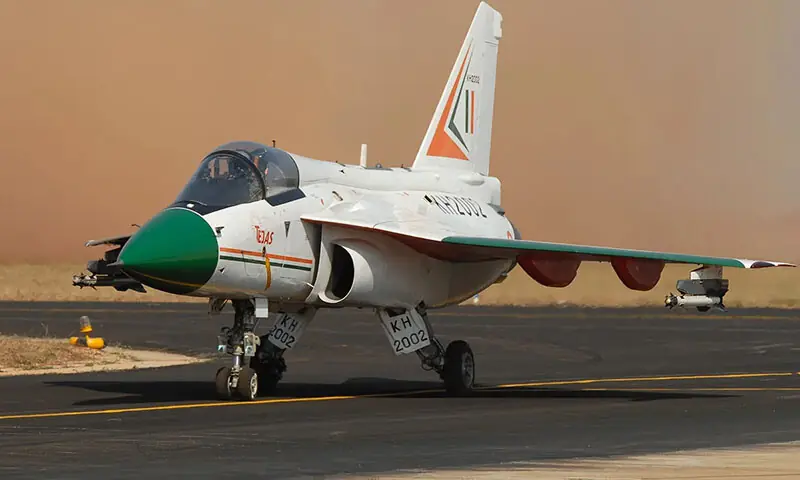
The LCA (Light Combat Aircraft) Tejas is a 4.5-generation multirole, single-engine, all-weather fighter aircraft designed to perform air and ground combat roles, according to its manufacturer HAL. It is currently operated by India’s navy and air force.

The Tejas Mk1A, which was involved in today’s accident, features a delta-wing configuration and is powered by an American General Electric F404-GE-IN20 turbofan engine.
The jet, named after the Sanskrit word for “radiance”, reportedly carries an Advanced Electronically Scanned Array (AESA) radar system and, with eight hardpoints, can fit a variety of weapons ranging from beyond visual range missiles and bombs.
According to a report from Indian outlet Frontline, 60 per cent of the aircraft’s components were made locally.
The IAF took delivery of 40 aircraft in 2021.
Key facts
- Max Speed: Mach 1.8
- Service ceiling: 50,000 feet
- Maximum payload: 14,600lb
- Combat range: 739 kilometres
- Fly-by-wire piloting system
Taking to the skies
The LCA project’s development started in the 1980s, with New Delhi seeking to replace the MiG-21 Bisons, which had a poor safety record and were nearing the end of their service lives.
The Indian government launched the Aeronautical Development Agency under the Defence Research and Development Organisation (DRDO) in 1984 to oversee the aircraft’s development, with HAL being appointed as the primary manufacturer.
Developing the aircraft took 20 years; the delta-wing design was finalised in 1990, with the prototype’s first flight in 2001. After the development of more prototypes, the first Limited Service Production aircraft took flight in 2007.
However, the Tejas was grounded for three months due to issues with the ejection system.
“The grounding of [the] Tejas … took place because of the new pilot’s helmets. Since these protruded above the ejection seats, the helmets could have prevented a smooth ejection by smashing into the fighter’s canopy before it was blown off,” a report in Business Standard from November 2012 read.
“Since that constituted a serious safety issue for pilots, flight-testing was halted in August.”
Operational history
The jet featured in military parades in India and made its international debut at the Bahrain Airshow in 2016.
Other than ceremonial use, the aircraft has participated in training exercises, such as ‘Gaganshakti-2018’ — the largest in India at the time — and the Vayu Shakti exercise in 2019.
The jet’s first operational deployment was on August 18, 2020, when the No 45 squadron was deployed along the Line of Actual Control, amid tensions with China.
Aside from today’s incident, the Tejas has only had one other recorded crash, when it crashed in India’s western state of Rajasthan last March. The pilot ejected safely, the Indian Air Force said in a statement.