


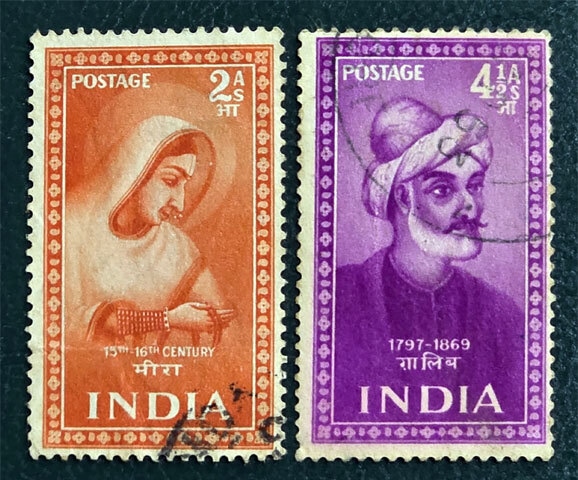
In a letter dated November 22, 1952, Professor Syed Masood Hasan Rizvi Adeeb of Lucknow writes to Allama Syed Murtaza Hussain Fazil Lakhnawi, “Yesterday, I sent you a registered letter in your name. It bears two postage stamps, one with Ghalib’s portrait and the other with Mirabai’s. The postmark has been placed in such a way that Ghalib’s picture has not been marred. Since you collect everything related to Ghalib, you should keep this stamp safe as well.”
This very stamp and the letter are still preserved in good condition. A faded Lahore post office mark on this stamp reads as “…53, Lahore”, indicating its arrival in Lahore in January 1953.
Fazil Lakhnawi, the editor of centenary editions of Ghalib’s collected works in Persian, Urdu-i-Mu’alla and Oud-i-Hindi, was an avid admirer of Ghalib and had a large collection centred around the poet, consisting of the first editions of his works, along with some of his letters and manuscripts. Adeeb was obviously aware of his passion.

Mirza Asadullah Khan Ghalib, one of the greatest Urdu and Persian poets, is honoured on postage stamps in Pakistan and India as part of their shared cultural and linguistic heritage. To my knowledge, he is not only the first Urdu poet depicted on postal stamps, but also among the earliest Persian poets to appear on them.

How did one of history’s greatest Urdu poets become a philatelic icon? Syed Muhammad Naqavi traces his journey from a 1952 Indian stamp series to multiple Pakistani commemorative issues, revealing how literature enters everyday circulation

EVOLUTION OF COMMEMORATIVE STAMPS
Postage stamps soon acquired a commemorative role after their introduction in the 19th century. With the adoption of adhesive stamps, postal systems gained a visual medium through which states could mark events, represent authority and honour figures of public importance. Although stamps were introduced as a practical means of pre-paid correspondence, they gradually assumed a broader function, carrying images and messages that reflected political authority, official memory and national identity.
The first stamps used in the Subcontinent were the Scinde Dawk [Sindh Daak] of 1852, issued in Sindh under the administration of the East India Company, followed by the first all-India issues in 1854. From that point onward and throughout most of British rule, Indian postage stamps generally carried the portrait of the reigning British monarch, a convention that continued until Independence in 1947.
Over time, stamps moved beyond their immediate postal purpose and began to reflect historical and cultural themes. By the early 20th century, many postal administrations were issuing commemorative stamps to mark anniversaries, prominent individuals and cultural achievements. Poets and scholars gradually became part of this visual record, signalling a growing recognition of their place in public life.
It is within this broader development — from postal utility to cultural commemoration — that Ghalib’s appearance on stamps in India and Pakistan should be understood.
The first stamp, mentioned in the letter, was issued in India as part of a six-stamp series titled “Indian Saints and Poets.” Ghalib was featured on a 4½ anna mauve stamp, the penultimate one of this series. It was issued on October 1, 1952, featuring images of Kabir (15th century), Tulsidas (16th-17th century), Mirabai (15th-16th century), Surdas (16th century), Ghalib (18th-19th century) and Rabindranath Tagore (19th-20th century). It was the second such series in India to feature portraits of individual personalities on postage stamps, the first being the 1948 Gandhi commemorative series.
THE CENTENARY YEAR
The year 1969 marked the centenary of Ghalib’s death, which was commemorated in Pakistan, India and the Soviet Union. Special editions of his works, including the mentioned centenary editions, were published. Iran also played a role in this event. The Collected Persian works of Ghalib, Kulliyat-i-Ghalib Farsi, by Fazil Lakhnawi, along with select other Persian works, was jointly commissioned by the governments of Iran and Pakistan. It was published by the Majlis-i-Taraqqi-i-Adab Lahore, with a photo of the Pahlavi Crown of Iran before the title page. It was the first critical edition of Ghalib’s Persian works.
Many other books and special issues were also published on this occasion in both Pakistan and India. Majlis-i-Yadgar-i-Ghalib in Lahore also published special editions of his works. In Karachi, the Ghalib Library was established that same year by the Idara-i-Yadgar-i-Ghalib.
In India, the Ghalib Academy was also established beside his burial site in Delhi by Hakeem Abdul Hameed, the elder brother of Hakeem Muhammad Saeed. Alongside these activities and efforts, the governments of Pakistan and India issued separate stamps to commemorate this occasion.
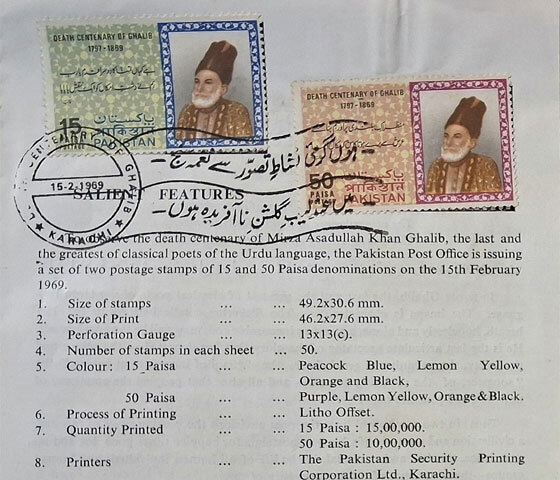
On February 15, 1969, Pakistan issued a pair of 15- and 50-paisa stamps, designed by artist Abdul Rauf, featuring a portrait of Ghalib wearing his famous long woollen hat, set against a Mughal-style floral border on the right. The left side, with a geometric pattern background, bears the text, including the occasion of this issue in English, “DEATH CENTENARY OF GHALIB 1797-1869”, in two lines with different couplets on each stamp.
It was Pakistan’s first pictorial stamp featuring a human portrait; although Pakistan had already issued stamps in honour of the Quaid-i-Azam and Allama Iqbal, none of them featured a portrait. An official cancellation stamp was also beautifully designed and used on the first-day covers, featuring a couplet by Ghalib.
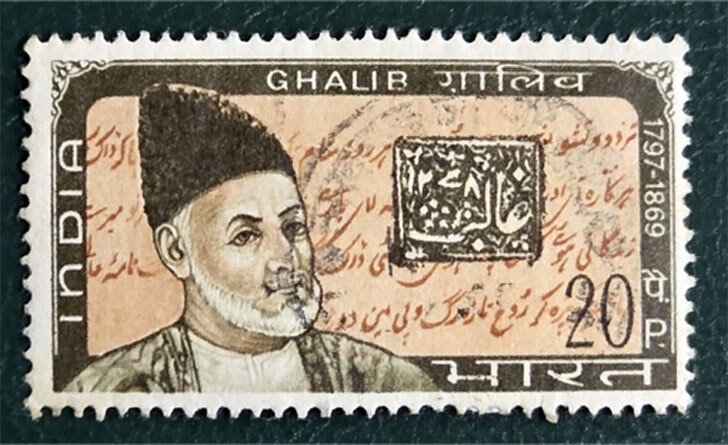
Two days later, India also issued a single 20-paisa stamp, bearing his left-facing portrait wearing a black cap, an impression of his personal seal dated 1278 AH, and a portion of his handwritten letter in the background. The black border bears the words “Ghalib” and “India” in English and Hindi, alongside his dates of birth and death.
SUBSEQUENT PAKISTANI STAMPS
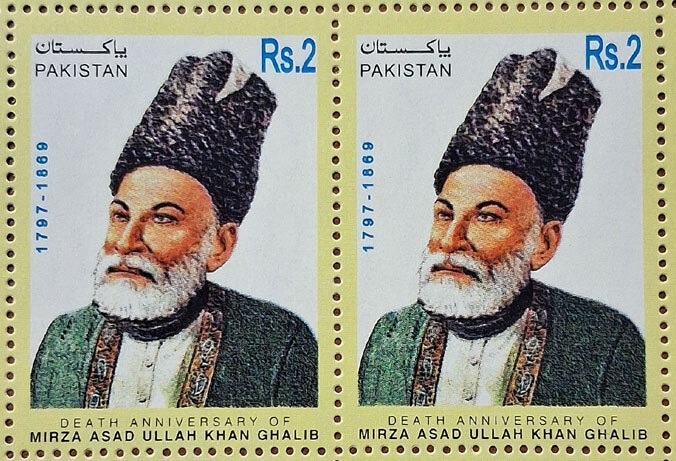
Another stamp was issued in Pakistan on February 15, 1998, designed by Faizi Amir and Saeed Akhtar, depicting the same image of Ghalib from the previous series, with different colours and a caption: “DEATH ANNIVERSARY OF MIRZA ASAD ULLAH KHAN GHALIB.”
This stamp served as a belated commemoration of the bicentenary of his birth, which was on December 27, 1997. Ideally, this stamp should have been issued on this occasion rather than on his 129th death anniversary. This delay, however, does not diminish the significance of the issue or the effort behind it.
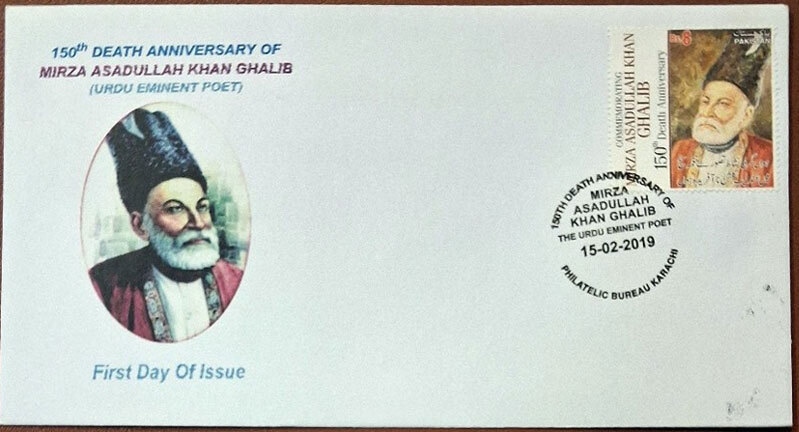
The most recent stamp about Ghalib was issued on the occasion of Mirza’s 150th death anniversary. According to litterateur Dr Aqeel Abbas Jafri, he sent a letter to the Pakistan Post authorities, requesting that they issue a stamp on this occasion. The request was accepted, and they asked him to write a note and suggest a Ghalib verse for this purpose.
This correspondence is preserved in his personal archives. Finally, an eight-rupee stamp, designed by Liaquat Ali, was issued on February 15, 2019, preserving his portrait from previous issues, with a couplet in his honour and an English caption on the right side, noting the occasion.
GHALIB AS CORRESPONDENT
While Mirza Ghalib is celebrated multiple times on postage stamps, one wonders whether he himself ever used stamps on his letters. He was a passionate correspondent and his letters have been largely preserved and studied and influenced Urdu and Persian literature. Stamps were introduced and widely used in British India in the last years of Ghalib’s life, but very few of the envelopes he sent are preserved; therefore, this question may require a detailed study.
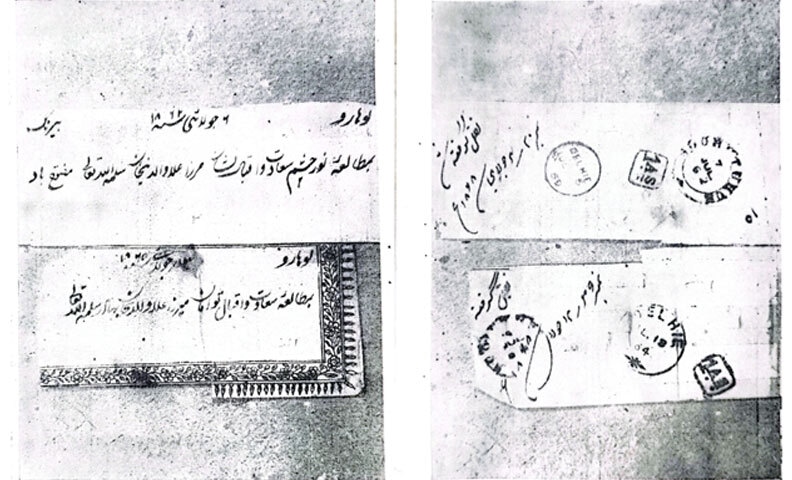
However, it’s noteworthy to examine two of his envelopes, published by Fazil Lakhnawi in March 1972 in Sahifa, Lahore. These envelopes, along with the letters written by Ghalib’s own hand, are preserved at the Lahore Museum. These letters were addressed to Mirza Alauddin Khan Alaa’i, a pupil of Mirza, who later became the Nawab of Loharu state. These envelopes were sent on July 6, 1862 and July 13, 1864.
Apparently, postage stamps were already introduced at that time, but they may not have yet been widely used. Instead of adhesive stamps, these envelopes bear one anna post office stamps, indicating the postal fee for a letter from Delhi to Loharu. They also bear postal markings from the Delhi and Loharu post offices.
These stamps are part of a cultural heritage not bound by national borders, as Mirza Ghalib not only does not belong to one city, country or nation but has also contributed to global literature as a whole. His works have been translated into multiple languages and he is celebrated in different countries.
In this sense, the stamps and letters together trace not only Ghalib in public memory, but also the quiet ways in which literature enters everyday circulation.
The writer is an author, historian, bibliographer, numismatist and research associate.
He can be reached at smn121@gmail.com. X: @smn121
Published in Dawn, EOS, December 28th, 2025