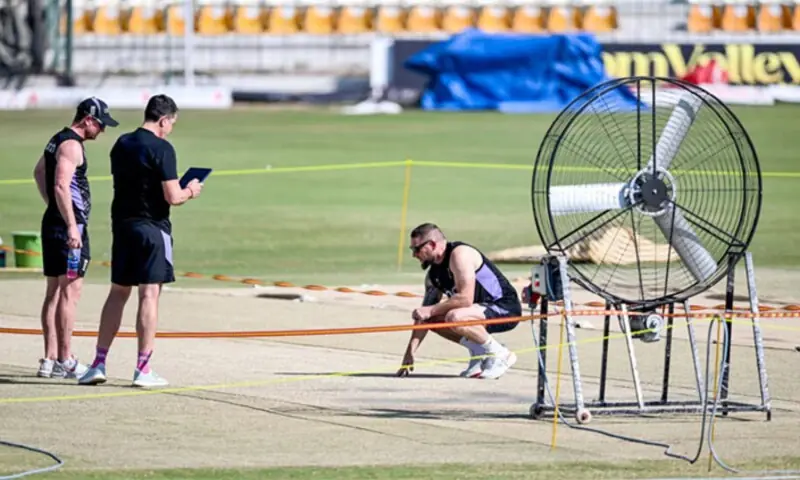

Pakistan is probably the only cricketing nation where the discussion around pitches becomes bigger than debates on team selection or performance.
This obsession did not appear recently. It really took shape three years ago, when Pakistan went through a painful home stretch. They lost a Test series to Australia with two dull draws and one defeat, were whitewashed 3-0 by England on lifeless tracks, and drew both home Tests against New Zealand.
These series exposed a major flaw. Instead of being an advantage, Pakistan’s home conditions had become neutral or even harmful. Flat pitches were presented as good for batting and supposedly good for long term development, but they killed any chance of producing results. When the Pakistan Cricket Board (PCB) chairman at the time, Ramiz Raja, defended this philosophy by saying it would take a year for Pakistan to be able to prepare proper five-day Test pitches, fans felt even more frustrated. Pakistan was not only losing matches but also losing identity.
The shift that has happened under the new management is remarkable. A set-up featuring Aaqib Javed, Azhar Ali and Aleem Dar walked in at a time when England had already beaten Pakistan in the opening Test of a three-match series in 2024. From that difficult position, Pakistan bounced back to win the remaining two Tests. After three years without a single home Test victory, this was more than just a result. It was a sign of a new mindset. Pakistan started using pitches as a strategic weapon rather than defaulting to flat surfaces that pleased nobody.

Pakistan has finally figured out its home turf advantage and now it must trust it…

This new thinking carried into the next series against the West Indies. Pakistan again used spin-friendly pitches and, even though they lost one Test, the overall trend was clear. Matches produced results. Pakistan also lost one Test at home to South Africa in the current cycle, but the real highlight is that there have been no drawn Tests since this approach began. That is a huge shift from the previous era, where slow and dull pitches created repetitive draws.
With every change, however, comes noise. Once Pakistan started getting results on turning pitches, a new debate began to dominate social media and television. People began claiming that Pakistan would destroy its fast-bowling legacy. Some insisted that producing spin-friendly tracks would undo decades of tradition built by legends such as Wasim Akram, Waqar Younis and Shoaib Akhtar.

Aaqib Javed addressed this in a recent interview on CricWick. Responding to claims that turning tracks would damage Pakistan’s identity, he asked a very simple question. He said that Pakistan play only two or three home Tests in a series, which takes about 20 days. If the best chance of beating strong teams is to create spin-friendly conditions for those 20 days, how could that possibly end the country’s fast bowling heritage?
He also clarified that Pakistan will not use the same approach for every opponent. He explained that fast bowling-friendly pitches will be prepared when Asian teams tour, because spin tracks would not make sense against sides like India, Sri Lanka or Bangladesh.
For the first time in a long while, Pakistan seems to understand what home advantage truly means. Previously, flat pitches allowed teams like England and Australia to dominate Pakistan even in Pakistan. Now opposition batters must work for their runs, spinners come into the match early, and seamers still have a role through new ball assistance, reverse swing or uneven bounce. The logic behind this approach is clear. Pakistan cannot outbat top sides on flat surfaces, but they can challenge them on pitches that require skill, patience and adaptability.
This mindset has also filtered into white ball cricket. Recently, Pakistan have been preparing ODI and T20 tracks that offer something for both pace and spin. Aaqib Javed explained in the interview that the team is already preparing for the upcoming World Cup in India and Sri Lanka. Pakistan is likely to play most of their matches in Sri Lanka, where conditions naturally help spinners. By playing on similar surfaces at home, the team hopes to adjust early, rather than waiting for the tournament to discover these challenges.
One of the most impressive aspects of the new system is how Pakistan have started producing different types of pitches at the same venue. The best example was seen in Faisalabad. One ODI was played on a surface that supported fast bowling and had carry, while the other two ODIs on the same ground assisted spin. This shows clear planning rather than random experimentation.
Aaqib also explained how the process works. Much of Pakistan uses Nandipur soil, which can be adjusted. A dry surface supports spin. Leaving some moisture and hardening the deck helps fast bowling. None of this is complicated. It just requires clarity, confidence and a willingness to back a strategy.
The benefits of this approach extend beyond immediate victories. Playing regularly on challenging surfaces will make Pakistani batters more complete. They will learn how to build an innings against turn, bounce and grip, rather than relying on flat tracks to pile up meaningless big scores. This is the type of experience they will need when playing in Sri Lanka, India or other spin-friendly countries.
For bowlers, especially spinners, these pitches provide the perfect platform to develop confidence, patience and the ability to out-think batters. Even fast bowlers can thrive in such matches through reverse swing, cutters and tactical spells.
This new philosophy also sends a clear message to the dressing room. Decisions will follow a defined home strategy. Players know what kind of cricket to expect. There is a clear template now. Pakistan identify the opposition’s strengths and weaknesses, prepare pitches accordingly, and select XIs that support the strategy. This clarity was missing during the era of flat wickets that produced neither entertainment nor results.
There will still be challenges. Spin-friendly pitches usually mean lower-scoring matches and more collapses. Some batters will struggle, and social media reactions will be harsh. One poor series may trigger calls from all sides to return to dead flat surfaces. That is where patience will matter. Players must adjust and fans must understand the long-term plan.
If Pakistan want to truly own this new identity, they must remain committed to it. They cannot panic after a single defeat and forget the purpose behind this approach. Three years of lifeless pitches showed what happens when a team has no idea of what it wants from its home conditions. The past year has shown the opposite. Pakistan finally looks like a team that understands what kind of cricket it wants to play at home.
The next step is simple but demanding. Pakistan must continue refining this template, trust the process, and accept that challenging, result-oriented pitches are the way forward. These are the conditions that will make Pakistan a fortress again, rather than a place where touring teams feel completely comfortable.
The writer is a cricket correspondent
and digital content creator.
X: @abubakartarar
Published in Dawn, EOS, November 23rd, 2025
Header Image: The Multan Cricket Stadium pitch, which was reused for the second Test match against England in October 2024. — AFP