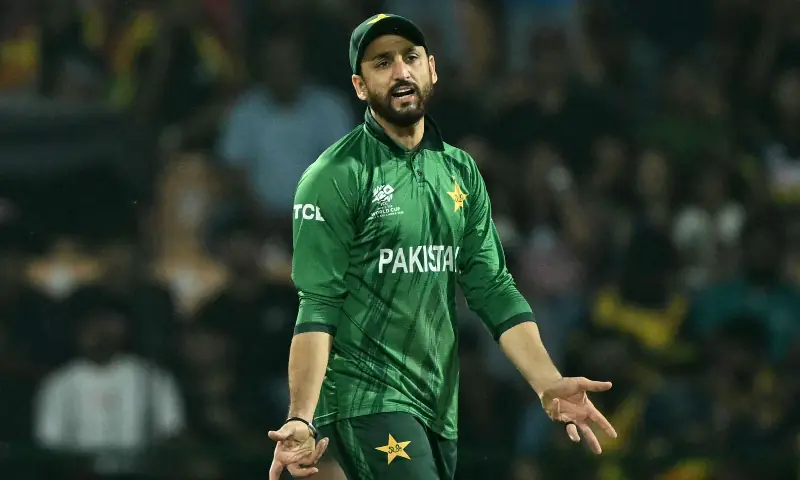

PAKISTAN were put out of their misery at the T20 World Cup when they failed to restrict Sri Lanka to 147 runs or less after posting a challenging total of 212.
Once Sri Lanka had eliminated Pakistan from the tournament, the rest of the match was irrelevant from a Pakistani perspective. In the end both Pakistan and Sri Lanka were losers.
Pakistan had failed to defeat any major team in the tournament before this game, and that says everything you need to know about the current standing of Pakistan in world cricket.
With three changes in Kandy, Pakistan relied on their bowlers to exploit Sri Lanka’s batting weakness. However, it was the stunning performance of Pakistan’s opening batsmen that created hope before Sri Lanka reminded the world of their own talent.

Farhan took the batting glory on his way to his second tournament hundred and to race past Virat Kohli’s record for most runs scored in a World T20.

The conditions supported his vigorous stroke play, the ball coming on nicely in pace and in line. The sense was that Farhan just needed to find some support from his fellow batsman, and here he found a willing accomplice in Fakhar Zaman.
Naseem Shah, one of the returning players, made the first incision of Sri Lanka’s chase.

He spotted Nissanka making room and cleverly produced a perfectly pitched googly that found Sri Lanka’s danger man overstretching.
The wicket started taking turn towards the end of Pakistan innings, and was now a more appetising prospect for spinners. Sri Lanka had won the toss and could only blame themselves for this slight imbalance.
Abrar rekindles hope
Abrar Ahmed, who had fluffed his lines against India, was the man who made Pakistan fans dare to believe. Full of confidence here, he slowed his pace down dramatically to repeatedly deceive Sri Lanka’s batsmen.
When Mohammad Nawaz chipped in to take the fifth wicket, and with Sri Lanka still some 50 runs short of the target that would eliminate Pakistan, hopes were high of completing a mission that wasn’t impossible..
Rathnayake had other ideas. As the rest of Sri Lanka’s batsmen struggled, Rathnayake launched into Nawaz and Shadab Khan. The ghosts of Pakistan’s inadequate tournament performance were back to haunt them. Pakistan had backed spin and spin bowling all-rounders, and the strategy hadn’t delivered.
When Shanaka plundered Usman Tariq for 13 runs in the 16th over, Pakistan were out and New Zealand were through to the semi-finals. Now, Pakistan had to somehow find the desire to win this game, and thanks to Shanaka’s brutal late hitting they almost didn’t.
Earlier Sri Lanka had put Pakistan in to bat, and Pakistan quietly expected. But nobody quite expected what followed.
Farhan and Zaman took the attack to Sri Lanka, quickly setting the run rate at 10 an over, and keeping it there. It was Farhan who generated the momentum, powerfully punching boundaries almost at will. He was also aware enough to settle for a single when it was the best option.
Farhan’s acceleration took the pressure off Fakhar in his return to the team. But once Fakhar too found his trademark strokes, Pakistan were flying.
Sri Lanka probably settled too early to defend runs by targeting width rather than seeking to slow down Pakistan by taking wickets. Both batsmen, as is the modern way, line up shots and then get their front leg out of the way to generate power. Farhan is more orthodox, while Fakhar is an innovator.
The result was a partnership of 176. At that moment Pakistan looked well set for a total above 220. After such a brilliant opening stand, the eventual target felt at least 20 runs short.
Question mark over Babar, Shaheen
In the end, Pakistan’s big decision to drop Babar Azam made no material difference to their score other than forcing the responsibility onto others. It really is hard to see how, as prolific as he has been, Babar has a future in the T20 team after this tournament.
Pakistan will point to recent improvements in performance leading up to this World Cup, and perhaps they got unlucky when their match with New Zealand was rained off.
But the hard truth is that Pakistan are short of high-quality cricketers in this format and probably the other formats as well. When the problems with Pakistan’s cricket are so systemic and deep-rooted, it seems almost academic to focus on individuals.
Of course that must be done, and the areas are clear. Pakistan fall short in quality of top order batting and pace bowling. The all-rounders aren’t good enough to support a strategy built on them. Then there is the question of whether the captain and a whole generation of senior players should continue in the T20 team — and, yes, this includes Babar and Shaheen Shah Afridi, alongside Nawaz and Shadab Khan.
The brutal answer is no. Pakistan must shed the deadwood that is now drenched in failure. Grow the tree again.
As ever, Pakistan do unearth talented new cricketers, but the problem is that the development of these cricketers is failing.
The PSL cannot continue to be the main pipeline for Pakistan’s cricket team across the three formats. The problems, therefore, are systemic and the challenge is complex and long-term. But what the PCB has continued to demonstrate, under every leadership and regime for the last 20 years and more, is that it does not have the patience to cure the disease at the core of Pakistan’s cricket.
Unless it does so, these disappointments will endure — and sadly failure is something that Pakistani fans are now numb too. The message to the PCB is simple: shed the deadwood, grow a new tree from the roots upwards, and make the trunk — the core — strong.
What’s true for the T20 team is also true for Pakistan cricket as a whole.
Pakistan’s main contribution to this tournament, the performance of Sahibzada Farhan aside, was to fulfil their obligations to the ICC and Sri Lanka by playing India. Is that all Pakistan cricket is — a cash cow for the ICC, albeit a cash cow that is in a sideshow?
Published in Dawn, March 1st, 2026