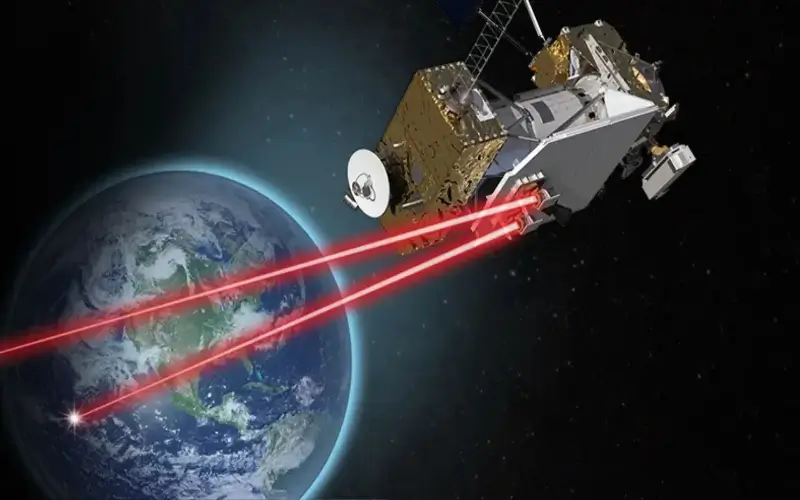

Chinese research institutions have successfully tested a laser communication link between a high-orbit satellite and a ground station, achieving two-way data transmission at a speed of 1 gigabit per second across a distance of more than 40,000 kilometers. The development was reported by China Science Daily.
At present, research in satellite-to-ground laser communication mainly focuses on two goals: increasing download speeds to manage large amounts of data in certain situations, and improving stable, long-term, two-way real-time communication in high-orbit environments. These capabilities are considered essential for modern space systems and advanced interactive applications.
The project was led by the Chinese Academy of Sciences Institute of Optics and Electronics, in collaboration with the Beijing University of Posts and Telecommunications, the China Academy of Space Technology, and other institutions. Together, they established a stable laser communication link between an observatory in Yunnan Province and a geosynchronous satellite.
The team achieved two-way communication at distances of up to 40,740 kilometers, maintaining a speed of 1 gigabit per second. The link was set up in just four seconds and remained stable for more than three hours, marking a significant technical milestone.

Because the experiment was conducted using a more complex high-orbit platform, it extended stable communication time from just a few minutes to several hours. This ensured reliable, high-speed, real-time two-way connectivity and represents a major step toward building an integrated Earth-space communication network.

This breakthrough allows satellites not only to send large volumes of data quickly but also to receive detailed commands in real time. As a result, high-orbit satellites could evolve from simple data relays into advanced, intelligent processing centers.
Researchers said the experiment also confirmed the deep-space communication capabilities of ground stations. The success opens the door to developing high-speed laser communication links with the Moon, Mars, and more distant space probes in the future.

The strong performance and reliability demonstrated in this test suggest that the technology has reached a level suitable for large-scale practical applications.