
• PM Shehbaz arrives in Washington today to attend Trump-led moot
• Summit to focus on Gaza ceasefire, $5bn US pledge and board’s institutional design
• Muslim states wary of combat role, seek viable pathway to Palestinian statehood
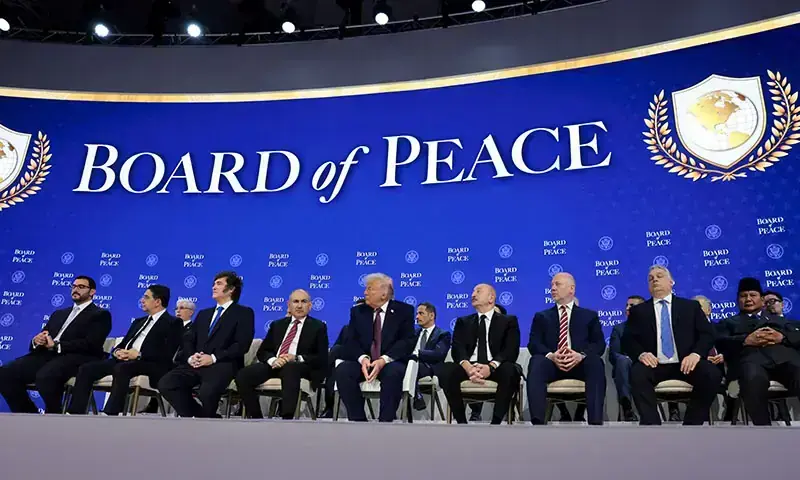
WASHINGTON: Prime Minister Shehbaz Sharif arrives here on Wednesday (today) to attend the global summit of the Board of Peace (BoP) hosted by US President Donald Trump, stepping into a forum that seeks to go beyond Gaza in restoring global peace and stability.
The summit’s immediate focus is expected to be threefold: consolidating a ceasefire in Gaza, mobilising financial pledges for the BoP — with Washington announcing an initial commitment of $5 billion — and finalising the contours of a proposed global forum that Trump hopes can achieve what the United Nations could not.
Participants are also likely to discuss the proposed International Stabilisation Force (ISF), tasked with securing reconstruction zones and supporting a post-conflict governance arrangement in Gaza.

For Pakistan, the question of contributing troops to the ISF has assumed particular importance after it reportedly figured in discussions between Chief of Army Staff Field Marshal Asim Munir and US Secretary of State Marco Rubio on the sidelines of the Munich Security Conference.

Diplomatic sources say several Muslim countries are open to participating in a stabilisation mechanism but are reluctant to accept any combat role that could place their forces in direct confrontation with Hamas. They are also seeking a clear political horizon for Palestinian statehood and opposing Israeli moves towards annexation in the West Bank.
The institutional design of the BoP — a compact, leader-driven body with an operational arm in the form of the ISF and a dedicated financing pool — reflects Washington’s preference for coalition-based mechanisms operating outside the slower multilateral framework of the United Nations. This has raised questions among diplomats and scholars about both effectiveness and legality.

Maleeha Lodhi, Pakistan’s former ambassador to the United States, Britain and the United Nations, was unequivocal in her assessment. “The jury is out on whether the Board of Peace can deliver peace. The absence of any Palestinian representation on the Board raises questions about its legitimacy,” she said. “If the principal party to the issue is excluded, how is this going to advance the peace process or carve out a post-conflict future for the people of Gaza.”
Dr Lodhi warned that externally imposed governance arrangements risk reproducing older power hierarchies. “Externally controlled governance arrangements make this a colonial-style project,” she observed, adding that “at least half of the countries invited to be members didn’t join the body as they had reservations about its role, legality and effectiveness as well as Trump’s pretension of turning this into a parallel body to the UN Security Council”.
She also questioned Islamabad’s early decision to sign on. “Pakistan should not have joined the Board in such haste and should have waited to see what exactly it will do, especially given the widespread view that it can end up becoming an instrument for continuing Israeli occupation.”
For PM Shehbaz, the visit is not only about Pakistan’s potential role in a new stabilisation architecture but also about navigating a complex web of domestic and external pressures, according to Akbar Ahmed, Ibn Khaldun Chair of Islamic Studies at American University.
“PM Shehbaz Sharif faces as sticky a wicket as can be imagined when he arrives in Washington for his meetings with President Trump,” Prof Ahmed said. “He is bringing with him two sets of dilemmas: an internal one and an external one.”
On the domestic front, he noted, the prime minister must manage a difficult civil-military balance amid rising security challenges. He added that Shehbaz Sharif also faces a politically sensitive decision regarding the continued incarceration and health of former PM Imran Khan.
Externally, the challenge is even more complex. “On the one hand, he must continue his newly formed amiable relationship with President Trump, which gives him access to American military and economic structures, and on the other, the consistent and immeasurable support that China has provided,” Prof Ahmed said, pointing to tensions on both the eastern and western borders as factors that make this balance unavoidable.
“With both the western border with Afghanistan and the eastern border with India heating up, Shehbaz Sharif cannot ignore this balance between America and China. His performance will be watched carefully and his words weighed. He will need all his legendary skills of survival.”
In that sense, the Washington visit is as much about testing the contours of Pakistan’s evolving relationship with the United States as it is about Gaza. For the Trump administration, the summit is expected to secure troop commitments for the ISF, financial participation in reconstruction and political endorsement for a US-led stabilisation model.
For Muslim and Arab countries, participation is tied to a permanent ceasefire, a credible pathway to Palestinian statehood and a non-combat mandate for any multinational force.
How PM Shehbaz positions Pakistan between these competing expectations — while coordinating with like-minded states and maintaining strategic equilibrium between Washington and Beijing — will determine both the immediate diplomatic outcome of the summit and the longer trajectory of Pakistan’s role in the emerging post-conflict framework for Gaza.
Published in Dawn, February 18th, 2026