
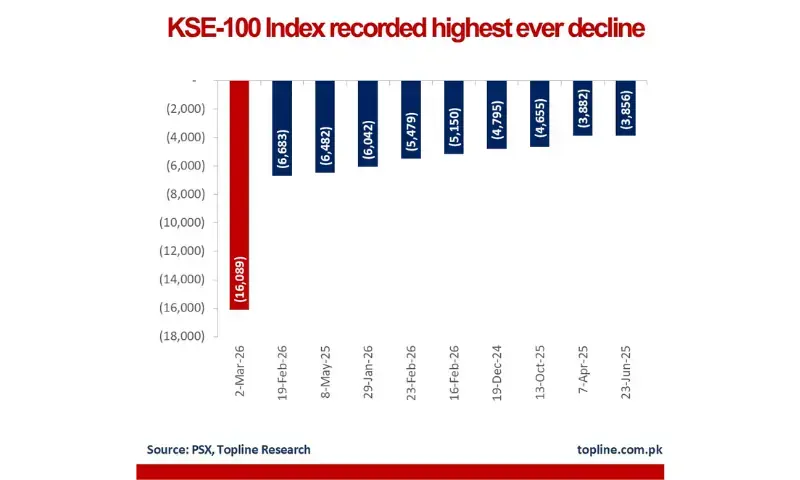
• Index sees unprecedented plunge of over 16,000 points, inflicting Rs1.7tr loss in a single day
• Conflict shakes investor confidence as they lose over Rs4 trillion since January peak
KARACHI: The Pakistan Stock Exchange (PSX) on Monday witnessed the steepest single-day plunge, which inflicted unprecedented losses of Rs1.74 trillion on panicky investors who rushed to exit as the assassination of Iran’s supreme leader, Ayatollah Ali Khamenei, in airstrikes by the US and Israel sabotaged Middle East peace, caused a rout in world equity markets and fuelled a surge in oil and gas prices amid growing fears of supply disruptions as Tehran retaliated.
Violent protests breaking out across the country in the wake of Khamenei’s assassination, causing dozens of deaths in clashes with security forces, also contributed to depressed market sentiment.
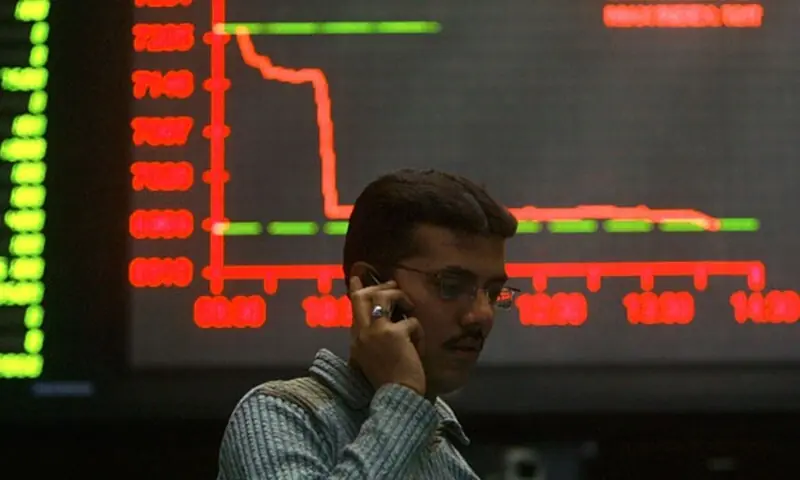
Panic-driven sell-offs dragged the benchmark KSE-100 index below the 152,000 level, marking the largest single-session decline in the bourse’s history. Since the all-time peak on Jan 23, the index has tumbled by 37,193.83 points, or almost 20 per cent, causing a cumulative loss of over Rs4.03tr in market capitalisation.

Topline Securities Ltd said Pakistan equities opened the session on an exceptionally bearish note, with aggressive, broad-based selling pressure gripping the market. The KSE-100 index posted its largest-ever single-day decline, shedding 16,089 points, or 9.57pc, to close at 151,973 points.

The steep correction was largely driven by widespread panic selling from both retail and institutional investors, compounded by the market’s previously overbought condition. Amid heightened volatility, trading activity was suspended after the index plunged almost 9pc for one hour shortly after the opening bell, to stabilise market conditions, in line with a risk management rule set by the PSX.
Heavyweight constituents, including Fauji Fertiliser Company, United Bank Ltd, Engro Holdings Ltd, Hub Power Company and Meezan Bank Ltd, exerted substantial downward pressure, collectively eroding 5,167 points from the benchmark index.

Amid a pronounced decline, trading activity reflected steep selling pressure, with trading volume increasing 50.96pc to 809 million shares and traded value surging 89.94pc to Rs48.5bn. K-Electric dominated the volume leaderboard, with more than 163 million shares. Ali Najib, deputy head of trading at Arif Habib Ltd (AHL), said selling pressure dominated from the opening bell, with the index falling to an intraday low of 152,991, down 15,071.01 points (8.97pc) in the first five minutes of trading, triggering a trading halt.
After trading resumed at around 10.22am, the market staged a strong technical rebound, with the index recovering over 6,000 points to reach an intraday high of 159,329. However, the recovery proved short-lived, as renewed selling pressure in the final hours erased gains and pushed the market to its day’s low close.
Major laggards included Fauji Fertiliser, United Bank, Engro Holdings, Hub Power, Meezan Bank, Oil and Gas Development Company, Habib Bank, Lucky Cement, MCB Bank and Pakistan Petroleum, which collectively shaved 8,148 points off the index.
Developments on the geopolitical front will remain a key determinant of market direction. Continued escalation could prolong volatility and exert further pressure on investor sentiment. Conversely, any meaningful signs of stability or de-escalation may help restore confidence, reduce risk premiums and pave the way for a gradual recovery in the equity market.
Shankar Talreja of Topline Research said Iran had also aggressively targeted multiple US bases in Middle Eastern countries, including Bahrain, the UAE, Qatar and Saudi Arabia, and directly attacked Israel over the weekend following the assassination of Khamenei and other top Iranian civil and military leaders.
“As a result, the airspace of Middle Eastern countries has also been closed, and some countries and states, including Dubai, Abu Dhabi and Kuwait, have announced the temporary suspension of their stock exchanges. The war-like situation is continuing, and experts believe that the conflict may continue for a month,” he noted.
For Pakistan, although the involvement is not direct, there are economic implications, including higher oil prices due to its heavy dependence on imported oil, which could spike inflationary pressures. Investors’ confidence could also weaken investment prospects in the country due to hostility on both the eastern and western borders of Pakistan.
Global oil and gas prices surged as retaliation by Tehran forced shutdowns of oil and gas facilities across the Middle East and disrupted shipping in the crucial Strait of Hormuz, which accounts for 20pc of the world’s oil supply, and which Saudi Arabia, the UAE, Kuwait, Iraq and Qatar largely use to export oil. A sustained rise in oil prices would endanger a global economic recovery and fuel inflation.
Brent crude futures rose as much as 13pc to $82.37 a barrel, their highest since January 2025, before retreating to trade up $4.92, or 6.75pc, at $77.79 a barrel at 1606 GMT. US West Texas Intermediate crude was up $3.87, or 5.77pc, at $70.89, having risen more than 12pc to $75.33, its highest since June.
The brokerage house noted that, due to the evolving nature of the conflict and the involvement of various countries, volatility might continue until the conflict is resolved.
However, any further fall in the index level may provide an attractive entry point for investors, as Pakistan’s recent reforms have created a decent buffer (reserves level) for absorbing external shocks.
Furthermore, the government would continue to adopt cautious policies to navigate this period. Mr Talreja said the Pakistan market had again returned to an attractive level below a 6.5x 2027 price-to-earnings ratio, lower than the historic average of 6.9x.
Pakistan’s annual petroleum imports, including crude, refined products, LNG and LPG, stand at $15-16bn. Every 10pc change in oil prices can increase the petroleum import bill by $1.5-$1.6bn. Other products directly linked to oil prices include edible oil ($4bn in imports), coal ($1bn) and rubber and tyres ($1bn).
Rising oil prices will also affect inflation, directly and indirectly. The brokerage house observed that expectations of higher imports and growing concerns in the Middle East might weaken the rupee.
Published in Dawn, March 3rd, 2026