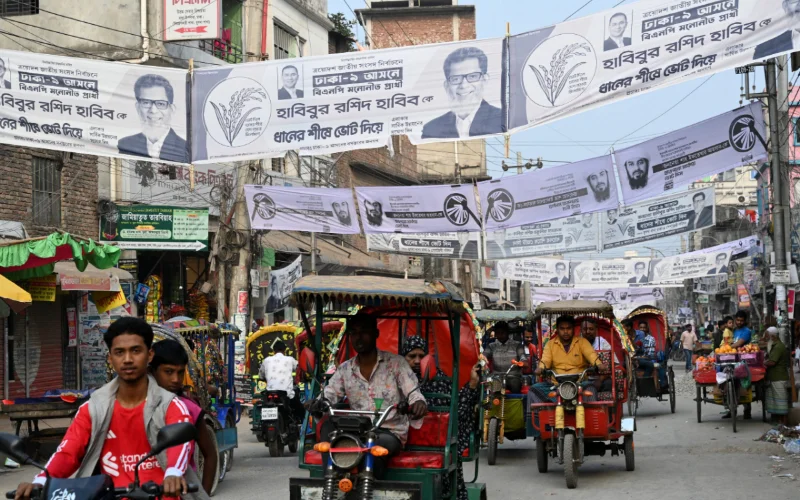

DHAKA: Bangladesh is set to hold general elections on February 12(Thursday) 2026 , widely regarded as one of the most significant polls in the country’s 55-year history.
The elections are taking place following the fall of Prime Minister Sheikh Hasina’s government in August 2024, after a student-led movement against her rule.
The unrest turned violent, leaving nearly 1,400 people dead. Sheikh Hasina remained in power from 1996 to 2001 and again from 2009 until 2024.
Following her removal, Nobel Peace Prize laureate Muhammad Yunus assumed leadership of the interim government, with a mandate to ensure transparent, free and fair elections.

Voter Landscape

Bangladesh has a population of more than 173 million, making it the world’s eighth most populous country.
According to the Election Commission, around 127 million citizens are registered to vote, including approximately five million first-time voters. Nearly 44 percent of registered voters are between the ages of 18 and 37, highlighting the significant role of the country’s youth in shaping the electoral outcome.
Significance of Dhaka
One of the world’s most densely populated countries, Bangladesh has an average of 1,366 people per square kilometre.
The capital, Dhaka, home to over 37 million residents, is expected to play a decisive role in determining election results. Muslims make up more than 90 percent of the population, while Hindus account for about 8 percent, with other religions forming the remainder.
Economic Context
Over the past 25 years, Bangladesh has achieved notable economic growth. However, growth slowed to 3.97 percent in the fiscal year ending June 2025, down from 4.22 percent previously.
The country’s gross domestic product (GDP) stands at $461 billion, while per capita income is approximately $1,990, reflecting ongoing challenges related to poverty reduction and economic diversification.
Political and Constitutional Framework
Bangladesh operates under a parliamentary system, where executive authority rests with the prime minister, who forms the cabinet, formulates policy and oversees governance. The president serves as the ceremonial head of state and is elected by parliament for a five-year term.
Legislative authority lies with the 350-member National Parliament (Jatiya Sangsad), comprising 300 directly elected members and 50 seats reserved for women. Administratively, the country is divided into eight divisions, 64 districts and 495 sub-districts.
Political Parties and Electoral Alliances
A total of 51 political parties are contesting 1,981 seats nationwide, alongside 249 independent candidates. Sheikh Hasina’s Awami League is currently suspended and is not participating in the elections, marking a major shift in the country’s political landscape.
BNP-Led Alliance
The Bangladesh Nationalist Party (BNP), led by Tarique Rahman, son of former prime minister Khaleda Zia, is contesting 292 of the 300 directly elected seats, in alliance with more than half a dozen smaller parties.
The BNP’s campaign focuses on financial assistance for low-income families, limiting the prime minister’s tenure to ten years, promoting economic growth through foreign investment, and strengthening anti-corruption measures. Opinion polls suggest the alliance holds a narrow lead, reflecting public appetite for political change after years of Awami League dominance.
Jamaat-e-Islami and NCP Alliance
Jamaat-e-Islami, led by Shafiqur Rahman, has formed an alliance with the National Citizen Party (NCP), a moderate political group established by youth leaders of the 2024 movement.
The alliance is contesting 224 seats under Jamaat-e-Islami and 30 under the NCP, with remaining seats allocated to smaller parties.
The bloc advocates governance based on Islamic principles, economic diversification beyond the garment sector, and stronger relations with neighbouring countries. Analysts believe the alliance could play a significant role in parliament even without securing an outright majority.
Other Contesting Parties
Other parties in the race include factions of the Jatiya Party (JP–Qader and JP–Ershad), the Left Democratic Alliance, and the Amar Bangladesh Party, all seeking to attract voters looking for reform-oriented alternatives to traditional political forces.