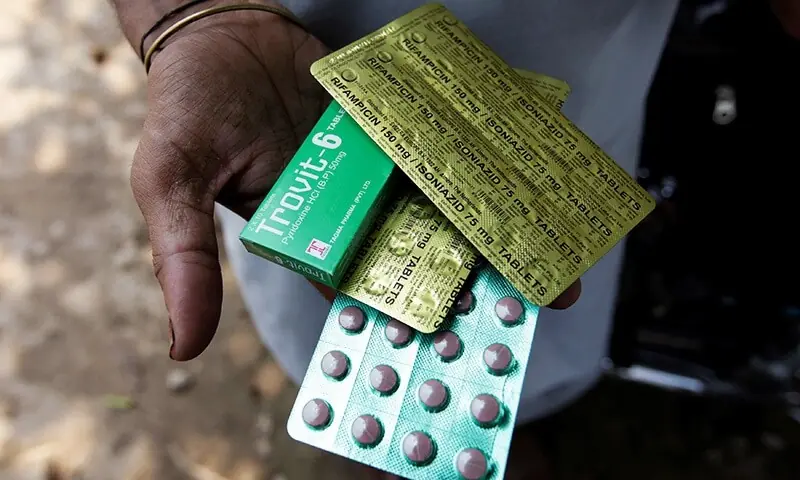

KARACHI: The Pakistan Medical Association (PMA) raised on Friday an urgent national alarm over the severe and persistent shortage of essential paediatric tuberculosis (TB) medications, warning that the situation could lead to a “catastrophic surge” in drug-resistant tuberculosis in the most vulnerable population.
Citing reports from healthcare facilities across the country, the association stated that they indicate “a near-total depletion” of first-line paediatric TB drugs, signalling a complete breakdown in the mandate of National TB Programme (NTP) in ensuring the availability of life-saving treatment.
“As the country with the fifth-highest TB burden globally, Pakistan stands on the precipice of a man-made disaster. The systematic collapse of TB control programme is not merely an administrative issue. It’s a staggering failure of the programme and a medical emergency, threatening the lives of our children,” stated the association.
Highlighting the adverse effects of persistent shortage of TB medicines, the association says that the interruption is extremely hazardous for the patient and creates a massive risk for multi-drug resistant (MDR) and extensively drug resistant (XDR) TB.

“The NTP has failed in its primary duty to maintain the drug supply chain. When a child’s treatment is inconsistent, we are effectively allowing bacteria to survive and mutate, forcing families toward years of toxic, expensive, and far less effective treatments.”

The association warns that the consequences of this shortage are severe and often permanent.
“With MDR-TB prevalence already at 40 per cent among previously treated patients, further interruptions risk the escalation to XDR-TB, which carries a mortality rate as high as 31pc.

“Children are uniquely susceptible. Without consistent medication, the risk of disseminated TB — where the infection spreads to the brain or blood — increases exponentially. If first-line drugs fail, children are forced onto second-line regimens lasting up to 24 months, associated with liver toxicity, anaemia, and permanent hearing loss.”
The association challenges the public opinion that no TB medicines are made locally. The reality, it points out, is more complex and highlights a systemic failure rather than a lack of capability.
“Contrary to the idea that nothing is manufactured here, several local companies have a history of producing TB drugs. In 2023, a local company became the first national company to receive the WHO prequalification for an anti-TB product, specifically for drug-resistant TB therapy.
“The misconception that these drugs aren’t made locally stems from a massive crisis where many companies halted production due to pricing disputes. Because the cost of raw materials rose while retail price caps remained frozen, it became financially unviable for firms to produce them, leading to a heavy reliance on imports.”
According to the association, many “disappeared” medicines following pharmaceutical deregulation in late 2024 have returned to production. However, the paediatric formulations — specifically designed for children — remain in a state of critical shortage due to ongoing procurement and distribution failures within the national TB programme and the Common Management Union of the federal health ministry.
To prevent a public health disaster, the association recommends that the federal and provincial governments must immediately initiate emergency imports of paediatric TB formulations to bridge the current stock-out.
The NTP, it emphasises, must be held accountable for the total breakdown of the supply chain, and the Drug Regulatory Authority of Pakistan must ensure that the recent deregulation benefits reach the paediatric sector.
“An immediate, transparent audit of all TB drug stocks is needed to ensure equitable distribution and prevent localised exhausts. Neglecting the paediatric supply chain today will result in a public health emergency tomorrow that our healthcare system is simply not equipped to handle. We call on the federal health minister and provincial leadership to intervene before this shortage becomes a permanent national health crisis,” the association concludes.
Published in Dawn, March 14th, 2026