


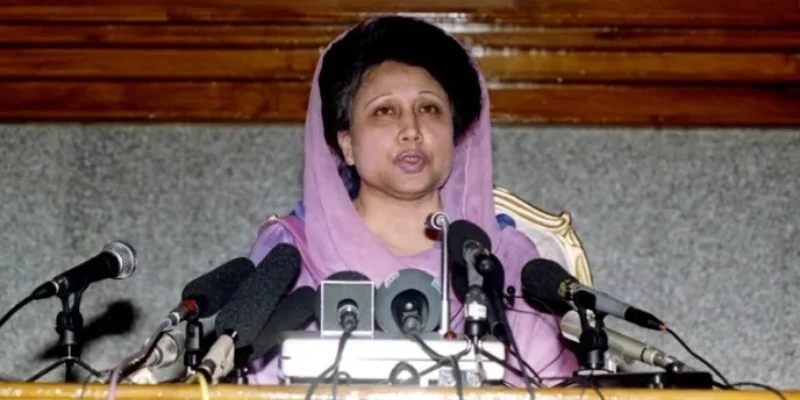
In early December, 48-year-old grassroots activist Tipu Sultan stood vigil outside Dhaka’s Evercare Hospital, holding a placard: “I want to donate my kidney to Begum Khaleda Zia.” For many Bangladeshis, that devotion captured the essence of the country’s first female prime minister, whose passing at age 80 on Tuesday closes a chapter in the nation’s turbulent political history.
From Tragedy to Leadership: Rising After Personal Loss

Khaleda Zia’s life was defined by tragedy, ambition, and an unwavering grip on power. Her husband, President Ziaur Rahman, was assassinated in a failed military mutiny in 1981, leaving the Bangladesh Nationalist Party (BNP) fractured and the nation in political limbo. Senior leaders turned to Khaleda, a homemaker until then, to preserve her husband’s legacy. By 1984, she had risen to BNP chairperson a symbol of continuity and resilience.
Champion of Democracy: Standing Against Military Rule

From the shadows of personal grief, Khaleda carved out a national identity. She stood against military authoritarianism in the 1980s, earning a reputation as an “unwavering” democratic leader. Over the following decades, she won three terms as prime minister, presiding over landmark economic reforms, an export-led industrial revival, and historic GDP growth that earned Bangladesh the moniker “Asia’s next tiger economy.” Her administration also expanded girls’ education and safeguarded freedom of expression in the press, steering the country from presidential to parliamentary governance.

Controversy and Criticism: A Legacy of Mixed Reactions
Yet, Khaleda’s legacy was never uncomplicated. Her tenure was marred by allegations of cronyism, corruption, and controversies including the 2004 grenade attack on an Awami League rally. Critics questioned her leadership style, while loyalists admired her uncompromising dedication to democracy.

The Battling Begums: Rivalry With Sheikh Hasina
Her rivalry with Sheikh Hasina, dubbed the “battling begums,” dominated Bangladeshi politics for more than three decades. Zia’s quiet, traditional style contrasted sharply with Hasina’s assertive, outspoken persona. Their cycles of alternating power defined the nation’s political rhythm, making their personal and political lives inseparable from Bangladesh’s modern history.
Enduring Influence: Public Loyalty and Political Future
Even in death, Khaleda’s story resonated with the public. Sultan’s vigil became a viral symbol of devotion, mirroring the loyalty of millions who saw in her a leader willing to sacrifice personal comfort for the country. Her passing comes just as her elder son, Tarique Rahman, returned from 17 years of exile, signaling a new chapter for the BNP ahead of February’s general elections.
A Life of Contrasts: Grief, Power, and Resilience
Khaleda Zia’s life was a study in contrasts: grief and power, loyalty and controversy, resilience and vulnerability. She was Bangladesh’s first woman to lead a nation, a figure who shaped its politics, and a symbol whose influence will be remembered long after the headlines fade.