




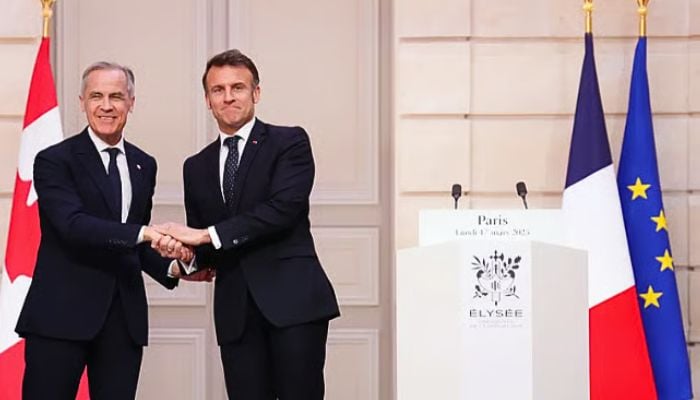
The joint visit by French President Emmanuel Macron and Canadian Prime Minister Mark Carney to the French North Atlantic archipelago of Saint Pierre and Miquelon serves as a sharply targeted diplomatic statement to Washington.
The high-profile trip was scheduled following a social media post by U.S. President Donald Trump featuring an AI-generated map of a expanded “United States.”
The image draped the U.S. flag over Canada, Greenland, Iceland, Mexico, Central America, and several French overseas territories—including Saint Pierre and Miquelon.

Coming on the heels of repeated rhetoric regarding the potential acquisition of Greenland or turning Canada into a U.S. territory, the post sparked sharp underlying tensions over allied borders.

By standing side-by-side on French soil just 20 kilometers off Canada’s coast, Macron and Carney delivered an unmistakable message: national borders, international law, and the sovereignty of allies are not negotiable and cannot be brushed off as online provocations.
The trip marked the first-ever official visit by a Canadian prime minister to Saint Pierre and Miquelon, underscoring a deepening alliance and economic alignment between Ottawa and Paris.
The trip also marks, Macron’s visit—the first by a French president since Francois Hollande travelled there in 2014, comes as Canada seeks to deepen ties with the European Union amid trade tensions with the United States and a deterioration in relations with Washington under Trump.
Located off Canada’s Atlantic coast, Saint Pierre and Miquelon is France’s only remaining territory in North America.
French officials said the trip would underscore France’s sovereignty over the archipelago and highlight its close relationship with Canada.
“For a territory of 5,800 inhabitants, it is rare to find so many issues that are important for France as a whole concentrated in a place of this size: France’s geostrategic presence in the North Atlantic, at the doorstep of the United States and the Arctic, maritime sovereignty, adaptation to climate change; and cooperation with Canada,” a French presidency official told reporters.
The Élysée Palace framed the summit as a clear stand against the return of aggressive power politics and external dependencies, emphasizing shared commitments to democracy and independent decision-making.
Before heading to New York for the United Nations General Assembly, Macron used the strategic stopover to visually and politically reinforce that North American and European borders remain firmly drawn.

