



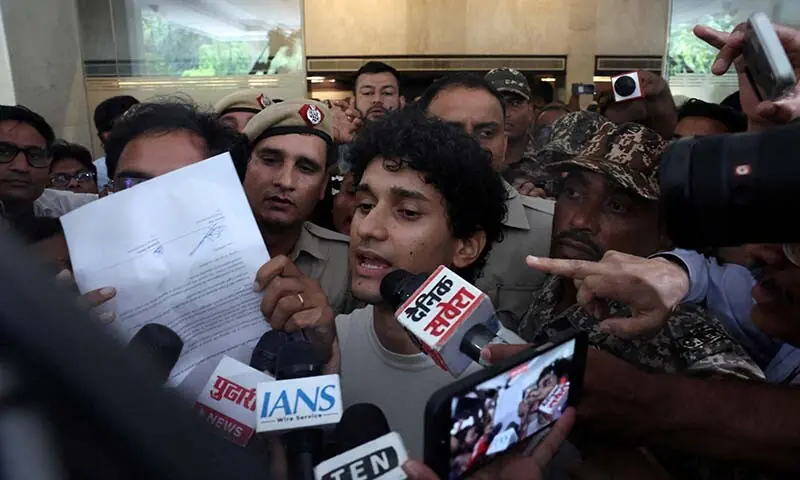

Leaders of India’s youth-led “cockroach” movement said on Friday that the government has sought time until Saturday afternoon to respond to their demand for the education minister’s resignation over exam paper leaks, following talks between the two sides.
The talks came hours after activist Sonam Wangchuk ended his 26-day hunger strike, raising hopes that the two sides could reach a breakthrough after tens of thousands of angry youth converged in the capital Delhi this week to demand the minister’s resignation.
The anti-government protests represent the biggest youth challenge to Prime Minister Narendra Modi since he came to power in 2014. Opposition parties have echoed the movement’s demands and have disrupted the monsoon session of parliament that began this week.
Friday’s talks were held between senior federal ministers JP Nadda and Jitendra Singh on one side, and Saurav Das and Ashutosh Ranka, spokespersons of the self-named Cockroach Janta Party (CJP) youth movement, on the other.

The CJP leaders said they had conveyed that nothing would be acceptable to them without Education Minister Dharmendra Pradhan’s resignation, and warned that without this, protests would spread.

“The government has asked for time until tomorrow afternoon to respond on this point (the resignation),” Ranka told reporters. “We hope the government will dismiss Dharmendra Pradhan at the earliest, or that he will resign, so that we can bring this matter to a conclusion.”
Minister Nadda said the talks were cordial.
“They had three main demands. We have told them we will meet you tomorrow afternoon and discuss the demands,” he said.
Scattered protests across the country
Besides the resignation of Pradhan, CJP wants police cases filed against protesters dropped, and compensation paid to families of more than a dozen students who local media reported took their own lives after the exam paper leak in May.
Although the protesters agreed to hold talks, they had also called for nationwide demonstrations on Friday over alleged police brutality against protesters who marched on parliament on Monday.
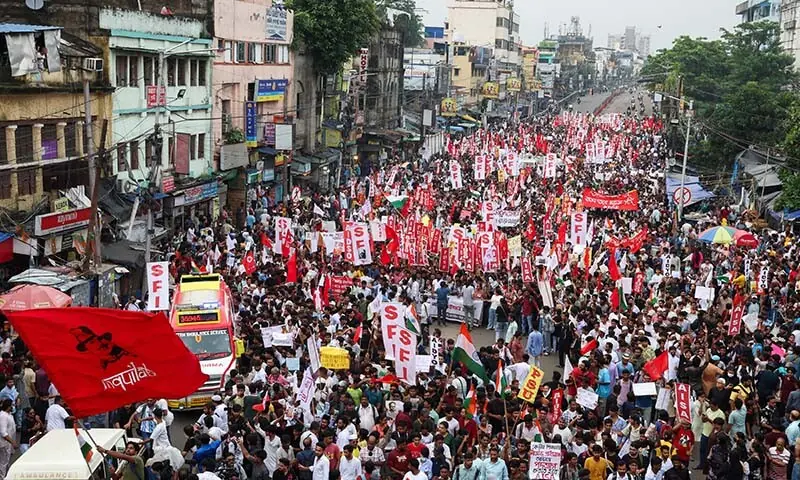
While thousands of protesters continued to gather at the main protest site of Jantar Mantar in central Delhi, there were reports of scattered protests across the country.
Students, youth activists and opposition supporters staged protests in the states of West Bengal, Telangana, Karnataka and Tamil Nadu, holding placards demanding Pradhan’s resignation and boycotting classes in some places, local media reported.
Parliament was disrupted and suspended again on Friday as opposition lawmakers also demanded Pradhan’s resignation, with no business conducted for the entire week.
The protests by CJP began as an online satire and involved only a few hundred young people when they were first launched. But they grew to pull in millions of online followers when a national medical school entrance test was cancelled in May because the question paper was leaked earlier, affecting about 2 million students.
Tens of thousands of supporters of the movement marched on parliament in violation of a ban on Monday and clashed with police when they were pushed back with tear gas and beaten with batons.
Metro stations shut, mobile internet blocked again
The movement’s surge in popularity reflects frustrations among young Indians over issues such as job shortages, as well as frequent exam leaks, analysts say.
The Delhi Metro Rail Corp. shut down 17 stations in and around central Delhi on Friday, the third time this week it resorted to such a large-scale closure of the system, which is the lifeline of the capital.
The government extended a mobile internet shutdown in the area until midnight on Friday, two industry sources told Reuters.
The government also defended surveillance by police at the protest site, saying in court that there was no right to privacy in a public space when there is a legitimate state interest.
Youth-led, street protests in neighbouring Sri Lanka, Bangladesh and Nepal have brought down governments in recent years.
Although national elections are due only by April 2029, key states like the most populous, Uttar Pradesh, run by Modi’s party, his home state of Gujarat, and Punjab, vote next year and anti-government sentiment could have an impact, analysts say.

