



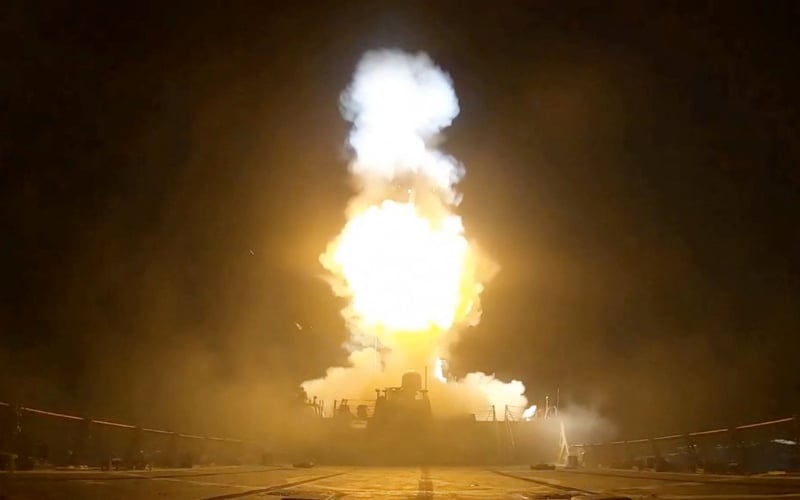

The United States and Iran exchanged fresh missile and drone attacks on Sunday and early Monday, intensifying regional tensions and raising fears of a wider conflict centered on the strategically important Strait of Hormuz.
The latest escalation came after Iran allegedly attacked a container ship in the strait over the weekend, setting the vessel ablaze and leaving one crew member missing.
In response, the United States launched new strikes on Iranian targets, while Tehran retaliated by targeting U.S. facilities and allied countries across the Gulf.
Iranian attacks extended to Bahrain, Kuwait, Qatar, Jordan, and Oman, marking one of the broadest regional escalations in recent months.

Missile sirens sounded in Bahrain, home to the U.S. Navy’s Fifth Fleet, though there were no immediate reports of casualties. Qatar said three people, including a child, were injured by falling debris and held Iran “fully legally responsible” for the attack.

The United Arab Emirates said its air defenses intercepted missile and drone threats, while Bahrain reported downing several aerial targets. Jordan and Oman also reported missile and drone incidents, and Kuwait confirmed damage to an oil drilling platform that left one worker injured.
Read More: US, Iran talks conclude in Doha, focused on Strait of Hormuz
Oman summoned Iran’s ambassador over the drone attacks, while the U.S. Embassy advised American citizens in certain regions to shelter in place.
U.S. Central Command (CENTCOM) said it launched additional strikes against Iran on Sunday evening to reduce Tehran’s ability to threaten commercial shipping and civilian vessels passing through the Strait of Hormuz.
CENTCOM spokesperson Tim Hawkins said U.S. aircraft also intercepted an Iranian cruise missile and a one-way attack drone.
In a brief interview with Reuters, U.S. President Donald Trump referred to the latest operations, saying: “We’re beating them up.”
Iranian state media reported explosions in several areas, including the strategic port cities of Sirik and Bandar Abbas and nearby Qeshm Island, with at least one fatality reported.
The renewed violence has cast serious doubt on the future of the interim agreement reached between Washington and Tehran last month, which was intended to reopen the Strait of Hormuz and pave the way for a permanent end to the war through negotiations.
Instead, the agreement has deteriorated into a cycle of military strikes and retaliatory actions over control of the key shipping route.
“A return to full-scale hostilities would have catastrophic consequences,” United Nations Secretary-General António Guterres said in a statement.
Iran’s Parliament Speaker and chief negotiator, Mohammad Baqer Qalibaf, also issued a warning on social media, writing: “The era of one-sided deals is over. We told you: keep your word or pay the price.”
The Strait of Hormuz, through which nearly one-fifth of global oil and liquefied natural gas shipments pass, has become the main point of contention between Tehran and Washington.
Iran has sought to establish a system for regulating traffic through the waterway and warned vessels against entering without its authorization.
Tehran announced over the weekend that it had again closed the strait after firing warning shots at a vessel traveling on what it described as an unauthorized route. Iranian authorities later said a second vessel had also been disabled.
India reported that one of its nationals was missing following the attack on the container ship GFS Galaxy off the coast of Oman, while Omani authorities said 23 crew members had been rescued.
Qatar advised all vessels, including fishing boats and recreational craft, to suspend activities because of the deteriorating security situation.
Iran’s newly established Persian Gulf Strait Authority said navigation through the waterway was temporarily impossible due to what it called “recent illegal movements” of U.S. military forces in the region.
The United States rejected Tehran’s assertion that it controls the strait, insisting that maritime traffic remains operational.
“Iran does not control the strait. Traffic is flowing,” U.S. officials said, adding that American forces remain deployed to safeguard freedom of navigation.
The U.S. Navy-led Joint Maritime Information Center also said an expanded southern route near Oman remains open for two-way traffic despite heightened security risks.
The conflict, which began after the United States and Israel launched military operations against Iran on February 28, has destabilized the Gulf and pushed global energy prices higher.
Disruptions in one of the world’s most important shipping corridors have increased concerns over energy supplies and inflation, while world leaders fear that the latest escalation could derail diplomatic efforts and trigger a broader regional war.

