



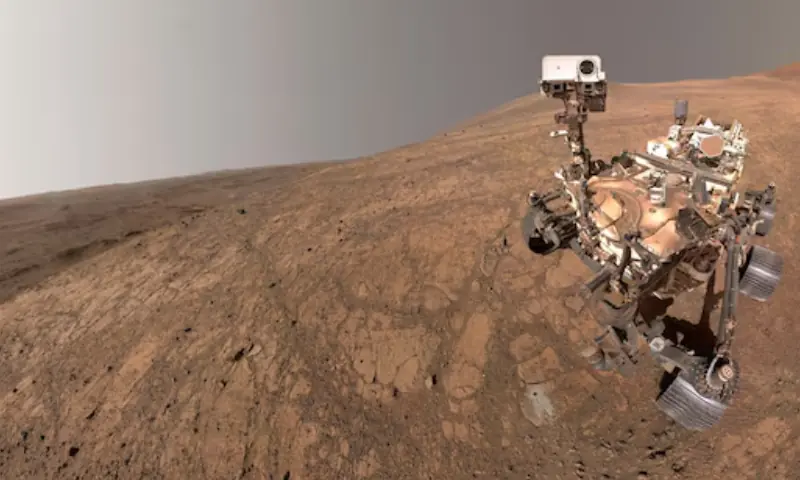

Using NASA’s Perseverance rover, scientists are getting a greater understanding of the nature of some of the organic carbon — the molecular backbone for all known living organisms — detected on Mars as they explore the question of whether Earth’s planetary neighbour ever harboured life.
New research describes the structure of the organic carbon found last year by the rover in sedimentary rock that contained a potential biosignature — a possible sign of past microbial life. This mudstone formed perhaps between 3.2 and 3.8 billion years ago beneath a now-vanished body of water in Jezero Crater in the Martian northern hemisphere.
Organic carbon can be a clue as to whether Mars ever harboured life because it serves as the chemical underpinning for the molecules that build DNA, cells and proteins. But its presence is not proof of life because it also can arise in nonbiological processes such as chemical interaction between rock and water.
The detection of organic carbon in two rocks in Jezero Crater — given the names Cheyava Falls and Walhalla Glades — was disclosed last year when the researchers announced the discovery of a potential biosignature in one of them.

The two rocks were sampled by the rover at locations about 330 feet (100 meters) apart, according to planetary scientist Ashley Murphy of the Planetary Science Institute in Arizona, co-leader of the new research published in the journal Science Advances

Following last year’s discovery, NASA released an image of the Cheyava Falls rock showing a very fine-grained and rusty-red-colored mudstone bearing ring-shaped features resembling leopard spots as well as dark marks resembling poppy seeds.
Such features on Earth can be associated with microbial activity. A potential biosignature is defined as a substance or structure that may have a biological origin but needs more data or further study before a conclusion can be made about the absence or presence of life.
A closer look for signs of life
Using Perseverance’s SHERLOC instrument, the researchers in the new study took a closer look at the complex carbon, called macromolecular carbon, present in the two rocks. They said this carbon bears similarities to carbon formed either through biotic or abiotic processes on Earth and to carbon formed through abiotic processes found in meteorites.
This marks the first instance of macromolecular carbon being discovered in mudstones in Jezero Crater, where Perseverance landed in 2021. NASA’s other rover operating on Mars, called Curiosity, previously found macromolecular carbon at another site called Gale Crater, located about 2,300 miles (3,700 km) away.
“These findings indicate that the habitability of Mars and the availability of organic materials may have been widespread across the planet billions of years ago,” said planetary scientist Kyle Uckert of NASA’s Jet Propulsion Laboratory in California and a co-leader of the study.
“This strengthens evidence that ancient Mars had chemical ingredients and environmental conditions that could have supported life, but does not provide proof of life, nor does it push the needle any further towards biotic or abiotic origins,” Uckert said.
The rover’s instruments do not have the capability to determine whether this carbon arose through biological processes possibly involving microbial activity.
“We need the return of these samples to Earth for more rigorous testing with higher sensitivity and higher resolution laboratory instruments,” Uckert said.
Now cold and desolate, Mars, during perhaps the first third of its existence, possessed a thicker atmosphere and warmer climate, allowing for liquid water on its surface. Like Earth and the solar system’s other planets, Mars formed roughly 4.5 billion years ago.
Water is considered a key ingredient for life — an important reason why Perseverance has been exploring Jezero Crater since 2021. This area of Mars once was flooded with water and home to an ancient lake basin. Scientists believe river channels spilt over the crater wall and created a lake. These bodies of water potentially could have been habitats for microbes.
“The only place in the universe where we know life has emerged is Earth,” Uckert said. “If life is discovered on Mars, it could indicate that the emergence of life is not restricted to Earth, assuming the right conditions and ingredients are available, which would be a profound discovery.”

