




US officials are concerned that any unfreezing of funds at this stage could remove a key leverage point over regime
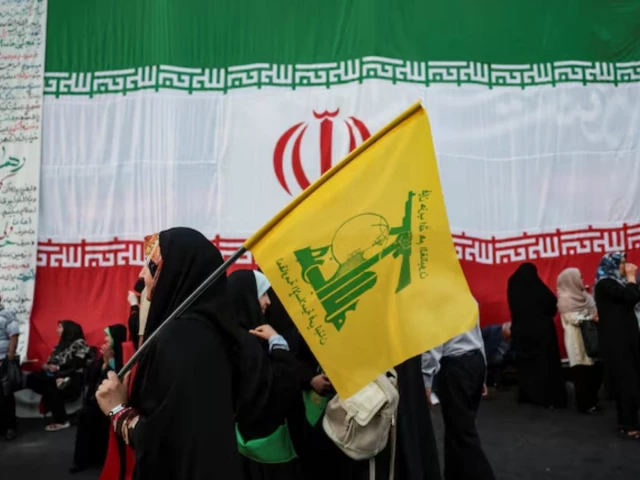
A woman holds a Hezbollah flag during a rally in support of Iran’s Supreme Leader, Mojtaba Khamenei, in Tehran, Iran, on June 4, 2026. West Asia News Agency via REUTERS
TEHRAN:

A potential peace deal between the United States and Iran hinges on the Trump administration agreeing to release $24 billion in frozen Iranian assets, a top Iranian official told CNN on Friday, warning that the US would “enter into a dark corridor” should it resume fighting.

“The negotiations are at a deadlock and (US President Donald) Trump must break this deadlock,” Mohsen Rezaei, military adviser to Supreme Leader Ayatollah Mojtaba Khamenei, told CNN in an exclusive interview in Tehran. “The ball is in Trump’s court.”
Iran has reportedly demanded the release of $12 billion in frozen funds as soon as once an interim agreement is signed with the US, and another $12 billion at a later stage.
US officials are concerned that any unfreezing of funds at this stage could remove a key leverage point over the regime.
Trump has demanded that any agreement appear far stronger than the nuclear deal struck in 2015, and to avoid anything that could be construed as handing over “pallets of cash,” a phrase he has invoked to criticize then-President Barack Obama’s decision to give Tehran financial compensation.
Iran’s military said on Friday it had fired “warning missiles” at two US destroyers in the Gulf of Oman, forcing the vessels to leave the area, according to state media.
It said the two destroyers left the Gulf of Oman “following the firing of warning missiles” by Iranian forces, according to a statement carried by state news agency IRNA.
The operation was in response to “maritime misconduct and harassment, as well as the hijacking of commercial vessels and oil tankers by the terrorist naval forces of the United States,” the military said.
The US military’s Central Command was quick to deny that the incident had taken place.
“Iranian forces did NOT attack or fire at US Navy warships. Doing so would be a gross violation of the ceasefire.”
It said its forces “continue to operate freely in regional waters” and were enforcing the US counterblockade on Iranian ports.
It is the latest episode to shake a ceasefire announced on April 8 that has largely halted hostilities between Iran and the United States as well as Israel following the outbreak of war on February 28, when allied forces targeted Iran.
Efforts to end the war through direct and mediated talks have so far failed.
US Secretary of State Marco Rubio said on Wednesday that Washington was “no longer conducting sustained strikes” against Iran as Operation Epic Fury, the US name for its attacks on Iran, was over.
He added that the United States had destroyed what Iran “had left of an air force” in addition to “wiping out their entire conventional navy”.
Iran has, since the onset of the war, imposed a naval blockade on the Strait of Hormuz, the strategic waterway connecting the Gulf with the Indian Ocean.
The United States later set up its own blockade of Iranian ports.
In peacetime, a fifth of the world’s oil used to pass through the chokepoint.
US President Donald Trump’s special envoy Steve Witkoff and son-in-law Jared Kushner traveled to the Oak Ridge National Laboratory in Tennessee on Thursday to consult with experts that could play a role in nuclear negotiations with Iran, a source familiar with the trip said on Friday.
The source, confirming an Axios report, did not provide additional details.
President Donald Trump is adamant that any deal to end the war with Iran include a provision that Tehran will not develop a nuclear weapon.
Iran is believed to possess about 900 pounds of highly enriched uranium that was at sites bombed by US planes a year ago. Tehran has been adamant that it must maintain the ability to enrich uranium and denies developing a weapon.
(With input from CNN)

