



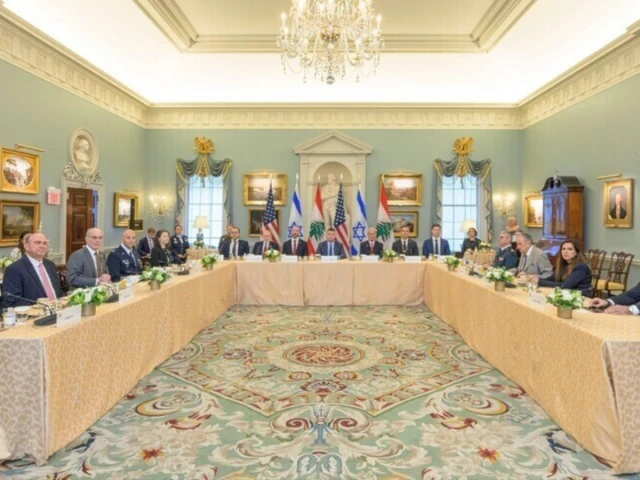

Ceasefire contingent on complete cessation of Hezbollah fire, evacuation of all operatives from South Litani Sector
Lebanon and Israel have agreed to renew their fragile ceasefire and establish “pilot zones” placing the Lebanese Armed Forces in exclusive territorial control, with all non-state actors excluded, according to a joint statement released on Wednesday.
“The ceasefire is contingent on a complete cessation of Hizbollah fire and the evacuation of all Hizbollah operatives from the South Litani Sector,” said the statement, which was released after the fourth round of US-mediated talks at the State Department.
The two sides agreed to “swiftly advance the creation of pilot zones in which the Lebanese Armed Forces will take exclusive control of the territory to the exclusion of all non-state actors,” the statement said.

“These steps will enable progress towards a comprehensive peace and security agreement,” it said.

The parties agreed to reconvene political and security tracks the week of June 22, with a view toward reaching a comprehensive agreement, it added.
The two countries also reaffirmed that they have “no hostile intent toward one another” and discussed a security framework which includes “the dismantlement of non-state armed groups, and the prevention of their re-emergence,” according to the statement.
The joint statement also condemned Iran’s attacks on countries in the region and its activities that “undermine stability throughout the Middle East, whether through support for proxies and all other acts of aggression.”
According to Lebanese sources speaking to Anadolu, the second and final day of the negotiations at the US State Department headquarters lasted more than six hours.
The talks follow weeks of near-daily Israeli strikes on Lebanon that have killed nearly 3,500 people since March 2, despite a ceasefire that took effect on April 17 and was later extended until early July.
The conflict recently saw an escalation as Israeli Prime Minister Benjamin Netanyahu ordered troops to deepen the incursion and called for strikes on Beirut.
Netanyahu, however, was allegedly restrained after a “tense phone exchange” with US President Donald Trump, according to media reports.
Hostilities continue
Earlier in the day, US President Donald Trump said he wanted to separate talks on the conflict in Lebanon and those on the war with Iran.
Tehran, however, insists the conflicts are linked and its Foreign Minister Abbas Araghchi warned that any attack on Beirut would trigger a “full-scale resumption” of war.
The Israeli military said it intercepted a “hostile aircraft” and two projectiles that crossed into Israeli territory from Lebanon on Wednesday.
Hezbollah, for its part, said that “in response to the Israeli enemy army’s violation of the ceasefire”, its fighters targeted soldiers in northern Israel with a rocket barrage.
Senior Hezbollah official Mahmud Qomati had told AFP on Tuesday that the group would “not accept a partial ceasefire”.
1 paramedic killed, another wounded as Israel targets ambulance in southern Lebanon
A paramedic was killed and another wounded early on Thursday in an Israeli strike targeting a medical team in southern Lebanon, according to Lebanon’s Health Ministry.
The ministry said the Israeli military targeted an ambulance team in the town of Zebdine in the Nabatieh district.
This was the fourth Israeli army attack on paramedics and medical facilities in less than 24 hours, it added.
The latest attack occurred at a time when Israel and Lebanon agreed to extend their fragile ceasefire and create “pilot zones” that would give the Lebanese Armed Forces sole territorial control and exclude all non-state actors during US-mediated negotiations in Washington, DC, on Wednesday.
Earlier, Lebanese and Israeli officials held a fourth round of US-sponsored talks in Washington, DC, aimed at preserving the ceasefire and addressing unresolved security issues.
Israel has continued near-daily airstrikes and ground offensives in Lebanon despite a ceasefire that took effect on April 17 and was later extended until early July.
According to Lebanon’s Health Ministry, Israeli attacks since March 2 have killed 3,516 people and injured 10,674 others across the country.
Israel continues to occupy several areas in southern Lebanon, including territories held for decades as well as areas seized during the 2023-24 conflict, while its forces have also advanced several kilometres into Lebanese territory during the current hostilities.
US House passes Iran war powers resolution in rare pushback against Trump
Four Republicans joined Democrats to pass the resolution in a vote of 215 to 208 in what has been seen as a rebuke of Trump’s decision to join Israel in attacking Iran beginning on February 28, as per Al Jazeera.
The vote marked the fourth time this year that the House of Representatives has voted on a war powers resolution to force Trump to seek congressional backing for his war against Iran.
It is the first time, however, that the resolution has been successful in the House.
‘Ceasefire’ violations
Since the US and Israeli strikes on Iran began on February 28, Tehran has repeatedly attacked targets in the Gulf region, home to US military bases.
Hostilities have periodically flared up in recent weeks despite a ceasefire agreed in early April, as the US has pushed to reopen the Strait of Hormuz, which handled roughly a fifth of global oil and liquefied natural gas shipments before the war.
Last week, Iran and the US signalled progress towards a tentative initial agreement to halt the war and reopen the strait, but the two sides have yet to sign off on the deal, which would leave more complex negotiations for later.
Read more: Deadly drone strike on Kuwait tests shaky ceasefire
Araghchi told Lebanese broadcaster Al Mayadeen on Wednesday that talks had not been cut off, but no progress had been made.
In addition to Tehran conditioning a deal on an end to fighting in Lebanon, it also wants access to billions of dollars in oil revenue, waivers on sanctions on crude exports, a lifting of a US blockade on its ports and continued leverage over the strait.
Trump, who is under pressure to bring down fuel prices, has said his top priority is to stop Iran from acquiring nuclear weapons. Iran says its atomic program is for peaceful purposes. In a podcast interview released on Wednesday, Trump said Iran had agreed not to have a nuclear weapon and that Khamenei was involved in negotiations.
Later on Wednesday, Trump suggested there could be progress in negotiations with Iran as soon as this weekend.
“If it happens, it could happen over the weekend,” Trump told reporters in the White House’s Oval Office, without elaborating on what he expected to happen within that timeframe.
Trump said that parties were working to separate the issue of reopening the strait from the conflict in Lebanon.

