



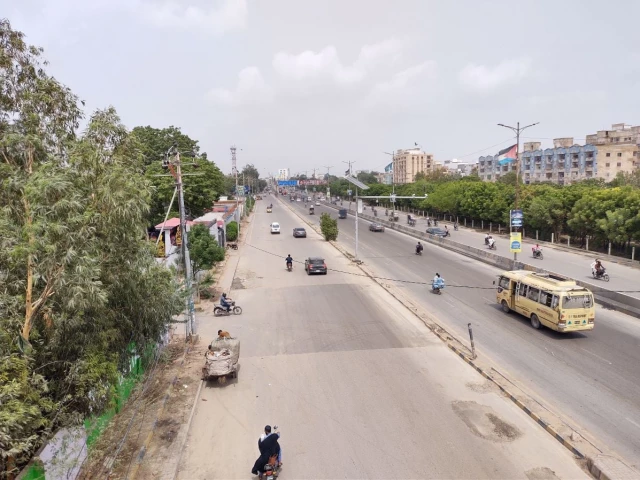

E-challans issued for violations as right lanes reserved for private vehicles and left for bikes, commercial traffic
Sharae Faisal, which spans approximately 14 kilometres, has been selected for the pilot project due to its importance as Karachi’s main traffic artery and the relative ease of monitoring compliance. PHOTO: ET
KARACHI:

Traffic authorities have formally launched an automated, faceless e-challan system on Sharae Faisal as part of a lane discipline enforcement plan aimed at improving traffic flow and reducing accidents on Karachi’s busiest artery.

Under the new system, vehicles violating designated lane rules are being automatically issued electronic challans. According to the traffic management plan, the two right-side lanes on Sharae Faisal are reserved for fast-moving private vehicles, including cars, jeeps and double-cabin vehicles, while the two left-side lanes are designated for motorcycles and commercial traffic.
Traffic police have set fines of Rs2,500 for motorcycles, Rs5,000 for private vehicles and Rs7,500 for commercial vehicles found violating lane restrictions.
Speaking to The Express Tribune, Deputy Inspector General (DIG) of Police (Traffic) Pir Muhammad Shah said the initiative aimed to ensure motorists remain in their designated lanes, thereby improving road safety and reducing traffic accidents.
“The primary objective is to enforce lane discipline so that each category of vehicle uses its designated lanes, improving overall traffic flow and safety,” he said.
Officials said the system was being implemented through a track-based monitoring mechanism. Commercial vehicles and motorcycles are required to strictly use the left lanes, while fast-moving private vehicles are barred from entering those lanes unnecessarily.
The right-most lane and the adjacent lane have been exclusively reserved for private vehicles to ensure smoother traffic movement along the corridor.
Sharae Faisal, which spans approximately 14 kilometres, was selected for the pilot project due to its importance as Karachi’s main traffic artery and the relative ease of monitoring compliance.
Traffic officials explained that the road includes both three-lane and four-lane stretches. On four-lane sections, the two right lanes are reserved for private vehicles, while the two left lanes are allocated to commercial vehicles and motorcycles.
DIG Shah said violations occur when commercial vehicles or motorcycles enter fast lanes, or when private vehicles unnecessarily shift into lanes reserved for commercial traffic.
He added that since Sharae Faisal had no U-turns or right turns, there was no operational need for motorcycles or commercial vehicles to use fast lanes. Slip roads and designated exits were provided on the left side of the road, while private vehicles heading towards Shahrah-e-Quaideen or Drigh Road are required to change lanes around 400 metres before their exits. He said the entire system operates automatically, reducing the need for manual enforcement.
Addressing concerns over vehicles without proper number plates, the DIG said such vehicles were more likely to violate traffic rules under the assumption that they cannot be tracked. To address this, traffic police have begun physical inspections at multiple points along Sharae Faisal at different times of the day.
Vehicles found without original registration plates will be temporarily impounded until compliance is ensured, while e-challans will also be issued.
Officials said lane discipline laws already exist, but enforcement had previously been weak. With the introduction of the automated system, authorities expect improved compliance, smoother traffic flow and a reduction in road accidents on one of the city’s busiest corridors.

