




WHO reports 906 suspected Ebola cases in Congo; confirmed cases rise to 282 with 42 deaths
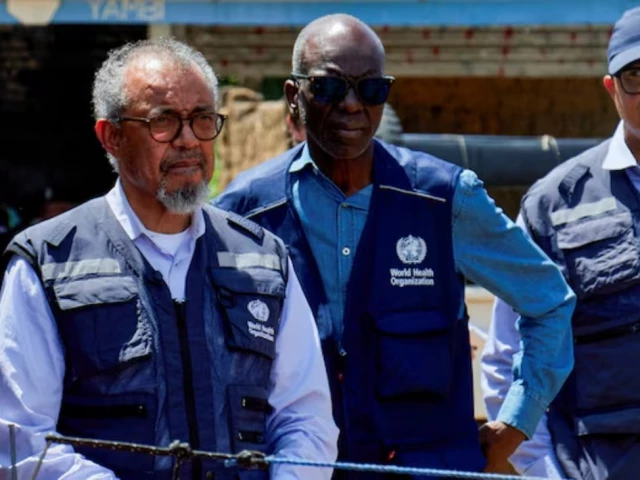
Director-General of the World Health Organisation (WHO) Tedros Adhanom Ghebreyesus tours the Evangelical Medical Center (CEM), one of the facilities at the forefront of the response to the Ebola outbreak during his visit to coordinate the response to the Ebola outbreak, as agencies intensify efforts to contain a new Ebola outbreak caused by the Bundibugyo virus strain, in Bunia, Ituri province, Democratic Republic of Congo, May 31, 2026. REUTERS
The head of the World Health Organisation (WHO) was due to meet with the Democratic Republic of Congo’s (DRC) president on Monday to discuss the country’s Ebola outbreak, which an aid agency warned was likely much larger than official figures reflect.
The outbreak, already the third-largest on record, persisted for weeks undetected, say health officials, who are now behind the curve and struggling to bring it under control.

Arriving in Congo last week, WHO Director-General Tedros Adhanom Ghebreyesus called for more international support to stop the disease’s spread before he travelled to Congo’s Ituri province, where the first cases were confirmed.

In a joint statement on Sunday night, the WHO and the Congolese government acknowledged it was “a challenging time” and that they were working to improve surveillance, testing and care for patients.
“Persistent challenges include early detection and isolation of cases, contact tracing, safe and dignified burials, robust infection prevention and control in health facilities, and strong community awareness,” the statement said.
I had the opportunity to meet with Lieutenant-General Johnny Luboya Nkashama, the Governor of Ituri, which is currently the province in the #DRC reporting the highest number of cases in the ongoing #Ebola outbreak caused by the Bundibugyo virus.
I want to express my appreciation… pic.twitter.com/PQaTMJtXRT
— Tedros Adhanom Ghebreyesus (@DrTedros) May 30, 2026
After flying back to Congo’s capital Kinshasa, Tedros was expected to meet with President Felix Tshisekedi at his residence before returning to Geneva, according to an official programme.
Outbreak likely larger than official figures show, IRC says
Read More: Worsening Ebola outbreak
The WHO said on Friday there were 906 suspected cases of Ebola in Congo, including 223 suspected deaths under investigation. And Congo’s government said late on Sunday the number of confirmed cases had increased to 282, with 42 deaths, after 19 new positive test results were recorded.
There have been 264 confirmed cases in Ituri province, as well as 15 in North Kivu province and three in South Kivu province, according to data distributed by the communications ministry.
Ebola cases have also been confirmed in neighbouring Uganda.
The International Rescue Committee (IRC), however, warned on Monday that the outbreak was likely significantly larger and more advanced than official figures suggest.
The aid agency said the virus may have been spreading for up to three months before the first official cases were detected in mid-May. And with only 20% of contacts currently being traced, it said, health authorities are struggling to identify and isolate new chains of transmission.
“When four out of five contacts are not being traced, it becomes incredibly difficult to contain the outbreak or even understand its true scale,” said Rachel Howard, IRC’s senior technical emergency health adviser.
While Congolese officials are well-versed in fighting Ebola, they have little experience with the Bundibugyo strain of the virus, which is responsible for the current outbreak and for which there is no approved vaccine.
Global health organisation CEPI will give roughly $60 million to Moderna and two other groups to accelerate the development of shots against Ebola Bundibugyo. It told Reuters it was possible to get vaccines against the strain ready for trials within a couple of months.
And China said on Monday it would send a team of medical specialists to Congo to assist with the outbreak.
Ebola recoveries offer hope in DRC as suspected cases emerge beyond Africa
Four nurses, who were being treated, have meanwhile been discharged from a hospital in Bunia after recovering from the disease, the WHO said on Sunday.
Four nurses who were being treated for Ebola caused by the Bundibugyo strain of the virus have been discharged from a hospital in Bunia after recovering from the disease, the WHO said on Sunday.
More recoveries are expected, especially when people are diagnosed early and able to access care, and as the response to the outbreak intensifies.
A laboratory worker had also recovered earlier this week, the agency said, bringing the total number of people who have recovered from the virus to five. However, suspected cases are being looked into in Brazil and Italy, tied to travel to affected nations.
Earlier this month, the WHO declared the outbreak caused by the rare Bundibugyo version of the virus in the DRC and Uganda a public health emergency of international concern, although it does not meet the criteria of a pandemic emergency.
Tedros, while on a Saturday visit to Bunia, the capital of the eastern Congolese province of Ituri, noted that although there currently is no licensed vaccine or treatment for Ebola caused by the Bundibugyo virus, “it is not without hope,” as it can be survived with good medical care.
Suspected cases outside Africa
The outbreak, the 17th in Congo and the third-largest since Ebola was discovered half a century ago, is outpacing the global response, which got off to a late start.
“The risk of regional spread is already happening,” Jean Kaseya, director-general of the Africa Centres for Disease Control and Prevention, said in an FT op-ed published on Sunday. It said that over 1,100 suspected cases are being investigated.
Also Read: WHO opposes travel curbs over Ebola spread
In Brazil, a man with a suspected case of Ebola in Sao Paulo tested positive for meningitis. Another suspected case emerged in Rio de Janeiro, where the patient tested positive for malaria, local health authorities said on Sunday. In neither case does the diagnosis rule out the possibility of Ebola, they said.
In the Sao Paulo case, a man from the DRC presented with a fever after recently visiting the African country, while in Rio, the patient had recently travelled to Uganda.
In Italy, protocols for a suspected case of Ebola were triggered in Sardinia’s capital, Cagliari, for a man who had flown back from Congo on Saturday with some symptoms, but the health ministry said early on Monday that he had tested negative.
“We confirm that the risk [of Ebola] in Italy remains very low,” the ministry said.

