
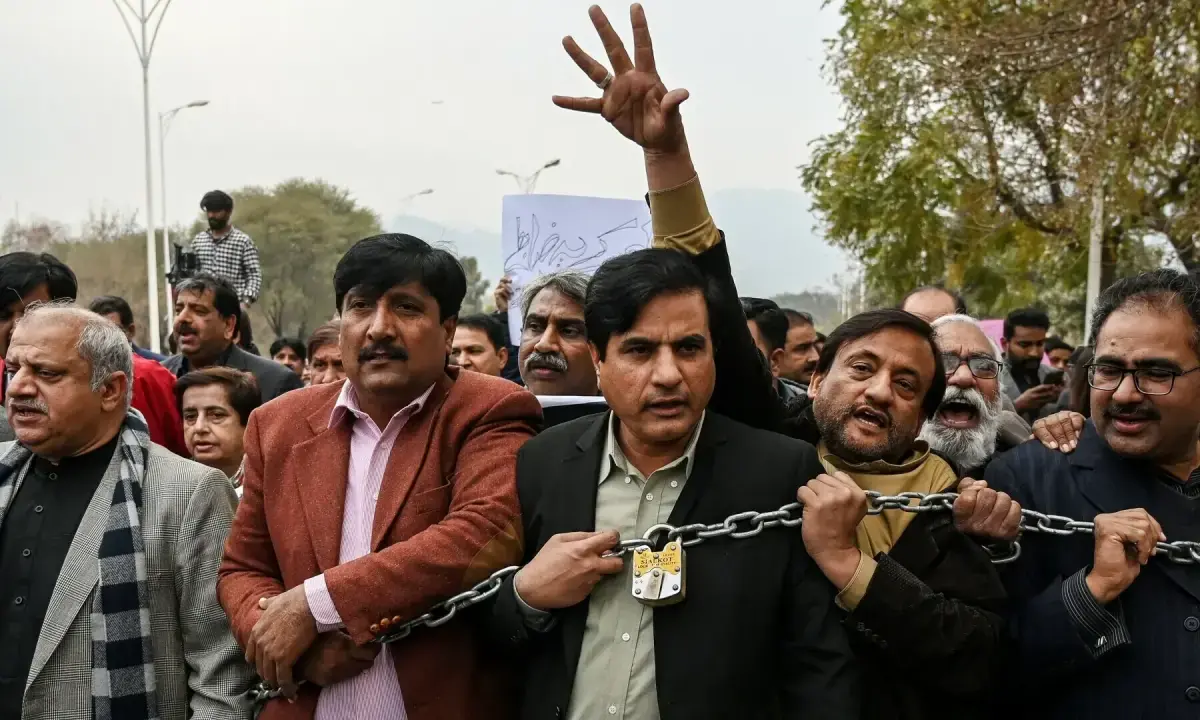

THE question should never be about who is at the receiving end at any given point in time: an assault on an individual or institution’s freedom is an assault on everyone’s freedoms. Last week, 600 journalists from all over the country lent their voice to a declaration rejecting a law that has unreasonably limited the constitutionally guaranteed freedom of speech granted to every citizen under Article 19.
Having gathered in Islamabad for a convention titled ‘Media Laws, Regulations and Ethics’, organised by the Pakistan Federal Union of Journalists (PFUJ) and the Rawalpindi-Islamabad Union of Journalists (RIUJ), Pakistani journalists and media practitioners have demanded that parliament review all laws affecting them that contradict Article 19, while formally rejecting the Peca 2025 amendments, which the Declaration terms “a draconian ‘black law’ specifically engineered to facilitate the arm-twisting of journalists and the suppression of Pakistan’s media landscape”.
The Declaration offers valuable insights into the state of Pakistani media today. Men and women who have dedicated their lives, their physical health and mental well-being, to championing the rights and interests of the public, feel they are constantly under siege. Their jobs are increasingly unsafe and no longer guaranteed; salaries that once represented middle-class stability have been eroded massively by breakneck inflation; the state refuses or fails to provide them with physical or economic security; and reputations built over years of dedicated work are now under constant attack by whoever disagrees with their views.
There is, therefore, much resentment against those seen as responsible for the difficulties journalists have been facing. The government, in particular, receives flak for taking advantage of the industry’s weakened economics to try to force the media to give up their principled positions through various means of coercion.

It is hoped that this Declaration can provide the impetus needed for journalists and media practitioners to coalesce around shared grievances and work towards solutions that will benefit them collectively. It is critical to challenge and push back collectively against legislative, economic and administrative tools used to limit the freedom of speech. In Islamabad, the community presented a unified front: it was a powerful, heartening moment.

One hopes it will not be remembered as a merely symbolic one. Building on the ‘Islamabad Declaration’, the industry must now collectively resolve to push parliament, along with other stakeholders such as civil society and the judiciary, to take up the demand to review laws repugnant to Pakistani’s constitutional rights.
A movement was launched against Peca last year by journalists and media practitioners. Unfortunately, it fizzled out due to a lack of sustained interest by the industry. This time, the industry must find allies, including among political parties, who are willing to push the agenda for civil liberties along with it more consistently.
Published in Dawn, May 25th, 2026