




Rubio on four-day India visit, to attend Quad summit with Japan, Australia and Indian counterparts
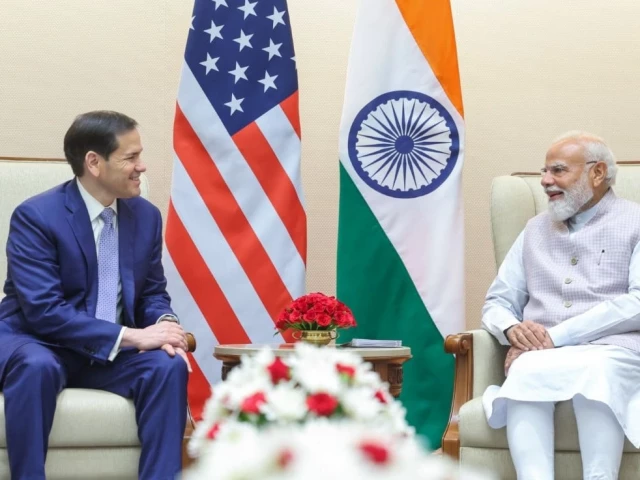
Indian Prime Minister Narendra Modi met with US Secretary of State Marco Rubio in New Delhi at May 23. PHOTO: MODI X POST
US Secretary of State Marco Rubio and Indian Prime Minister Narendra Modi discussed deepening bilateral ties in the national capital New Delhi on Saturday.
Rubio arrived in India early Saturday for his four-day trip to the South Asian nation.

Modi said he was happy to receive Rubio. “We discussed sustained progress in the India-US Comprehensive Global Strategic Partnership and issues related to regional and global peace and security,” Modi said through US social media company X.

Happy to receive the US Secretary of State, Mr. Marco Rubio.
We discussed sustained progress in the India-US Comprehensive Global Strategic Partnership and issues related to regional and global peace and security.
India and the United States will continue to work closely for… pic.twitter.com/CuD0DdDXB7
— Narendra Modi (@narendramodi) May 23, 2026
He said India and the US will continue to work “closely for the global good.”
US Ambassador to India Sergio Gor, who also joined the meeting, said they had “a productive discussion on ways to deepen US-India cooperation across security, trade, and critical technologies – areas that strengthen both our nations and advance a free and open Indo-Pacific.”
Gor added: “India is a vital partner to the United States!”
In another post, Gor said Rubio extended an invitation, on behalf of US President Donald Trump, for Modi to visit the White House in the “near future.”
Discussion on Middle East
A statement issued by Modi’s office said Rubio briefed the Indian prime minister on the “sustained progress” in bilateral cooperation across a range of sectors, including defense and strategic technologies.
Read More: Toffees and selfies: ‘Melodi’ duo steal spotlight at Italy-India talks
Rubio shared the US “perspective” on various regional and global issues, including the situation in the Middle East, it added.
Earlier in the day, after landing in the city of Kolkata, Rubio visited the Missionaries of Charity, founded by Mother Teresa.
Rubio wrote on X that Mother Teresa left a “tremendous legacy of compassion and service.”
In New Delhi, I met with Indian Prime Minister @narendramodi to underscore the importance of the U.S.-India relationship. We discussed the situation in the Middle East and U.S.-India partnership in energy, securing critical supply chains, and collaboration on emerging… pic.twitter.com/ehdaVlrwkS
— Secretary Marco Rubio (@SecRubio) May 23, 2026
“I was honored to visit the Missionaries of Charity today to pay homage to her legacy and to see the living example of the Catholic faith in action,” he said.
It is Rubio’s first trip to India, which will also include stops in the cities of Agra and Jaipur.
The top US diplomat is scheduled to hold talks with his Indian counterpart S. Jaishankar on Sunday and participate in the Quadrilateral Security Dialogue, commonly known as the Quad, next week.
The Quad, a partnership among the US, Australia, India, and Japan, was formed in 2007. The last Quad leaders summit was held in the US in 2024.
A US State Department statement ahead of the visit said the secretary will discuss “energy security, trade, and defense cooperation during meetings with senior Indian officials.”
In February, India and the US reached a framework for an interim agreement on trade to lower tariffs on Indian goods to 18% from 50%, half of which were linked to India’s buying of Russian oil.
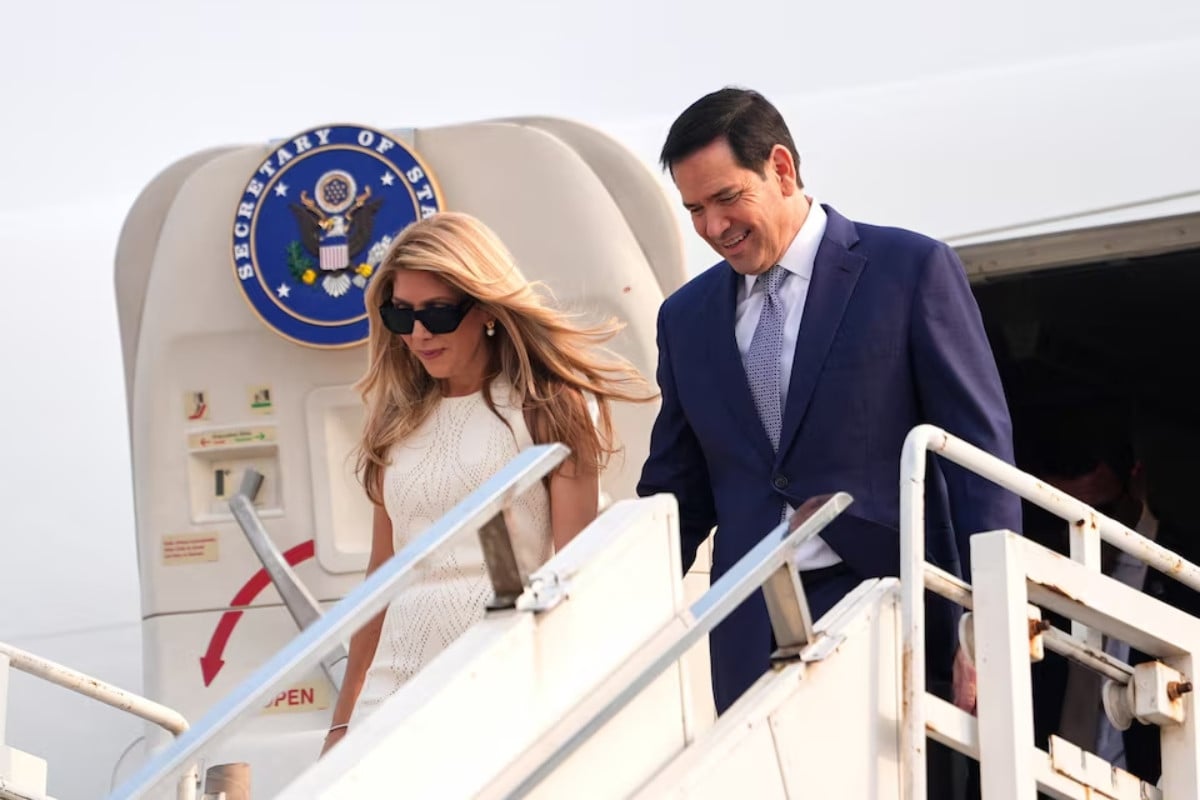
US Secretary of State Marco Rubio disembarks his plane with his wife Jeanette at Netaji Subhash Chandra Bose International Airport in Kolkata, India, Saturday, May 23, 2026. Reuters
A trip meant to repair ties
United States Secretary of State Marco Rubio arrived in India on Saturday on a mission to shore up a partnership battered by President Donald Trump’s tariffs and Washington’s renewed engagement with New Delhi’s rivals Pakistan and China.
US presidents, including Trump in his first term, have long tried to pull historically non-aligned India closer as a counterweight to Russian and rising Chinese influence in the Indo-Pacific. Those efforts appeared to take a blow last year when Trump slapped some of the highest US tariffs on India.
Rubio seeks to restore ties hurt by tariffs
Many of those were rolled back in an interim agreement, but the two countries are yet to finalise a comprehensive agreement on trade.
New Delhi has pressed for a Trump visit to India, tied to a summit of the Quad group of countries, which groups the US, India, Japan and Australia. But analysts say that it fell by the wayside amid trade tensions and distractions, including the US-Israeli war on Iran.
Read More: Pakistan remains primary interlocutor: Rubio
The US has meanwhile grown closer to India’s rival and neighbour Pakistan, with Islamabad emerging as a key interlocutor in efforts to end the war, a new irritant to the US-India relationship.
The energy crisis sparked by the war has also set back US efforts to wean India off Russian oil.
Rubio said on Thursday that the US was already in talks to expand its share of India’s energy supply.
“We want to sell them as much energy as they’ll buy,” he said. “There’s a lot to work on with India. They’re a great ally, a great partner. We do a lot of good work with them.”
For India, Trump’s visit this month to Beijing amplified concerns about US ties, said Basant Sanghera, a former State Department South Asia policy expert now with The Asia Group consultancy.
Sanghera said Trump’s approach had “created a perfect storm of anxiety” in India about the US relationship, “but ties have stabilised, and both sides are trying to build momentum in the areas that there is convergence.”
The Biden administration lavished attention on India as a vital strategic partner and feted Modi during a 2023 state visit. Trump also welcomed the prime minister to the White House early in his second term before imposing steep tariffs that threw ties off course.
Influential ambassador
US Ambassador Sergio Gor, dubbed “the India whisperer” by Michael Kugelman of the Atlantic Council think tank, arrived in New Delhi in January and has sought to reset ties. Gor is a friend of Trump’s and previously a White House adviser.
In February, the two countries reached a “framework for an interim agreement” on trade to lower Trump’s tariffs on Indian goods to 18% from a punishing 50%, half of which had been linked to India’s prior purchases of Russian oil.
But talks to finalise the deal slowed after the US Supreme Court in late February struck down Trump’s tariffs.
That effectively brought the duty rate on Indian goods down to 10%, but New Delhi has been weighing its options as the Trump administration pursues investigations under unfair trade practices legislation widely expected to restore much of the prior levies.
One person familiar with the talks said the US had been disappointed with India’s perceived foot-dragging and apparent belief that it could strike a good deal without giving much up, and this mood was likely to cloud Rubio’s efforts to stabilise ties.
“I do not expect Secretary Rubio will have much impact in changing the downward trajectory,” said Richard Rossow of the Centre for Strategic and International Studies think tank.
“The lack of a trade agreement, more than three months after the announcement of the ‘interim deal’, clouds other areas of engagement.”
India’s entreaties for the White House to schedule a Trump visit for a summit of the Quad, which was formed as a counter to China’s growing influence, have so far gone unanswered, according to another person familiar with the talks.
Rubio’s meeting with other Quad foreign ministers in Delhi next week will be the third such gathering without a leader-level engagement and effectively an “unannounced downgrade” of the grouping, Rossow said.
In a post on X, the US Embassy in New Delhi nevertheless emphasised the importance of the Quad, saying it stood “together for a free and open Indo-Pacific … From supporting regional security to diversifying critical minerals supply chains”.

