



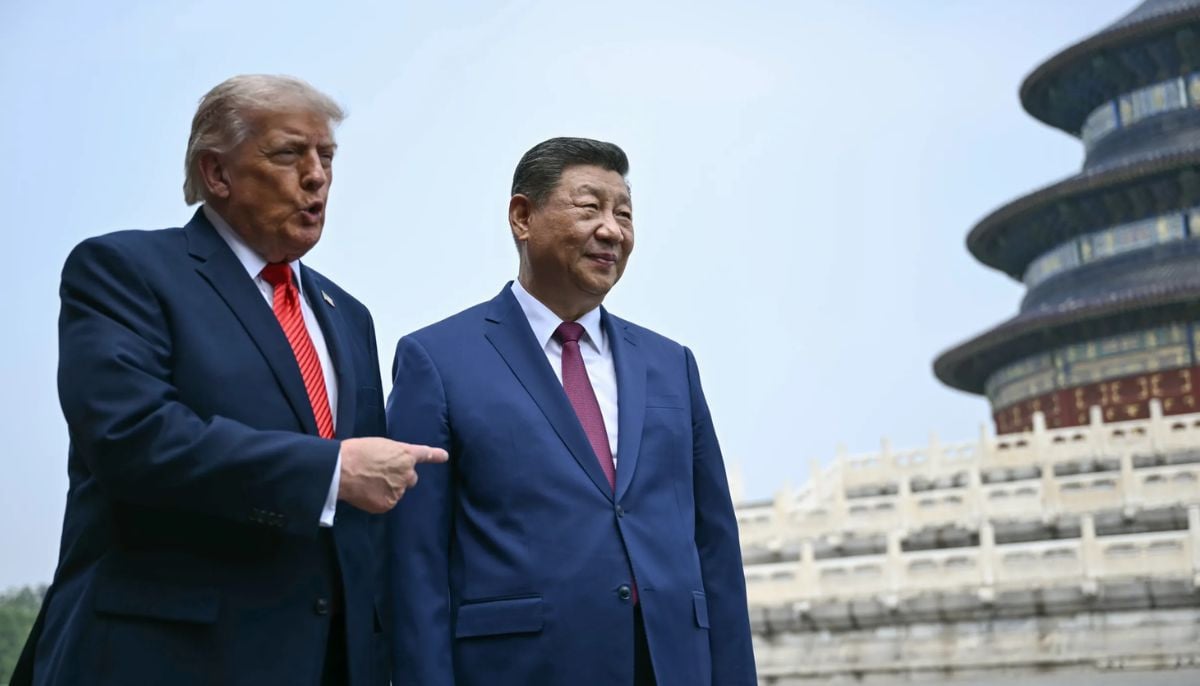

For years, the US and China relations are at the crossroads marred by geopolitical, economic, and diplomatic conflicts. After 9 years, both leaders of global superpowers are once again involved in highly-anticipated diplomatic talks.
President Trump is on a three-day state visit scheduled to conclude on May 15. This is his second state visit to the country; his previous visit took place nearly nine years ago, from November 8–10, 2017.
The high-stakes Xi-Trump summit taking place in Beijing has sparked the global debate over the “Thucydides Trap.” The historical theory posits that a rising power, China, and an established hegemon, the US, are structurally inclined to being involved in conflict.
Chinese President Xi Jinping, during a meeting with Donald Trump, has urged the American President to avoid the Thucydides Trap and call for international collaboration over various issues.

As reported by Chinese state broadcaster CCTV, Xi said in his opening remarks, “The world has once again reached a new crossroads. Can the U.S. and China transcend the Thucydides Trap and pioneer a new paradigm for major-power relations? Can we jointly respond to global challenges and bring greater stability to the world?”

“Can we, for the welfare of our peoples and the future of humanity, open a beautiful future for bilateral relations? These are historical, global, and people’s questions, and as leaders of major powers, we must together write the answers of our time.”
In his opening remarks, Trump not only called Xi a “great leader” but also asserted that the discussions in the summit will be “a very important one. The relationship between China and the U.S. will be better than ever.”
In the summit or upcoming meetings, both leaders are expected to cover discussions related to Iran, war, the Taiwan issue, trade issues, supply chains, and AI.
While the tone of the summit began with pageantry, experts point to three critical areas where the “trap” remains most dangerous. For instance, when talking about the Taiwan issue it is highly possible that China will resist changing any stance as Xi always warned that mishandling Taiwan could lead to clashes, “putting the entire relationship in great jeopardy,” Beijing’s foreign ministry said.
In terms of trade, a temporary truce in late 2025 capped tariffs at 30% have been reached, but structural competition persists.
In today’s summit, Xi talked about how economic or trade wars lead to losses with no “clear winner.”
“Our economic and trade teams produced generally balanced and positive outcomes. This is good news for the people of the two countries and the world,” Xi said, according to Chinese Foreign Ministry spokesperson Mao Ning.
“The two sides should jointly sustain the good momentum that we have worked hard to develop.”
Technology could be another roadblock that would perpetuate Thucydides Trap. In the competitive AI landscape, both countries are pursuing different strategies and policies when it comes to reigning in AI. The US seeks to safeguard its innovation ecosystem from China’s “intelligentized” military pivot.
According to Li, professor of political science at the University of Hong Kong’s Centre on Contemporary China and the World, “The US and China, as two superpowers in AI, need to take responsibility or a leadership role to discuss these very urgent, very important issues.”
Nuclear arms is also another treacherous territory to navigate. The US has always expressed a desire to open a dialogue on nuclear arms control, but Chinese officials have been reluctant over this issue. Now there is a high possibility that China’s stance will not change over the nuclear issue even in this summit.

