



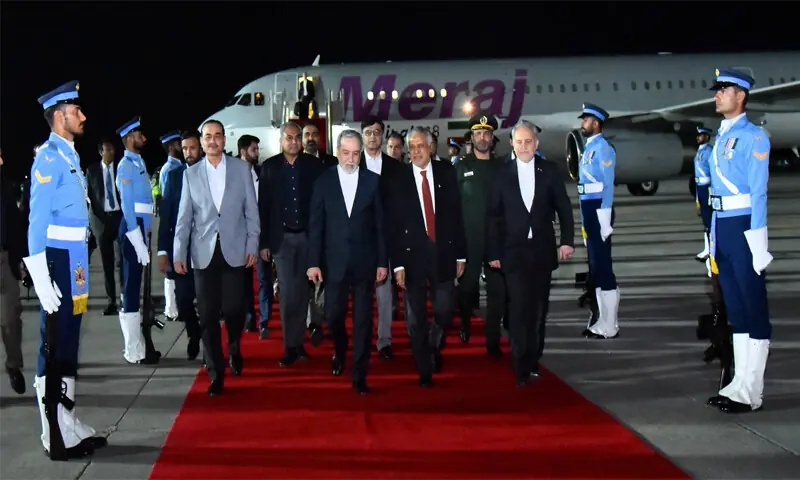

• Iranian foreign minister arrives in capital late on Friday, set to visit Oman, Russia next
• Will hold meetings with political, military leadership; expected to convey Tehran’s response to US messages
• White House says Kushner, Witkoff set to travel to Pakistan; Vance ‘on standby’
ISLAMABAD: Iranian Foreign Minister Abbas Araghchi arrived in Islamabad late on Friday — carrying Tehran’s formal response to proposals conveyed earlier by the US through Pakistan — as renewed diplomatic activity gathered pace and US envoys Steve Witkoff and Jared Kushner prepared to travel to Islamabad.
Even so, prospects for direct engagement between the two sides remain uncertain.
The Iranian foreign minister was received by Deputy Prime Minister and Foreign Minister Ishaq Dar and Chief of Defence Forces Field Marshal Asim Munir, according to a Foreign Office statement issued late on Friday night, indicating the importance the Pakistani side attaches to the visit.

“During the visit, the Iranian foreign minister will hold meetings with Pakistan’s senior leadership to discuss the latest regional developments as well as ongoing efforts for regional peace and stability,” the statement said.

The visit comes at a delicate moment in the US-Iran standoff, with a fragile, indefinitely extended ceasefire holding on paper, while core disputes over the naval blockade, nuclear restrictions and sequencing of concessions remain unresolved.
“Purpose of my visits is to closely coordinate with our partners on bilateral matters and consult on regional developments. Our neighbors are our priority,” Araghchi said in a post on X before departing Tehran for a three-country tour, that also includes stops in Oman and Russia.
Pakistani officials said the Iranian minister’s trip was primarily aimed at conveying Tehran’s considered response after internal consultations.
The proposals had been handed over last week by Field Marshal Munir during his visit to Tehran, where he had carried messages from Washington as part of Islamabad’s mediation effort.
Diplomatic contacts intensified ahead of the visit. Abbas Araghchi held separate telephone conversations with Dar and Field Marshal Munir, focusing on the ceasefire and the diplomatic track. According to the Foreign Office, Dar “underscored the importance of sustained dialogue and engagement to address outstanding issues.”
It was after these exchanges that Pakistani government sources indicated that Araghchi was travelling to Islamabad and that there was a possibility of a second round of talks in Islamabad. The officials emphasized that logistical preparations were quietly under way and a US advance team was already present.
However, signals from Tehran remained cautious. An Iranian official, speaking to Dawn on background, said negotiations with US would remain on hold unless Iran’s conditions were met, particularly regarding lifting of the US naval blockade, which Tehran says is a precondition for a meaningful dialogue.
Though Moscow came into spot light with Araghchi announcing that Russia was part of his regional tour, Dar too during the day spoke to his Russian counterpart Sergey Lavrov.
The Foreign Office, in a statement on the conversation, said “FM Lavrov appreciated Pakistan’s constructive role in facilitating dialogue between Iran and the United States.”
Dar, according to the statement, “underscored Pakistan’s resolve to continue contributing to efforts aimed at promoting dialogue and diplomacy to resolve all issues.”
Later in the evening, the White House confirmed that Special Envoy Steve Witkoff and Jared Kushner would travel to Islamabad to “engage in talks” facilitated by Pakistan.
“The Iranians reached out … asked for this in person conversation, so the president is dispatching Steve and Jared to hear what he has to say,” spokesperson Karoline Leavitt said.
US officials, however, indicated that Vice President JD Vance would not immediately join the delegation, citing the absence of his Iranian counterpart, parliament speaker Mohammad Bagher Ghalibaf.
Vance, they said, remains on standby and could travel if negotiations show progress, while members of his team are expected to be present in Islamabad.
Despite these parallel movements, there is little clarity on whether direct face-to-face talks will take place. Iranian officials have consistently maintained that engagement under pressure, particularly amid the ongoing maritime blockade and recent vessel interdictions, is not acceptable.
During the day, US media suggested that lead Iranian negotiator Bagher Ghalibaf had quit after differences with the leadership on the negotiations strategy.
But hours later, Iranian parliament’s communications section denied the claim saying Ghalibaf had not resigned and that he did not travel to Pakistan because negotiations with US had not been scheduled as yet.
The current phase follows the first round of direct talks held in Islamabad on April 11 and 12, which ended after more than 20 hours without agreement but kept the diplomatic channel open.
Since then, exchanges have continued indirectly through Pakistan, with both sides calibrating positions while avoiding a formal breakdown.
The ceasefire, originally brokered around April 7 and 8, has been extended without a defined timeline, creating space for diplomacy but also prolonging uncertainty. Officials in Islamabad described the situation as fluid, with mediation efforts focused on bridging the sequencing gap between US demands and Iranian preconditions.
Published in Dawn, April 25th, 2026

