



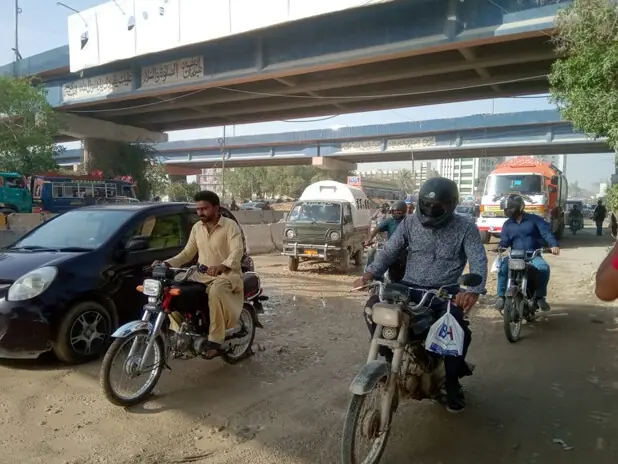

THERE are roads that are inconvenient, and then there is University Road — a legendary stretch of mostly dirt, rocks and some tarmac – that seems determined to test not just one’s patience, but endurance, judgement, and at times, even sanity.
A recent journey along this arterial route left me with the unmistakable impression of having entered a war-ravaged landscape, where the casualties are not counted in numbers but in hours lost, nerves frayed, and routines disrupted.
If we stick to the battlefield analogies, here water tankers replace tanks, and relentless digging stands in for artillery shelling.
Beginning my journey at Jail Chowrangi, I head towards Safoora Chowrangi. With the veneer of tarmac stripped away, I see the road’s true face: fractured surfaces, uneven patches, and dust that hungs stubbornly in the air.

A road that, until a few years ago, comfortably accommodated four to five lanes of traffic has, in several places, been reduced to less than a single functional lane.

On Sharea Faisal, the drive is smooth and uninterrupted. But on University Road, it feels as if my flight has been abruptly thrown into violent turbulence. Not even a kilometre in, and fatigue has already begun to set in
Progress towards my destination was slow. Where stagnant water blocked what remained of the navigable surface, drivers had to inch ahead with calculated caution, while motorcyclists gingerly navigated such patches for fear of spoiling their clothes.
The comparison — even with other thoroughfares in the metropolis — is stark. Only moments earlier, I had been travelling along Sharea Faisal. Here, the drive was smooth and uninterrupted. Traffic flowed with a degree of rhythm and predictability. Not so on the ill-fated University Road.
Here, my journey felt like a flight abruptly thrown into violent turbulence. Not even a kilometre in, and fatigue had already begun to set in.
My experience is far from unique. Thousands of commuters endure this reality daily. Those travelling from Sharea Faisal through Shahrah-i-Quaideen and Tariq Road to reach University Road encounter, within a single commute, two binaries of urban life.
On one end, there is structure, flow, and discipline; on the other, there is fragmentation, obstruction, and uncertainty. The transition is so abrupt that it borders on the absurd.
The 13-kilometre stretch from Jail Chowrangi to Safoora Chowrangi, which under ordinary circumstances should take no more than 20 minutes to traverse, consumed over 70 minutes. This is not merely a matter of inconvenience; it represents a significant loss of productive time on a daily basis for thousands of citizens.
Crossing the road presents its own challenges. Pedestrians must first navigate one track, then climb the uneven and often hazardous passage across the under-construction Bus Rapid Transit Red Line corridor, before attempting to cross the second track. It feels less like crossing a road and more like navigating an obstacle course — without the luxury of a second attempt.
Seemingly ongoing construction work further complicates matters. Water pipelines, sewerage installations, and excavation sites appear intermittently along the route, showing how the project is both everywhere and nowhere, in terms of completion.
The disappearance of service roads has compounded the problem, leading to severe parking constraints and forcing vehicles onto the already constricted main carriageway.
The absence of functional U-turns and the erosion of service infrastructure have also contributed to the rise of wrong-way driving — not out of disregard for rules, but out of necessity. In several sections, the road narrows to such an extent that only one vehicle can pass at a time.
For students, the situation is particularly concerning. Despite the presence of major institutions such as Federal Urdu University of Arts, Sciences and Technology, NED University of Engineering and Technology, University of Karachi and many other private institutes along the corridor, there are no adequate pedestrian crossings, functional signals, or traffic-mitigation measures.
As a result, students are compelled to cross the road in hazardous conditions, often running between moving vehicles — a daily risk that has, alarmingly, become normalised.
In the digital sphere, University Road has become a recurring subject of satire. Social media users frequently draw ironic comparisons — noting, for instance, that even the Strait of Hormuz appears to have been “cleared” more efficiently than this road. Others suggest, with weary humour, that its completion could be expected by 2099.
The humour of these observations belies the trauma that it inflicts on an entire generation, and reflect a deeper frustration with the pace of urban development and governance.
Sentiments such as the refrain: “My life was going quite well — then I found myself on University Road” tend to stay with you.
For those who traverse this route regularly, this is lived experience. For occasional users, the experience is disruptive. And for those not from Karachi or familiar with the importance of University Road, it has become the ultimate anecdote of civic failure.
Published in Dawn, April 25th, 2026

