

Starmer faces backlash over Mandelson envoy pick, raising doubts about leadership grip
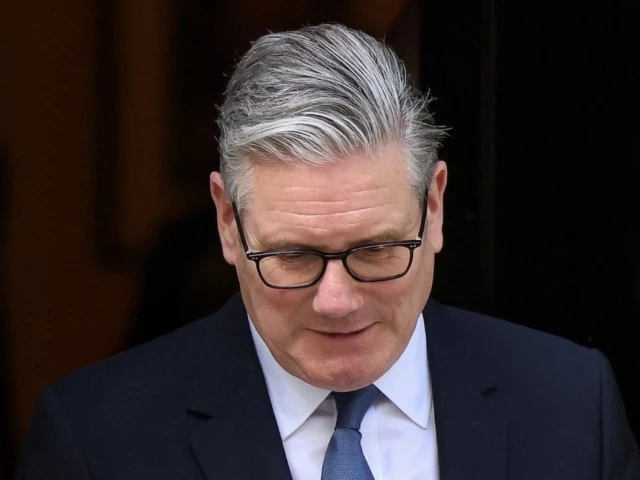
ritain’s Prime Minister Keir Starmer steps outside 10 Downing Street to welcome Council of Europe Secretary General Alain Berset, in London, Britain, April 22, 2026. REUTERS
Prime Minister Keir Starmer came to power on a promise to govern Britain efficiently after years of political turmoil. Less than two years later, accusations that his office forced through a key appointment have shattered that image of competence.
Embroiled in a scandal over his decision to appoint Labour Party veteran Peter Mandelson to Britain’s top diplomatic post as ambassador to the United States, Starmer’s grip on power appears to be slipping and his leadership skills are in question.

Starmer’s office denies allegations made by Britain’s former top foreign ministry official, Olly Robbins, that it put pressure on his team to accelerate Mandelson’s appointment last year.

But Robbins’ testimony to a parliamentary committee on Tuesday, days after he was sacked, has exposed what Starmer’s opponents say is a lack of political instinct and intensified critics’ doubts about how he runs his office.
Three people close to his Downing Street operation told Reuters there had been an over-reliance on a small group of trusted advisers that meant Starmer, who once vowed to “end the chaos of sleaze”, had been blindsided by outside events and become detached from his party and the public.
Read More: Starmer seeks to deflect blame over Mandelson appointment
“Starmer presented himself as if he was going to be holier-than-thou and at least competent,” Chris Hopkins, political research director at polling firm Savanta, told Reuters.
“When you lose what are your main selling points, you don’t have much left.”
Constant pressure over appointment
Starmer appointed Mandelson, 72, who served as a minister when Labour was last in power more than 15 years ago, in late 2024, hailing his “unrivalled experience to the role”.
He sacked him last September after a trove of emails revealed the depth of Mandelson’s ties with the late convicted US sex offender Jeffrey Epstein. British police arrested Mandelson in February on suspicion of misconduct in public office, but he has not been charged. He does not face allegations of sexual misconduct.
While Starmer may have hoped sacking Mandelson marked the end of the political saga, last week he said information had come to light that a vetting body had advised against the appointment in the first place.
Robbins confirmed on Tuesday that Starmer had not been told about the vetting advice. But he said Downing Street had conveyed “a very, very strong expectation” that Mandelson should be appointed quickly.
“I think throughout January (2025), honestly, my office, the foreign secretary’s office, were under constant pressure,” Robbins said, recalling the “frequent phone calls” from Starmer’s private office. He described himself as a “scapegoat”.
Starmer’s spokesperson rejected Robbins’ allegations, saying there was a distinction between applying pressure and being kept informed.
The war of words is a long way from Starmer’s early days in office, however, when he pledged to “restore honesty and integrity to government”.
“Process and procedure and doing things properly matters to me,” he said.
Starmer quickly came under fire from the public for what was widely seen as a lack of charisma and a slowness to act, more keen on initiating reviews before implementing legislation to deliver the change his party had promised before the election, when Labour ended 14 years of Conservative government.
The three sources close to Downing Street, who spoke on condition of anonymity, said Starmer had initially relied on a small group of trusted advisers who acted as “gatekeepers”, often deciding what he did or did not have time for.
Many of those advisers have since left, most notably his chief of staff Morgan McSweeney, a protégé of Mandelson who resigned in February to take responsibility for the whole affair, and Starmer now meets more regularly with Labour lawmakers who previously objected to his “bunker mentality”.
One source said Downing Street was now more functional than six months ago.
But it may be too little, too late.
“It’s terminal,” said one Labour lawmaker, although they said there would be no immediate move to oust Starmer largely because “colleagues are terrified of the unknown”.
Also Read: UK PM Starmer faces parliament over Mandelson vetting as resignation demands swirl
A spokesperson for Starmer said the government was focused on delivering for working people, including helping to tackle the cost of living and cutting waiting times in the state-run health service.
Small group of advisers
Starmer has repeatedly expressed anger over the Mandelson saga, and members of his team support his self-portrait of being incandescent over not being told about the security vetting body’s advice.
Those closest to him say it also runs against how he operates, running his office methodically and never taking decisions “on a whim”.
Once Britain’s former top prosecutor, Starmer sees it as a strength to be able to listen and change his mind when needed.
Instead, policy U-turns, including several reversals on welfare, have been held up by commentators and even his own lawmakers as proof of his weakness.
But his former reliance on a handful of advisers may prove to have been his biggest weakness. One source said he explicitly trusted his advisers to do the right thing, yet since taking office in July 2024, he has lost more than 10 of them, including two chiefs of staff and four directors of communication.
A second Labour lawmaker, who served under former prime ministers Tony Blair and Gordon Brown and asked not to be named, said Starmer and his team had thought they did not need input from the wider party.
Starmer appears to have few defenders left in Labour, and the questions over his judgment in appointing Mandelson, twice sacked from cabinet under Blair and whose friendship with Epstein was known, are unlikely to stop any time soon.
More documents relating to the appointment are expected to be released after local and regional elections on May 7, when Labour looks set to suffer large losses at the hands of the populist Reform UK party led by Brexit veteran Nigel Farage.
“Labour and Starmer are now seen as more of the same as before,” said Hopkins. “And that is going to be almost impossible for him to recover from.”