Representatives from Pakistan’s fan industry seek policy interventions during meeting with finmin

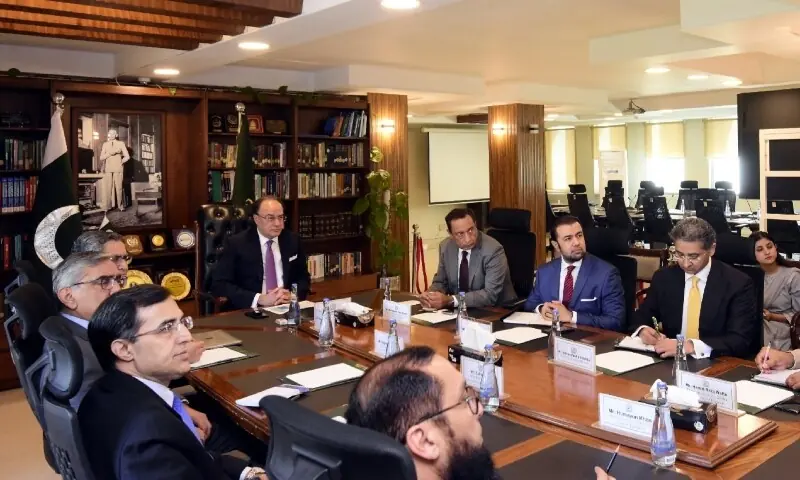

ISLAMABAD: The country’s fan industry on Monday sought policy interventions to reduce the export of its raw materials for balanced value addition, greater quality exports and energy-efficient fans in the country.
They also recommended interventions that could enable financing and energy efficiency initiatives during a virtual meeting with Finance Minister Muhammad Aurangzeb.
The group of representatives from the electric fan industry was led by members of the Federation of Pakistan Chambers of Commerce and Industry (FPCCI) and the Pakistan Electric Fan Manufacturers Association (PEFMA). The group highlighted sectoral challenges, export potential, and avenues for policy support.
According to an official statement from the finance ministry, Aurangzeb reiterated the government’s commitment to undertaking focused consultations with individual sectors to better understand their operational landscape and support their growth.
The group provided an overview of the structure and economic significance of the fan industry, highlighting that it was a fully indigenous manufacturing sector with around 300 manufacturers concentrated in Gujrat and Gujranwala.

“The industry contributes significantly to employment, with approximately 40,000 direct and over 150,000 indirect jobs, and maintains a strong value addition profile. Members also shared insights into the sector’s export footprint, particularly in the Middle East and Africa, while noting recent trends in export performance,” the handout said.
Discussions also focused on the sector’s transition towards energy-efficient DC (direct current) fan technology. The group highlighted its capacity and readiness to support large-scale replacement of conventional fans, with potential implications for reducing electricity consumption. In this context, the finance minister noted that while the policy framework was in place, greater traction would require enhanced awareness and improved coordination with financial institutions. He emphasised the importance of addressing implementation gaps to accelerate adoption, the statement said.
Access to finance for capacity expansion was also discussed, particularly in the context of scaling up production to meet potential demand under energy efficiency initiatives. The finance minister underscored the importance of facilitating investment in productive capacity and noted that existing financing frameworks would be reviewed to better align with sectoral requirements, the statement added.
During the discussion, members of the group drew attention to a number of structural and policy-related matters affecting the sector, particularly in relation to the availability and utilisation of key raw materials such as copper and aluminium.
“It was noted that increased exports of these inputs in raw form have had implications for domestic value-added manufacturing, and the need for a balanced approach that promotes higher value addition within the country was emphasised,” the statement said.
Matters relating to small or medium-sized enterprise liquidity, including the processing of tax refunds, export facilitation mechanisms, and tariff structures on inputs, were also deliberated. Aurangzeb emphasised that ongoing reforms were aimed at rationalising input costs and improving the overall business environment, while encouraging the industry to share specific details for further review, the handout said.
The discussion further touched upon opportunities for expanding market access and enhancing the competitiveness of the electrical appliances sector through targeted policy support and innovation.
In his remarks, Aurangzeb underscored that sustainable export growth was contingent upon a combination of competitiveness, scale, and policy consistency.
“He noted that while taxation remains an important element, access to finance, energy efficiency, and market development are equally critical to strengthening industrial performance. He encouraged continued engagement between the industry and relevant government stakeholders to refine practical and forward-looking proposals,” the statement said.
He also highlighted the importance of promoting energy-efficient technologies and noted that improving awareness and implementation of existing initiatives would be essential to achieving intended outcomes.
Concluding the meeting, the finance minister reaffirmed the government’s commitment to supporting value-added manufacturing and export-oriented sectors. He emphasised that sustained dialogue with industry stakeholders would remain central to policy formulation and economic planning.