



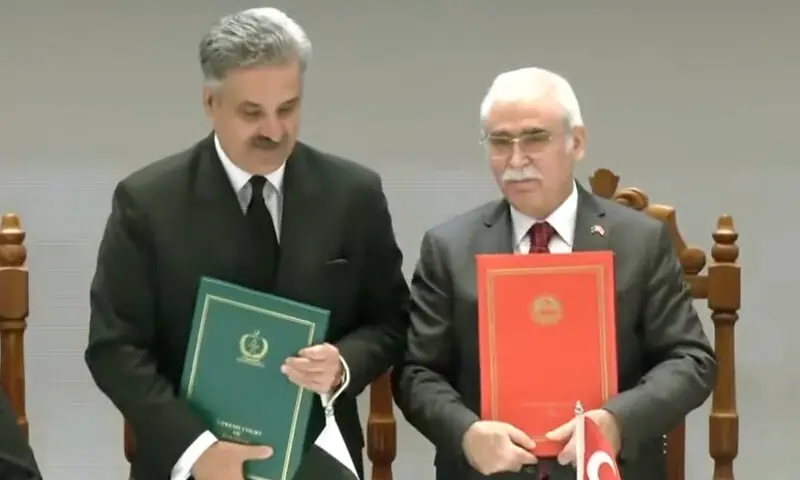

The Supreme Court on Monday signed a memorandum of understanding (MoU) on judicial cooperation with Turkiye’s Constitutional Court.
On Sunday, the SC said it will be hosting a high-level delegation from Turkiye’s Constitutional Court from April 6 to 9, led by its president Kadir Özkaya, for the signing of an MoU.
The agreement was signed at a ceremony held at the Supreme Court in Islamabad attended by Chief Justice of Pakistan (CJP) Yahya Afridi and Özkaya.
Addressing the ceremony before the signing, CJP Afridi expressed hope that the agreement will “provide a forward-looking framework for collaboration between the two judiciaries”.

“One that emphasises the exchange of judicial knowledge and best practices, the promotion of comparative constitutional jurisprudence, strengthening of institutional linkages and the advancement of capacity building through joint programmes, research, and judicial exchanges,” CJP Afridi said.

He noted that under the MoU, a joint working group comprising judges from the Federal Constitutional Court (FCC) and SC would be formed, which “will ensure our cooperation remains active […] rather than remaining symbolic”.
CJP Afridi noted that the delegation’s visit reflected the “enduring, historic, fraternal relationship between Pakistan and Turkiye — one that transcends formal diplomacy”.
He maintained that the MoU was not only a “simple document of cooperation between courts, but it also represents our shared vision and resolve to strengthen constitutional governance, uphold the rule of law, ensure judicial independence and protect fundamental rights”.
Justice Afridi stressed that judicial institutions cannot function in isolation, adding that “common challenges such as rapid technological change, evolving understanding of rights, and complex constitutional questions require us to engage in global judicial conversation”.
He was of the opinion that with the help of such agreements, “courts learn from each other and strengthen their collective capacity to deliver justice”.
Concluding his address, CJP Afridi expressed hope that the MoU will “pave the way for deeper understanding, meaningful exchanges, and a lasting partnership between our two judiciaries”.
As per SC’s Sunday statement, a central feature of the proposed cooperation was the professional development of the judiciary, particularly at the district level, through joint training programmes, academic exchanges, and exposure to comparative judicial practices.
“The collaboration is also expected to support the integration of modern technologies in judicial processes, aimed at improving efficiency, transparency, and accessibility of justice,” it said.
According to the handout, the delegation, during the visit, is also expected to engage in high-level institutional interactions, alongside engagements with key justice sector stakeholders.