



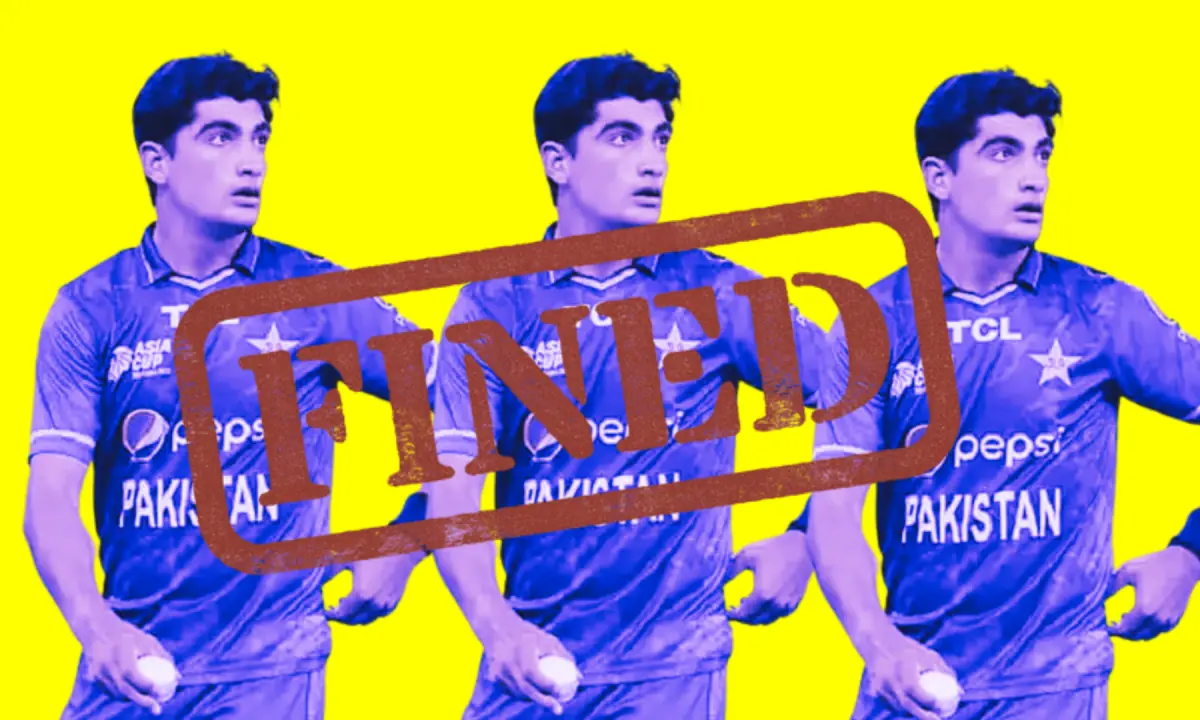

On March 30, the Pakistan Cricket Board (PCB) slapped a Rs20 million fine on fast bowler Naseem Shah for a post that was promptly deleted from his X account, and for which he publicly apologised.
The tweet, posted from Shah’s official X account, had quote-tweeted the PCB’s post, which featured Punjab Chief Minister Maryam Nawaz being welcomed by the interior minister and the cricket board’s chairman, Mohsin Naqvi, at the opening ceremony of the Pakistan Super League.
Those who follow Shah on the social media platform saw the tweet and instantly knew trouble would follow. Within a short span of time, they saw the tweet disappear, followed by a new post clarifying that the account had been hacked.
Quick recovery of a hacked account, they thought.

The cricketer subsequently fired his social media manager and even tendered an apology via X. However, for a post that was probably up for all of 10 minutes and was followed by a disclaimer, the PCB issued a show-cause notice to Shah along with disciplinary proceedings and a whopping fine.

The board cited violations of various clauses of his central contract and social media code. The fine was estimated to be equivalent to eight months of the cricketer’s annual income and has since made global headlines.
Who posted?
One of the early questions raised amid the fiasco was whether the tweet was posted by Shah or his social media manager. If it was the former, why was the social media manager fired and blacklisted by the PCB? And if it was the social media manager who did it, why was the cricketer fined?
Whoever posted it — Shah, the manager, or a third party — liability typically lies with the account holder.
Over the past few years, it has become common practise for social media managers to run accounts or, at an organisational level, for multiple people to have access to and post from official accounts. But come time for heads to roll or consequences to set in, it is always the person in whose name it is who faces the music.
Sometimes things are done accidentally; the way many apps work is that you have to switch between your private account and the one you are managing, and this sometimes ends up in errors. But error or deliberate, either way, the consequences can be dire.
The cricketer vs the citizen
Much has been spoken about contractual violations committed by Shah, but what clauses exactly did he violate in this instance? The PCB did not elaborate.
Many argue that such a tweet should not have been posted from the fast bowler’s official account. As a professional cricketer, political leanings or views should not be expressed, they contend. This is yet another extension of the corporatisation of society, where people are expected to be apolitical or at least refrain from expressing their views. Many organisations police such expressions of employees as well, and the consequences result in punitive action.
There are some merits to codes of conduct and organisational policies with respect to official account management, and to maintain a respectful and safe work environment. But the organisational policing of expression through personal accounts that are public is a fine line.
Since October 7, 2024, many companies across the world have fired employees for expressing outrage against the ongoing genocide in Gaza. Should an individual not have the right to express their views? Is punitive action in response to it, because it goes against the leanings of the organisation or those running the show, justified?
While corporate codes are now the norm, embedded as the done thing in the collective psyche, they are antithetical to the social and political evolution of society and individuals. Political expression can be polarising and uncomfortable, but it is the very same expression that is also necessary to speak truth to power.
Most are looking at this through the lens of Shah, the cricketer, but what about Shah, a citizen of Pakistan? Is he not entitled to hold and express an opinion about not just a public figure but someone who is a government official?
There is much conjecture about Shah being spared a two-year ban instead. For what? A social media post about a public figure, simply asking why she is treated like royalty? Should an opinion — framed as a question, such as we read in the now-deleted tweet — be subjected to such censure or fine? Is a 20-million rupee fine not excessive and disproportionate?
Climate of silencing
The message the fine sends out, that too after an apology was tendered: fall in line, or else. Despite a retraction and public apology, he has been fined and made an example of for others, to not cross a line which has been drawn by the management. Clearly, Shah has been punished for a lack of deference that is required to be shown to those who wield power. You don’t question, you don’t criticise. And if you do, consequences ensue.
This feeds into the larger climate of silencing. While the Prevention of Electronic Crimes Act (Peca) has been the go-to tool, which fortunately for Naseem, was not brought into play in his case, it is time to also realise the risk punitive measures such as fines carry. Such censure and sanction essentially illustrate that expression on social media is cost-prohibitive and can put your career in jeopardy.
So far, we have been accustomed to action under Peca for social media expression. A summon. An FIR. Imaan and Hadi’s is the first conviction under the amended provisions for sharing comments on state policy. But fines also create a chilling effect.
Take also the example of Meesha Shafi. A sessions court in Lahore ordered her to pay a fine of Rs5 million to Ali Zafar for defaming him. The defamation suit was filed after she levelled harassment allegations against him on social media.
Meesha’s harassment case is still pending, the basis of this claim. Yet this is the case that has been decided first. The reaction to the verdict has been polarising, as expected. Some have taken to celebrating, saying this means exoneration for Zafar, while others caution that the verdict is a blow to victims and survivors, who will hesitate to speak up even more now about harassment and abuse, due to retaliatory defamation proceedings.
The cost of expression
The debate about the Punjab Defamation Act has also been reignited after the LHC started hearing petitions filed against the law two years ago, when it was enacted. Under the legislation, though a civil law, for a social media post, there will be proceedings before a tribunal, which can instruct not just that the post be removed but also sanction the entire account and impose fines ranging from Rs10-30 million for a single post.
The heads of these tribunals will be appointed by the provincial government. Recently, government officials publicly remarked that the law would be used against those peddling “fake news”, which simply goes to show the law intends to really protect the already powerful and shield them from public scrutiny and criticism, including on issues such as where public money is spent.
Another forum to watch out for is the recently notified Social Media Protection and Regulatory Authority (SMPRA), which replaces the Pakistan Telecommunications Authority (PTA) under Peca.
Everyone is familiar with the ad hoc blocking of platforms carried out by the PTA over the years. The SMPRA will do the same, but more. It has been tasked with the enlistment of platforms — without any criteria specified — and a wide net has been cast due to the definition, which states that anyone who “manages an online information system” has to enlist. It can issue directions to block and remove content of course, and also initiate action for violations and prescribe fines, no limit for which has been specified, especially in relation to definitions added under the “unlawful and offensive content online” category, which includes “aspersions against any person including members of Judiciary; Armed Forces, Majlis-e-Shoora (Parliament) or a Provincial Assembly”.
Digital media is not free, unregulated and a free-for-all as many tend to claim. In Shah’s case, it has resulted in a hefty fine as a result of disciplinary action. In the case of others, expression has amounted to arrests, ongoing cases and convictions. This is the price put against not a crime, but criticism of public officials and state policy in Pakistan.

