



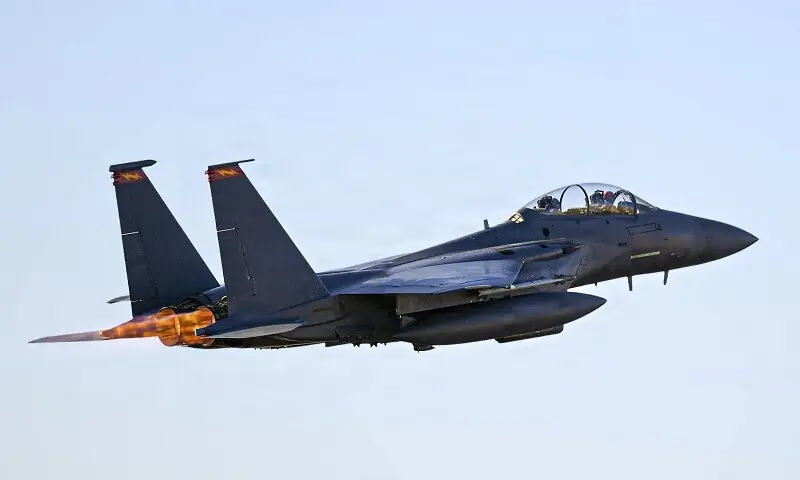

WASHINGTON: The shooting down of American warplanes over Iranian territory and the Gulf on Friday represents the most consequential single development in the six‑week conflict between the United States, Israel, and Iran.
What had been a largely asymmetric air campaign — with US and Israeli air power pounding Iranian military sites, air defences, and infrastructure — has now produced a symbolic and potentially strategic setback for Washington.
According to Iranian and American sources, an F‑15E Strike Eagle was shot down over Iran’s rugged southwestern terrain, and an A‑10 attack jet crashed in the Gulf region after being hit during combat operations. One US crew member was rescued, and two helicopters involved in the subsequent search‑and‑rescue mission were struck by fire. At least one pilot remains missing and is being actively sought by Iranian forces.
In Tehran, official media broadcast images of wreckage and urged local residents to assist in locating the downed personnel, promising rewards for delivering an “enemy pilot” to security forces. The dramatic appeal underscored Tehran’s attempt to turn the incident into a victory display, portraying itself as resilient against foreign aggression.

President Donald Trump, who had repeatedly asserted that US and allied forces maintained control of Iranian airspace, sought to minimise the impact of the losses.

In a phone interview with a major US network, he argued that the downing of the F‑15E “will not affect” the United States’ indirect negotiations with Iran and reiterated in blunt terms: “No, it’s war.”
Yet in the US capital, the political ramifications were immediate and fractious. Lawmakers from both parties reacted with a mixture of concern, criticism, and calls for restraint.
Senator Chris Coons, a Democrat from Delaware, issued a statement expressing solidarity with the missing airman and with the families of those at risk, but also sharply criticized the broader conduct of the conflict.
“I’m praying for the crew, their families, and loved ones, and for all those risking their lives to bring them home,” Coons said. He condemned the war as “reckless,” saying it “has endangered American troops, jeopardized national security, and hurt our economy.”
Maryland Governor Wes Moore, a Democrat and Army veteran who served with the 82nd Airborne Division, compared the conflict against Iran to the long and costly war in Afghanistan. He warned that the United States risked slipping into what he termed “another forever war,” with no clear articulation from the White House of what success would actually look like.
From the Republican side, Senator John Curtis of Utah took a constitutionalist line, vowing not to support further military funding without a formal declaration of war from Congress. “While I support maintaining our readiness and replenishing stockpiles,” Curtis said, “I cannot support funding for further military operations without a formal declaration of war from Congress.”
Curtis’s remarks struck at the core of a long‑standing tension in American governance: the power of the executive branch to initiate and conduct military operations without an explicit declaration of war, and the constitutional authority of Congress to decide whether the nation should be at war.
Until this week, US officials publicly maintained that American and allied aircraft operated with near‑total control of Iranian airspace. The loss of two manned fighter aircraft calls that narrative into question.
Tehran’s air defence systems, whether surface‑to‑air missiles, mobile launchers, or integrated radar networks, have now proven capable of threatening even advanced US aircraft operating deep within Iranian territory.
Pentagon figures released in recent days confirm that at least 13 US service members have died in the conflict so far, and more than 365 have been injured. Iranian casualties are widely estimated in the thousands, and the toll on civilian infrastructure has been heavy.
Military analysts argue that the downing of US jets is not merely a tactical event but a sign of operational risk. Piloted aircraft bring with them not only the danger of loss of life but also the strategic complication of search‑and‑rescue operations under hostile fire.
The fact that two rescue helicopters were struck during the recovery effort highlights how contested this battlefield has become.
The diplomatic consequences of the jet shoot‑downs are also significant. Tehran’s public appeal for help locating the missing pilot elevates the risk of a hostage crisis, which could dramatically expand the conflict’s political and media footprint.
Iranian officials are already suggesting on state television shows that Washington’s objectives have shifted from regime change to search‑and‑rescue missions.
Regional governments are watching developments closely, especially in the Gulf. Iran’s continued attacks inside Gulf states and its control over the Strait of Hormuz have already driven up global oil prices.
The Strait, a narrow waterway through which an estimated one‑fifth of the world’s oil and liquefied natural gas transits in peacetime, remains under restricted shipping conditions.
Even the suggestion of prolonged disruption has unsettled global energy markets, raising concerns among US allies in Europe and Asia about energy security and economic stability.
Diplomats from across the world have urged restraint, warning that further escalation could trigger a broader regional conflagration. European capitals, in particular, have called for a return to diplomatic engagement, implicitly rebuking what many see as an overreliance on military force.

