


Off the road: How rising fuel costs are pushing ride-hailing captains to the brink

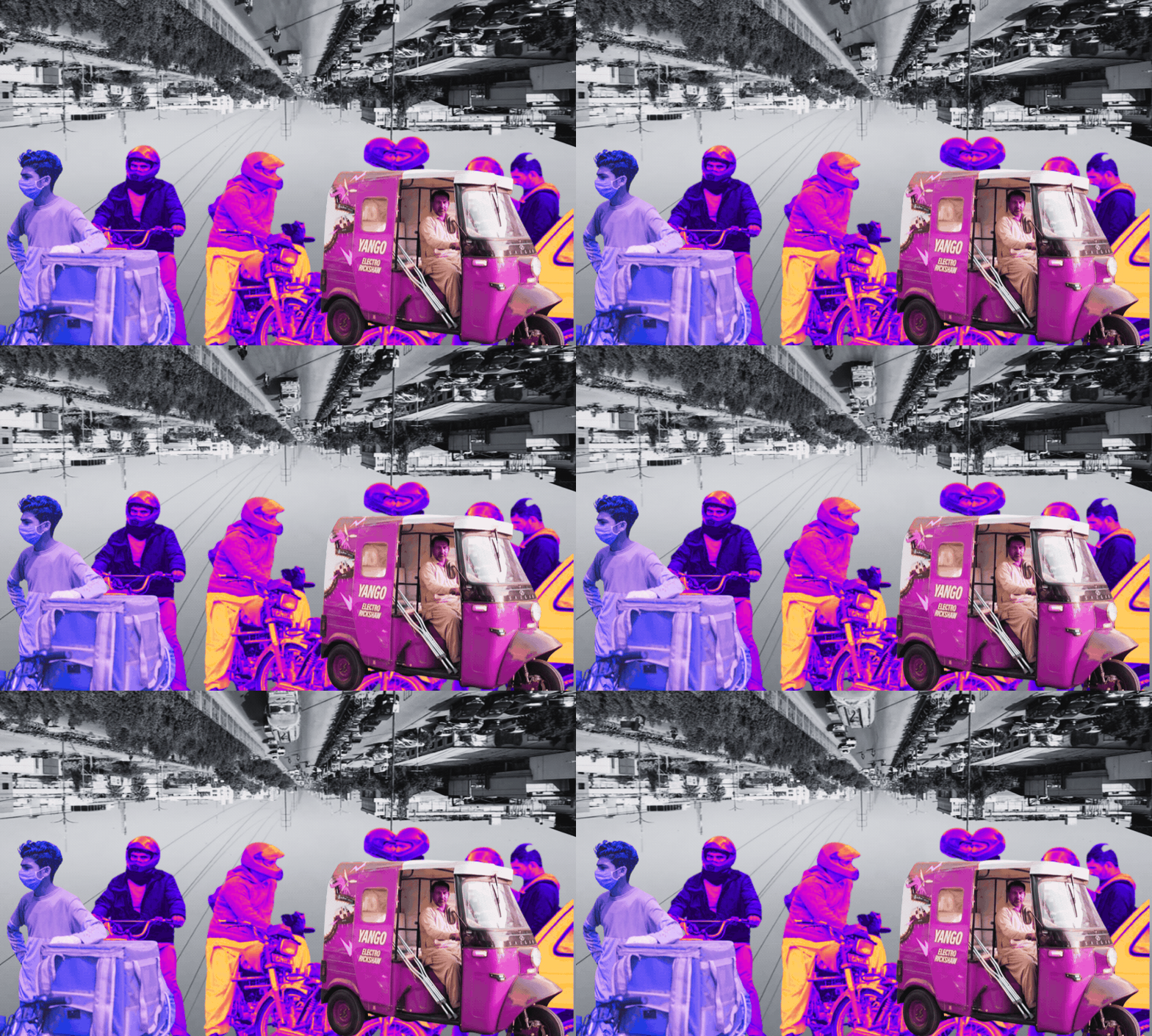

Amjad Ali Khan, 27, left his hometown of Umerkot and moved to Karachi in 2010 in search of a better livelihood. Over the next decade, he moved from one precarious job to another — working in factories, taking odd shifts at hotels and cleaning bungalows — before finally settling down as a driver. Two years back, he rented two cars — one for himself and the other for his brother-in-law — and signed up on Yango, a ride-hailing service.
Amjad’s earnings rose to roughly Rs12,000 per day, of which nearly half went to rent and fuel, leaving him with around Rs3,500 to take home and thereby allowing him to call his family of four to the port city earlier this year. But then, war came to the Middle East.
While Pakistanis are no strangers to conflict (with neighbouring India and Afghanistan in recent months), this one, despite not involving Islamabad, hit the country’s jugular vein: a massive surge in petrol prices.
When the United States and Israel attacked Iran on February 28, the impact travelled far beyond the battlefield, disrupting oil flows through the Strait of Hormuz — a corridor that carried 20 per cent of global liquified natural gas and a quarter of seaborne oil. In the aftermath, Pakistan increased petrol prices by a staggering Rs55 overnight, with another rise on the cards in the coming days.

Running on empty
For Amjad, the developments threatened to upend the life he had only just started to build. “Even during Ramazan, we managed,” he said, referring to the holy month when economic activity typically slows down in the country. “Now, [the cost of] petrol has completely disrupted everything.”

On the day of the interview, he had already warned the car’s owner he might return the vehicle if prices rose again. “I have already decided … if there is yet another price hike, I will head back to my village,” he said. Ever since petrol prices skyrocketed to Rs321.17, Amjad has been scrambling to make ends meet. “Now there are days when I return home with no money.”
The 27-year-old is not alone.
Muhammad Tahir, who works as a Foodpanda rider, narrated a similar ordeal to Dawn. He would make between Rs50 and Rs70 per delivery and get a weekly fuel allowance of Rs1,500, far from what he spends every day. He was only getting by when the petrol bomb dropped. Now, a day’s fuel costs him Rs1,600 instead of the previous Rs1,000-Rs1,100.
“If we request an increase in the fuel allowance, we are straight-up told to leave,” he sighed. Like Amjad, Tahir too has decided to quit. There’s no other option, he lamented.
According to business and economic journalist Khurram Hussain, Asia has been hit the hardest due to the oil price and supply disruptions triggered by the war. In an op-ed for Dawn on March 26, he explained that Pakistan’s fiscal envelope is too weak to carry the burden of fuel price subsidies for very long, making a price hike unavoidable within days now.
“Having held them steady for two weeks now, the government is in the unenviable position of having to pass on another major jolt to the people to avoid derailing its fiscal framework altogether,” he wrote.
Simply put, this will make life harder for people like Tahir and Amjad, whose households run on the vehicles they drive.
Qamar Abbas, an inDrive captain and the sole breadwinner of his seven-member family, has been on Karachi’s roads since 2019. Speaking to Dawn, he held the ride-hailing companies — such as Yango, inDrive and Bykea — responsible for the disproportionate burden that has befallen drivers like him.
“Our current rates have not been adjusted since 2018,” he said. “Back then, petrol cost Rs120 per litre … today it stands at Rs322 per litre, but our payments remain the same,” Abbas said, adding that none of the companies had increased per-kilometre rates to adjust to the recent fuel price hike.
Before the war, Abbas was able to take around Rs100,000 home monthly. That has shrunk by 50pc in the last 30 days.
For its part, Parisey Tariq, communications manager at inDrive, said that the company does not approach fuel price movements with a flat or automatic fare increase.
“We keep our pricing fair, and any adjustments are reviewed in the context of overall market conditions rather than a direct pass-through tied only to petrol prices,” she said, explaining that multiple factors, including trip distance, route efficiency, driver availability, time, and broader operating cost pressures, were “continuously assessed” to ensure a fair balance between rider affordability and driver earnings.
In a written response to Dawn, Parisey emphasised that inDrive’s focus was on ensuring fairness for both the drivers and customers, and one of the ways to do that was by supporting drivers through “marketplace measures and incentives, while keeping prices affordable for customers”. However, she did not get into the specifics of these incentives.
When the math stops math-ing
Over the past few years, the ride-hailing sector in Pakistan has become an important part of everyday mobility, with over two million people using the services. While motorcycle-based rides have become increasingly popular among male commuters, car-based services remain particularly important in urban centres such as Karachi, where many women rely on them due to unreliable public transport.
Ayesha Emaad Khan has spent nearly two decades in the banking industry. Today, a significant part of her routine and income is consumed simply in getting around the city. Ever since she moved to Karachi in 2018, she has relied on ride-hailing services not just for work but also to simply manage daily life.
Every day, she travels between her workplace and home — a gruelling 15km-17km distance — using these services. Much like the rest of Karachi, she too gets off at 5:30pm, which means traversing through peak traffic; an easy 20-minute drive often turns into 90 minutes of torture. Initially, a one-way trip cost her about Rs900, but following the fuel price hike, the same journey now means a dent of Rs1,700-Rs2,000 on the pocket.
“On days of rallies, protests, rain (the list goes on), this could go up to anything between Rs2,500 and Rs3,000 bucks,” she told Dawn. “It is almost the same as paying for a one-day trip to Hyderabad,” she quipped. “Time bhi utna hi lagta hai, paise bhi utne hi lagte hain (it takes the same amount of time and money).”
But desperate times call for desperate measures. At Ayesha’s office, even senior executives have shifted to motorcycles and rickshaws. She, too, has stopped using Yango and works from home most days. On days she has no other choice but to be in the office, she uses a rickshaw.
“Even if I have to walk 5-10 minutes to reach a bus stop, I do that. But I will not pay Rs3,000 every day on a one-way trip,” she stressed.
Similarly, Haleema*, a Lahore-based teacher in her mid-20s, heaved a sigh of relief when her school switched to a work-from-home schedule. Despite carpooling with her colleagues every day, she would not have been able to afford fuel. In fact, she recalled that within hours after the hike was announced, her driver had increased the monthly vehicle fee by almost 25pc.
In the wake of the massive price hike, the private sector has been encouraged to move to hybrid work schedules, where employees are allowed to work from home for most of the week to reduce the fuel burden.
On the other hand, inDrive’s Tariq stated that even though petrol price hikes have made users more price-conscious, which may “ slightly affect short-term trip demand and frequency”, the overall mobility demand, according to her, would remain strong as ride-hailing was a daily necessity for many commuters.
The cost of staying on the road
As the war crosses the 30-day mark, one thing is clear: this crisis is not going away anytime soon. So, what next? For its part, the government is undertaking efforts to provide relief to the lower and middle classes, according to Prime Minister Shehbaz Sharif. “We will not leave the economically weaker section of the society alone in this hour of difficulty,” he said earlier this week.
At a consultative meeting last week, both the federal and provincial governments agreed to introduce a proposed capped fuel subsidy for motorcyclists, while higher-consumption users would pay market-based prices. This would be implemented through a mobile application-based quota system to ensure subsidies reach low-income groups and minimise leakages.
But the question remains: will these policy responses account for those whose livelihoods depend entirely on fuel? And is the government, already grappling with mounting fiscal pressures, even in a position to address such realities at scale? As customers begin to drop off, fuel prices continue to surge, and inflation bites deeper, uncertainty looms large. For ride-hailing drivers, it is reshaping not just their earnings, but the way they work — and increasingly, the experience they offer.
Mustafa Rehman, 28, largely depends on ride-hailing services — motorcycle-based rides — for his daily commute. Of late, he has noticed a behavioural shift in drivers. “There is a lot of negativity, dejection, and depression … they barely interact, and even if they do, it is about their life struggles,” he told Dawn.
Rehman recalled being reached out to by several riders seeking financial help, something that has become very common ever since the fuel price hike. This crunch time was also visible to him — torn seats, missing horns, broken headlights.
Karachi’s Ayesha also narrated a similar experience. Being a frequent conversationalist during her rides between work and home, Ayesha observed that the quality of service provided by the captains had deteriorated. “Obviously, their morale, their attention span, their presence of mind, all these factors matter to someone who is using [the services] daily […] the kind of conversation and feedback I am getting from these captains speaks about the pressure they are under to make ends meet,” she said.
Meanwhile, in its response to Dawn, Yango said the company was working on bringing down the drivers’ day-to-day costs through a series of targeted collaborations, including fuel vouchers, discounts on oil and lubricants, and savings on everyday essentials such as medicines and groceries.
“We expect to announce several of these partnerships in the coming weeks as part of our ongoing efforts to help partner drivers manage operational costs while continuing to provide affordable mobility for riders,” it said.
But for drivers like those Ayesha speaks to, relief still feels a step behind reality. For now, the strain on drivers may be contained, but it’s visible in telling ways: the worn-out vehicles, the frustrated drivers, and the conversations that circle back to empty pockets. What was once a routine, almost invisible service, is becoming harder to sustain, both for those behind the wheel and those in the back seat.
*Names changed to protect identity

