



Pentagon officials say US has spent more than $11.3 billion in first six days of war
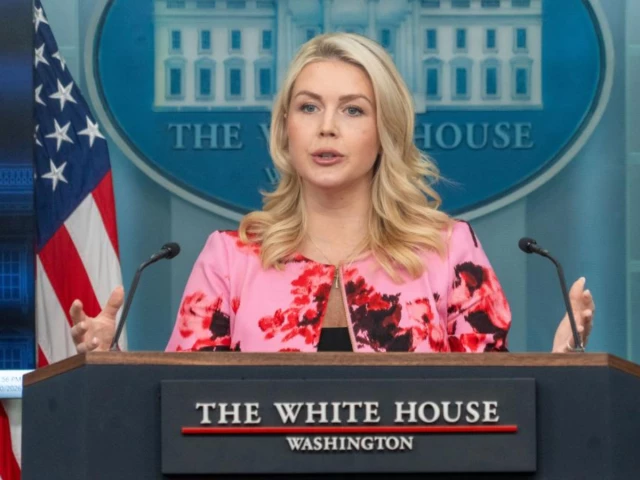
White House Press Secretary Karoline Leavitt speaks during a press briefing at the White House in Washington, D.C., the United States, March 30, 2026. PHOTO: XINHUA
US President Donald Trump is interested in calling on Arab countries to pay for the cost of the Iran war, White House press secretary Karoline Leavitt said on Monday, adding talks with Tehran to end the conflict are progressing well.
Leavitt, asked at a news briefing whether Arab countries would step up to help pay for the war, said she would not get ahead of the Republican president but that it was an idea that Trump had.

“I think it’s something the president would be quite interested in calling them to do,” Leavitt said. “It’s an idea that I know that he has and something that I think you’ll hear more from him on.”

Leavitt said that what Tehran says publicly differs from what it tells US officials in private and that Iran had privately agreed to some of Washington’s points.
Also Read: Italy refuses airbase access to US military aircraft involved in Iran war
“Despite all of the public posturing you hear from the regime and false reporting, talks are continuing and going well. What is said publicly is, of course, much different than what’s being communicated to us privately,” Leavitt said.
Trump earlier on Monday warned that Iran’s energy plants and oil wells would be obliterated if it did not open the Strait of Hormuz, after Tehran described US peace proposals as “unrealistic” and fired waves of missiles at Israel.
Pentagon officials told the US Congress earlier this month that the Trump administration spent more than $11.3 billion in the first six days of its war against Iran.
The figure does not include battle damage and replacement of losses, which likely costs the Pentagon roughly $1.4 billion to $2.9 billion over the first three weeks of the war, according to a Wall Street Journal report, quoting Elaine McCusker, former Pentagon budget official who has been tracking the cost for the American Enterprise Institute.
‘Regime change’
Trump has said that negotiations with Tehran were going well and suggested that “regime change” in Iran is complete.
“We’ve had regime change, if you look, already, because the one regime was decimated, destroyed, they’re all dead. The next regime is mostly dead. And the third regime, we’re dealing with different people than anybody’s dealt with before. It’s a whole different group of people,” Trump told reporters on Sunday.
“So I would consider that regime change, and frankly, they’ve been very reasonable.”
Read More: Iran’s parliament starts process to adopt plan on Strait of Hormuz management
But US Secretary of State Marco Rubio said on Monday that while it would be good news if Iran had new leadership and people in charge “who have a more reasonable vision of the future,” the US also had to “be prepared for the possibility, maybe even the probability, that that is not the case.”
Leavitt, asked on Monday how the US will ensure it is making a deal with people who can implement it, warned that anything Iran says to Washington privately will be tested and that the US would ensure that Tehran is held accountable.
“If they are not, the president has laid out the military consequences that the Iranian regime will see if they don’t hold true to the words that we are hearing privately behind the scenes,” she said.

