




• Saudi Arabia, Turkiye and Egypt back efforts to create conditions for Washington-Tehran structured negotiations
• FMs explore ways for permanent end to hostilities, insist war is ‘not in favour of anyone’
• Deputy PM to leave for Beijing to meet Chinese foreign minister tomorrow
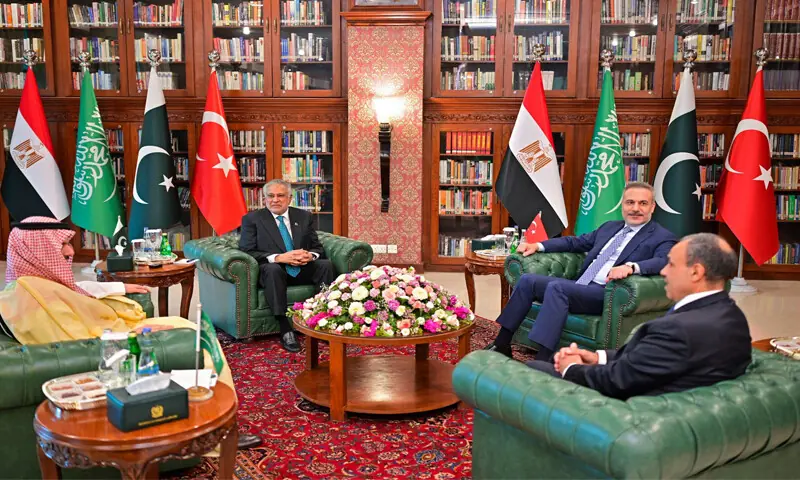
ISLAMABAD: Pakistan on Sunday signalled that it could host direct talks between the United States and Iran in the coming days, as Deputy Prime Minister and Foreign Minister Ishaq Dar concluded a four-country meeting that emphasised “dialogue and diplomacy” as the only path to ending hostilities in the Gulf region.
“Pakistan will be honoured to host and facilitate meaningful talks between the two sides in the coming days, for a comprehensive and lasting settlement of the ongoing conflict,” Mr Dar said at the close of the consultations in Islamabad and ahead of his upcoming trip to Beijing for consultations on Iran-US talks.
The meeting brought together foreign ministers from Pakistan, Saudi Arabia, Turkiye and Egypt as part of a coordinated regional push to de-escalate a conflict that has now completed its first month, raising fears of wider spillover and disruption to global energy supplies.

The quadrilateral format, launched earlier this month with an initial meeting in Riyadh, is described by officials as the most coordinated regional effort yet to steer the crisis towards diplomacy.

Besides Mr Dar, participants included Saudi Foreign Minister Faisal bin Farhan, Turkiye’s Foreign Minister Hakan Fidan and Egyptian Foreign Minister Badr Abdelatty.
Backing for Iran dialogue
In a joint review of the situation, the ministers expressed concern over the “devastating impact on lives and livelihood” and agreed that the war “is not in favour of anyone and would only lead to death and destruction,” Mr Dar said.
They reaffirmed the need for an immediate end to hostilities, stressed unity among Muslim countries and backed efforts to create conditions for structured negotiations between Washington and Tehran.
Mr Dar said he had briefed his counterparts on the prospects of potential US-Iran talks in Islamabad, with the visiting ministers expressing “full support” for the initiative.
Despite the diplomatic momentum, a senior diplomatic source cautioned that direct talks between Washington and Tehran have not yet been confirmed and would depend on developments on the battlefield. The conflict, now in its fourth week, continues to shape the timing and feasibility of any negotiations, with contacts between the two sides still limited to indirect exchanges of messages.
China’s role
Pakistan’s efforts have drawn broad international support, most notably from China, which has endorsed Islamabad’s role and encouraged Iran to engage in dialogue. Mr Dar, who spoke with his Chinese counterpart Wang Yi earlier this week, is scheduled to travel to Beijing for further discussions on March 31.
A diplomatic source said the visit is expected to build on their recent exchanges and explore ways for Beijing and Islamabad jointly supporting US-Iran dialogue. Mr Dar’s trip also suggests that a US-Iran meeting, earlier speculated for Tuesday, is unlikely to take place on that timeline.
Securing navigation through Strait of Hormuz
Discussions at the Islamabad meeting focused heavily on de-escalation measures, and included proposals to manage and secure navigation through the Strait of Hormuz, a critical global trade artery.
Officials said ensuring safe passage of shipping was viewed as a potential confidence-building step toward broader negotiations.
Mr Dar had earlier announced Iran had agreed to allow 20 additional Pakistan flagged vessels to transit the waterway.
The four countries also agreed to establish a committee of senior officials to develop modalities for continued coordination.
Engagements on the margins
On the sidelines, Mr Dar held separate one-on-one meetings with his Turkish, Saudi and Egyptian counterparts to align positions and advance diplomatic options.
The visiting ministers later called on Prime Minister Shehbaz Sharif, who stressed the urgency of collective efforts to end hostilities and reiterated Pakistan’s commitment to bringing US and Iran to the negotiating table.
Prime Minister Shehbaz also emphasised the importance of unity among Islamic countries and discussed proposals for stabilising maritime routes and broader regional security.
The visiting ministers shared their respective national perspectives and briefed the prime minister on their diplomatic engagements.
While no firm timeline has been set for direct talks, officials say the convergence of regional and international backing has created a narrow but significant opening.
Mr Dar said both Washington and Tehran had expressed confidence in Pakistan’s role, even as the situation on the ground remains volatile.
“The unity of Muslim Ummah in these challenging times is of utmost importance,” he said, reiterating that dialogue and diplomacy remain “the only viable pathway” to peace.
Published in Dawn, March 30th, 2026

