




• Tehran strikes aluminium producers in UAE and Bahrain, chemical plant in Israel; Neot Hovav industrial zone fire declared ‘hazardous materials incident’
• US-Israel forces bomb Iranian port city, Isfahan varsity, media office in Tehran; at least five killed
• Iranian parliament speaker accuses US of plotting ground invasion after 3,500 troops arrive in ME
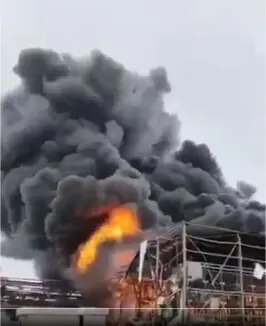
TEHRAN: A day after its industrial infrastructure was targeted by the US and Israel, Iran on Sunday fired a volley of missiles and drones at plants belonging to two of the world’s largest aluminium producers in Bahrain and the United Arab Emirates, as well as an industrial plant in Israel, causing a “hazardous fire”.
The US and Israel, on the other hand, bombed a building in Tehran housing the office of the Qatar-based news channel Al Araby, a university in Isfahan, a missile production facility, and a quay in a port city on Sunday, amid reports that the US was preparing for a ground invasion of Iran. According to Iran’s parliament speaker, the US was planning to invade Iran despite talking about diplomacy.
According to AFP, Iran’s Revolutionary Guards said they struck industries linked to the US military in the UAE and Bahrain. Emirates Global Aluminium (EGA) said an Iranian attack wounded six and caused significant damage to its plant, while Bahraini state media said two Aluminium Bahrain (ALBA) employees were injured in a second attack.

Similarly, Adama, a maker of active ingredients and crop protection materials, said its Makhteshim plant in southern Israel had been hit either by an Iranian missile or debris from an intercepted missile, but no injuries were reported, according to Reuters.

Adama, part of the Chinese-owned Syngenta Group, said the extent of any damage to the plant was not immediately known. Israel’s fire and rescue service said a fire broke out in an industrial area in southern Israel that houses several chemical manufacturing and industrial plants following an Iranian missile attack, likely caused by debris from a missile that was intercepted.
BBC quoted Israeli authorities as saying that the fire in Neot Hovav industrial zone had been declared “a hazardous materials incident” and workers were urged to evacuate “exposed” areas and instead shelter in “protected structures”.
Kuwait also came under fire. According to Al Jazeera, 10 Kuwaiti military personnel were injured in an Iranian attack on an army camp in Kuwait. A statement issued by the spokesman of the Ministry of Defence said the injured are receiving medical treatment, and that there was also “material damage at the site”.
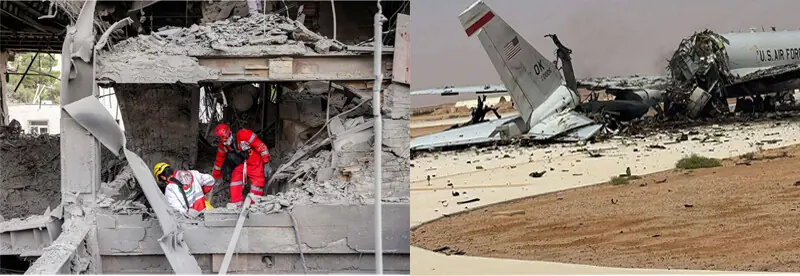
Meanwhile, in Tehran, two blasts shook the city early Sunday, an AFP journalist said, although it was not clear what was targeted. However, Qatari news channel Al Araby said an Israeli missile hit the building housing its office in the city. Footage from inside the office showed broken windows and shattered glass. The news outlet said it was located in a civilian area. It subsequently had to suspend its transmission due to the attack.
“I miss a peaceful night’s sleep,” an artist in Tehran told AFP, saying night-time strikes were “so intense it felt like all of Tehran was shaking”.
A university in Iran’s central city of Isfahan says that it was hit by US-Israeli airstrikes for the second time since the war between the foes erupted a month ago, AFP reports. “Around 2pm (10:30 GMT) today, Isfahan University of Technology was targeted for the second time (during the war) by a brutal airstrike by Zionist-American aggressors,” the university said in a statement carried by the Fars news agency.
“According to initial reports, the attack on one of the university’s research institutes also caused damage to several other buildings and resulted in minor injuries to four university staff members,” it added. Iran warned of targeting US-linked universities in retaliation for the attacks on Iranian universities.
The Israeli military claimed overnight that it attacked a key production facility in Tehran used by Iran’s defence ministry to manufacture components for ballistic missiles, reported AFP. “The site is one of only two of its kind in Iran where critical components were developed for the assembly and operationalisation of missiles set to launch toward the state of Israel,” the military said.
Iranian state media reported that US-Israeli strikes also hit a quay in the port city of Bandar Khamir, near the Strait of Hormuz, killing at least five people and injuring several.
Boots on the ground
Separately, Iran’s parliament speaker accused the US of plotting a ground attack despite talking about diplomacy, after a US warship with around 3,500 military personnel arrived in the Middle East. Mohammad Bagher Ghalibaf’s comments come after more than a month of aerial bombardment of Iran by US and Israeli forces and ahead of talks between key regional players on Monday.
“The enemy publicly sends messages of negotiation and dialogue while secretly planning a ground attack,” Ghalibaf said in a statement carried by the official IRNA news agency. “Our men are waiting for the arrival of the American soldiers on the ground to set them on fire and punish their regional allies once and for all,” he added. The USS Tripoli, an amphibious assault ship carrying around 3,500 Marines and sailors, arrived in the Middle East on Friday.
The Washington Post reported that the Pentagon was preparing plans for weeks of ground operations—potentially including raids on Kharg Island and sites near the Strait of Hormuz—though US President Donald Trump has yet to approve any deployment.
Iran said it has effectively blocked the Strait of Hormuz, a vital shipping lane which accounts for a quarter of the world’s seaborne oil trade, to hostile shipping. US President Donald Trump has repeatedly spoken of diplomatic contacts with Iran, although these claims have been denied by Tehran. Trump’s special envoy Steve Witkoff said a US-Iran meeting could take place soon, and promoted a 15-point plan that Washington says “could solve it all”.
The war has escalated into a regional conflagration as Iran has retaliated with attacks on Gulf states, sending energy markets into a tailspin and threatening the world economy. Iran’s neighbour Iraq too has increasingly been drawn into the conflict. In Syria, authorities said Sunday they had repelled a drone attack from Iraq targeting a US military base, which came after a series of strikes that have been claimed by pro-Tehran Iraqi groups.
Published in Dawn, March 30th, 2026

