



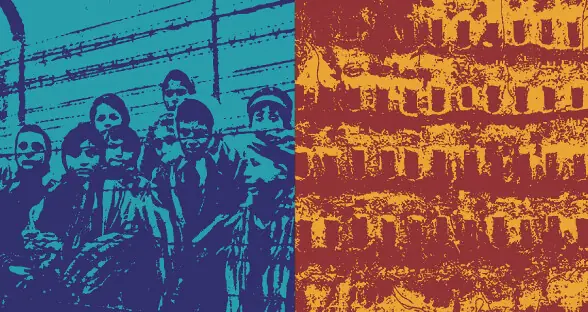

On the screen, horrific images of World War II flicker, showing the skeletal figures of Jewish men, women and children in Nazi concentration camps being marched into the horrors of the “Final Solution.”
It is a sombre cinematic and television ritual we have come to expect. Yet, if one observes the scheduling of these screened tragedies, a pattern emerges.
Whenever the state of Israel faces widespread condemnation for its brutal excursions in the Middle East, the Western entertainment industry develops a sudden, renewed obsession with Jewish victimhood during the last world war.
This is what media scholars call “affective management”, a term describing how our emotional responses are curated by those who control the narrative. In 1988, academics Edward Herman and Noam Chomsky examined this as an attempt to mitigate the public relations (PR) disaster of the present with the trauma of the past.

By re-running the tragedy faced by the Jewish people at the hands of the Nazis, the Western entertainment industry provides a moral counterweight that often dilutes contemporary criticism of Israeli state violence. The criticism becomes ‘antisemitism’.

In the 1970s and 1980s, as Israel’s image gradually mutated from the ‘underdog’ of 1948 to a regional leviathan, especially following its 1982 invasion of Lebanon, Western airwaves were hit with a wave of Holocaust dramas. The 1978 NBC miniseries Holocaust did not just win Emmys. It reached hundreds of millions of viewers precisely as the international community began to grapple with Israel’s diplomatic isolation at the United Nations (UN).
From acclaimed Holocaust dramas to nationalist blockbusters, the strategic revival of past trauma can influence public perception, shifting attention from present-day violence to the moral weight of historical suffering
When the First Intifada broke out in the occupied territories of Palestine in the late 1980s, during which young Palestinians fought Israeli troops with slingshots, the American broadcasting network ABC responded with the expensive multi-part epic War and Remembrance.
As the world watched nightly news footage of Israeli soldiers using violent tactics against Palestinian stone-throwers, War and Remembrance provided an emotional diversion. It ensured that the image of the Jew as the eternal victim remained the dominant cultural framework, even as the Israeli state was acting as the primary aggressor.
In 1997, media scholar Yosefa Loshitzky noted that the “sacralisation of the Holocaust” provides a moral shield, creating a binary where the memory of a past genocide is used to silence discourse on Israel’s contemporary human rights violations.
Films such as The Zone of Interest (2023), which depicts a troubled German commandant of a concentration camp during World War II, do not simply appear by chance. They are launched with massive fanfare at film festivals, precisely when discourse on apartheid or genocide in the Middle East reaches a boiling point.
In the age of Netflix and streaming, this reflex has become even more frequent. During the recent ‘Gaza War’, in which Israeli forces killed tens — if not hundreds — of thousands of Palestinian men, women and children, and during Israel’s recent attacks on Lebanon and Iran, streaming platforms seemed to have gone into overdrive.
Suddenly, films such as Schindler’s List (1993) and The Pianist (2002), meditations on the horrors of the Holocaust, were pushed to the top of ‘recommended’ lists, while old and new documentaries on World War II appeared to tell the same story repeatedly.
This is what the American literature professor Michael Rothberg, in his book Multidirectional Memory, identifies as “screen memory.” The term describes a historical trauma brought forward specifically to obscure a problematic contemporary reality. Viewers become so preoccupied weeping for the victims of the 1940s that they find themselves with very little emotional bandwidth left for the families currently being pulled from the rubble in Gaza and Iran.
However, this is not exclusively a Western speciality. Bollywood has also mastered this art of cultural deflection. Whenever the Modi government in India faces international heat over its increasingly exclusionary treatment of minorities, the Mumbai dream factory starts to churn out ‘epics’ about internal enemies whose ancestors supposedly sought to destroy Hinduism.
This is the Indian version of “competitive victimhood”, or the act of shouting about the past sufferings of the ‘self’ so loudly that the current suffering of ‘the other’ becomes mere background noise.
For example, 2020’s Tanhaji: The Unsung Warrior reimagined India’s historical Muslim rulers as monstrous invaders while elevating Hindu warriors as the ultimate defenders of Hinduism. Similarly, films such as The Kashmir Files (2022) or Article 370 (2024) framed the Indian state’s military presence in Kashmir not as an occupation but as a moral necessity, to prevent a return of past tragedies that befell Hindus.
In this narrative, the ‘other’ (largely Muslim) is cast as the eternal aggressor. This shift has been described by the US-based academic Nilanjana Bhattacharjya as the “new Bollywood”, where the screen memory of past conflicts is used to displace the immediate reality of contemporary state-led violence.
This trend went into overdrive after the Indian air force suffered major losses against Pakistan in May 2025. This time, instead of resurfacing a past trauma, a past victory from the 1971 Indo-Pakistan war was brought forward to displace the reality of a recent defeat. This year’s Border 2 is an example.
The Turks, under the banner of ‘Neo-Ottomanism’, have followed a similar script. While Ankara’s regional ambitions draw Western criticism, Turkish television has been dominated by historical fantasies such as Dirili: Erturul. Such shows re-imagine the Ottoman past as a period of heroic resistance against the West and internal traitors. As the Germany-based transcultural studies scholar Josh Carney points out, these dramas function as a “moral reset” for the modern state, priming the audience to view Turkiye as a beleaguered fortress defending its sacred heritage.
The early 20th century Italian philosopher Antonio Gramsci wrote that dominant groups shape “cultural common sense”, making their version of history the absolute moral benchmark. When the Western entertainment industry consistently rewinds material on the violence against Jews, it establishes a framework where the security of the Jewish state is an ethical necessity that transcends international law.
By flooding the public sphere with historical trauma, the industry effectively moves the focus from the present to the past. The result is a self-reinforcing loop, where the market for historical tragedy becomes most active exactly when that tragedy serves a political purpose.
Across the board, from Hollywood to Mumbai, the industry’s reflex turns complex contemporary human rights issues into a binary struggle of survivors versus villains. It is a potent form of cultural hegemony, ensuring that the ghosts of the past remain more real to us than the dying children of the present.
Published in Dawn, EOS, March 29th, 2026

