



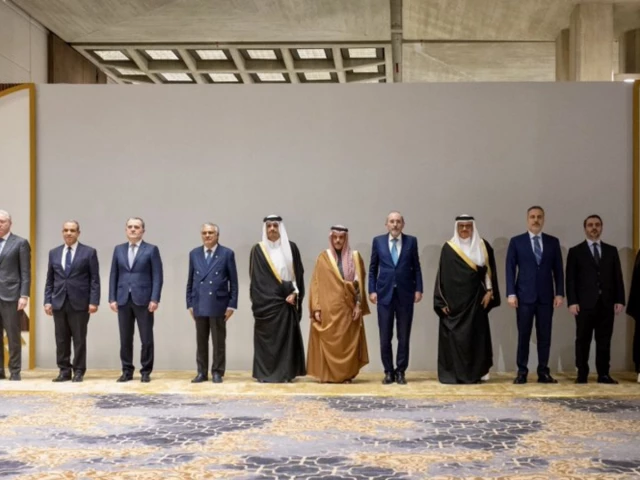

Riyadh ministerial meeting condemns missile, drone strikes, calls for diplomacy and protection of regional sovereignty
Meeting of foreign ministers from regional Arab and Islamic countries to deliberate growing tensions in the Middle East PHOTO: X/FOREIGN MINISTRY OF KINGDOM OF SAUDI ARABIA
Pakistan, along with 11 other Islamic countries, issued a joint statement on Thursday urging Iran to immediately stop its attacks on Gulf Cooperation Council countries and regional allies, following a consultative ministerial meeting held in Riyadh a day earlier to deliberate diplomatic efforts to tone down the conflict in the Middle East.
The meeting comes as the United States and Israel’s war against Iran intensifies, deepening instability across the Middle East. Iranian state television reported on Wednesday that Iran targeted Tel Aviv with missiles carrying cluster warheads, describing the attack as retaliation for Israel’s assassination of Iran’s security chief Ali Larijani.

According to the statement released by the Saudi Press Agency, ministers from Azerbaijan, Bahrain, Egypt, Jordan, Kuwait, Lebanon, Pakistan, Qatar, Saudi Arabia, Syria, Türkiye, and the United Arab Emirates “affirmed their condemnation and denunciation of these Iranian deliberate attacks with ballistic missiles and drones, which targeted residential areas, civilian infrastructure, including oil facilities, desalination plants, airports, residential buildings, and diplomatic premises.”

The statement stressed that “such attacks could not be justified under any pretext or in any manner whatsoever,” and emphasised “the right of states to defend themselves in accordance with Article 51 of the United Nations Charter.”
The ministers called on Iran to “immediately halt its attacks” and highlighted “the necessity of respecting international law, international humanitarian law, and the principles of good neighborliness, as a first step toward ending the escalation, achieving security and stability in the region, and promoting diplomacy as a means to resolve the crisis.”
The statement further noted that the future of relations with Iran depended on respecting the sovereignty of states and non-interference in their internal affairs, as well as refraining from violating their sovereignty or their territories in any manner whatsoever, and not using or developing its military capabilities to threaten countries of the region.
Read: US intelligence flags Pakistan missile programme as potential threat to American homeland
The ministers also called for Iran to abide by UN Security Council Resolution 2817 (2026), which “called for an immediate halt to all attacks, unconditional cessation of any provocative acts or threats against neighbouring states, and the cessation of support, financing and arming its affiliated militias in Arab countries, which Iran is doing to serve its goals and against the interests of these countries.”
They further urged Iran to refrain from any measures or threats aimed at closing or obstructing international navigation in the Strait of Hormuz or threatening maritime security in Bab al-Mandab.
Iran has responded to the US-Israeli strikes with waves of drone and missile attacks not only toward Israel but also against Gulf states hosting US military installations, including Saudi Arabia, widening the conflict’s regional impact.
The escalation has struck key infrastructure across Gulf countries, including airports, ports, hotels, and oil and military facilities. Disruptions to oil and gas shipments through the Strait of Hormuz, a route carrying roughly one-fifth of the world’s petroleum and liquefied natural gas, have intensified economic concerns.
Lebanon
In addition, the ministers reaffirmed support for “the security, stability, and territorial integrity of Lebanon, activating the sovereignty of the Lebanese state over all its territories, and supporting the Lebanese government’s decision to limit weapons to the state.” They also condemned Israel’s aggression against Lebanon and “its expansionist policy” in the region.
The statement concluded with the ministers reaffirming their commitment to ongoing consultation and coordination, pledging to closely monitor developments and assess emerging challenges. They emphasised that this approach will “ensure the formulation of common positions and the adoption of necessary legitimate measures and procedures to protect their security, stability, and sovereignty, and to halt the Iranian heinous attacks on their territories.”
Diplomatic efforts
Foreign Minister Ishaq Dar arrived in Riyadh yesterday. The Foreign Office said FM Dar would use the meeting to reiterate Pakistan’s diplomatic position amid escalating tensions in the Middle East.
Earlier, on March 12, Prime Minister Shehbaz Sharif travelled to Riyadh for detailed discussions on the regional situation with Saudi Crown Prince Mohammed bin Salman.
Amid rising tensions following US-Israeli strikes on Iran, Pakistan has reiterated its strong strategic commitment to Saudi Arabia while urging restraint to avoid a broader regional conflict.

