




Baghdad airport base, Ali Al Salem airbase and Iranian cities hit; Cluster munitions cause injuries in Israeli cities
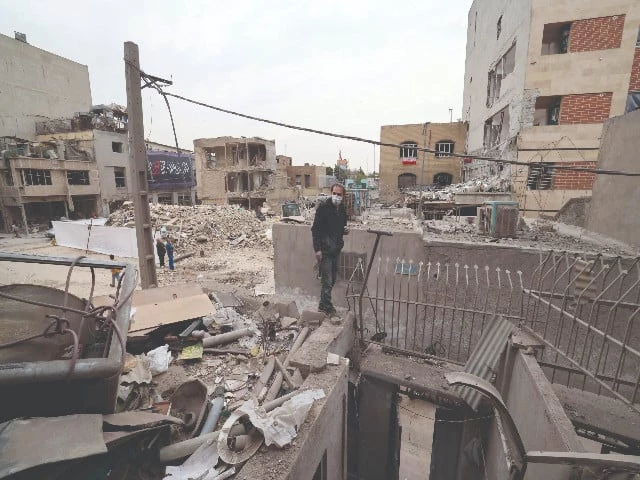
An Iranian looks at the debris of destroyed buildings following a strike on Tehran. Photo: AFP
BAGHDAD/DUBAI:

Iranian drone and missile attacks targeted several sites across the Gulf region on Sunday, marking the latest escalation since the US and Israel launched coordinated strikes against Iran on February 28.

As the conflict entered its third week, reports emerged of a critical shortage of missile interceptors in Israel, while the Strait of Hormuz remains effectively closed.
US President Donald Trump’s appeal for countries to send warships to secure the vital waterway produced no commitments. Amid strikes reported from Baghdad to Kuwait, Tel Aviv, and Beirut, global markets, particularly oil, remained on edge as the war showed no sign of abating.
In Iraq, multiple strikes targeted the Victory military base within the Baghdad airport complex, which also houses a US diplomatic facility. “Nine attacks with drones and rockets targeted the base,” said one security official, with explosions audible across the capital. At least three drones were downed by Iraqi air defences, the official added.
In Kuwait, the Ali Al Salem airbase, hosting US and Italian forces, was struck by a drone on Sunday morning. Italian military officials confirmed the drone hit a shelter containing a remotely piloted aircraft, destroying the asset but causing no injuries.
Italy’s defence chief General Luciano Portolano, described the aircraft as “an essential asset for operational activities,” noting that personnel remained safe and operational capabilities intact. Earlier in the week, another Italian base in Erbil, Iraqi Kurdistan, had been struck, prompting Rome to temporarily reduce its personnel there.
The United Arab Emirates also felt the impact of Iranian strikes. In Fujairah, fire ignited by debris from intercepted drones at commercial facilities continued, while another blaze broke out in Sharjah because of accidental leak in a petroleum tank. The fire later brought under control.
Tehran has warned civilians to avoid industrial sites and demanded that US-linked industries in the region relocate, citing them as potential targets in retaliation for US-Israeli attacks on Iranian soil.
In Israel, repeated Iranian missile strikes caused at least eight injuries. Some missiles contained cluster munitions, scattering submunitions over multiple sites. Iranian Revolutionary Guards reported targeting Lahav 433, a police unit, and the Gilat Defence satellite communications centre. Videos and eyewitness reports showed damage across central Israel and the Tel Aviv area, including residential buildings and streets.
Amid escalating attacks, Israel faces a critical shortage of missile interceptors. US officials cited by Semafor reported that Israel informed Washington its stock of ballistic missile interceptors was critically low, heightening concerns over the country’s defensive capabilities.
Israeli Prime Minister Benjamin Netanyahu appeared in a video on social media, joking about rumours of his death and affirming that Israeli forces were striking Iran and Lebanon in retaliation.
Overnight Israeli airstrikes in Lebanon’s Sidon and Al-Qatrani killed at least four civilians. Lebanese authorities report more than 850 dead and over 2,100 injured since the conflict began, including 66 women, 107 children, and 32 health workers.
Hezbollah, meanwhile, claimed responsibility for targeting Israel’s Palmachim airbase with an advanced missile, while Israeli retaliatory strikes in southern Lebanon killed Hamas official Wissam Taha.
In Iran, footage shows a police station struck, with nearby buildings heavily damaged and some losing outer walls. Residents described the attacks as sudden and devastating. At least 1,300 people have been killed since February 28, including 223 women and 202 children.
Global energy markets remain under strain. The International Energy Agency announced the immediate release of strategic oil reserves across Asia and Oceania, with Europe and the Americas to follow at the end of March.
The release aims to mitigate price surges caused by production disruptions and threats to shipping lanes, particularly the Strait of Hormuz, through which a fifth of the world’s oil normally passes. Tehran has declared the strait closed to the US and its allies.
President Trump called on allied nations, including China, France, Japan, South Korea, and Britain, to deploy warships to protect tanker traffic through the strait. As of Sunday, no commitments had been confirmed.
So far, 13 US service members have died, including six in a plane crash in Iraq. Israel and US strikes continue against Iranian military sites, while Iranian-backed groups such as Hezbollah and Hamas have escalated retaliatory attacks.
The war has also intensified domestic political debate in the United States. President Trump faces criticism from both opposition parties and some of his own supporters over his handling of the conflict, rising gas prices, and civilian casualties.
Democratic strategists say the administration’s lack of a clear endgame has left the public increasingly sceptical. Additionally, easing sanctions on Russian oil shipments to counter energy shortages has drawn criticism from European allies.
Iran’s Foreign Minister Abbas Araghchi said Tehran was not interested in negotiations with the US, pushing back against remarks by Trump that Iran was seeking a deal to end the war. Araghchi indicated that Iran would not pursue talks under current circumstances.
Meanwhile, senior Iranian politician Ali Larijani, while writing on the social media platform X, alleged that figures linked to the network of late financier Jeffrey Epstein could be planning a conspiracy resembling the September 11, 2001 attacks and attempting to blame Iran.
The conflict shows no sign of abating, with casualties rising across multiple countries, global oil supply disrupted, and civilian populations enduring mounting threats. Governments and international agencies remain on high alert as the humanitarian and strategic stakes continue to escalate.

