



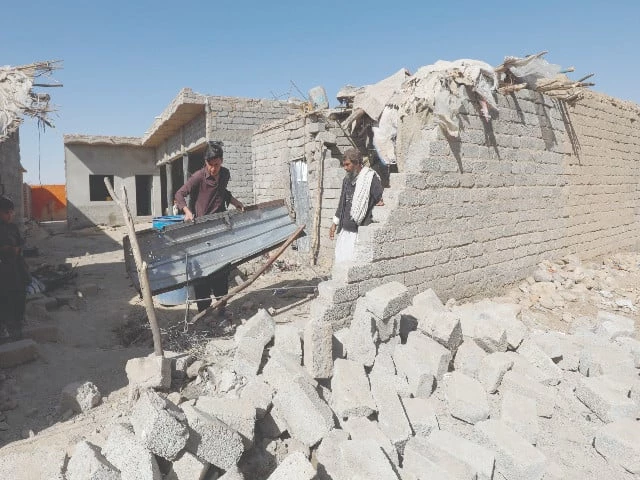

People inspect the damage after a drone hit a residential house in the Sarah Gharghai area in Quetta. Photo: Reuters
ISLAMABAD:
President Asif Ali Zardari on Saturday said Afghan Taliban elements had crossed a “red line” by carrying out rudimentary drone attacks aimed at Pakistani civilian areas, warning that the move had brought grave consequences upon the regime in Kabul.

Pakistan is likely to respond forcefully to what officials describe as a fresh provocation by the Afghan Taliban regime after security forces intercepted two rudimentary drones launched by a terrorist group backed by Kabul near Islamabad, according to officials.

According to the officials, the drones were detected and neutralised through measures described by the Inter-Services Public Relations (ISPR) as both “soft and hard kill” before they could reach their intended targets.
The ISPR said that the debris from the drones injured two children in Quetta and a civilian each in Kohat and Rawalpindi.
“These attacks were aimed at inducing fear in the public and remind us of the terrorist mindset which drives the Afghan Taliban. On one hand, the Afghan Taliban project victimhood to garner global sympathy while on the other hand, they actively target civilians through their terrorist proxies and drones,” the statement said.
Condemning the incidents, the president said the illegitimate Taliban regime had escalated tensions by targeting civilians despite Pakistan’s continued efforts to promote regional peace and stability.
He strongly condemned the rudimentary drone attacks carried out a day earlier by Afghan Taliban elements aimed at targeting civilian areas in Pakistan.
The president said the illegitimate and terrorist Taliban regime had brought grave consequences upon itself by crossing this red line.
“The illegitimate regime of Afghanistan installed by terror and brute force continues to renege on its commitments not to provide safe sanctuaries to terrorist groups and now has the audacity to provoke a major military power of the Islamic world,” President Secretariat Media Wing, in a press release, quoted the president as saying.
While the Afghan terrorist regime sought negotiations with Pakistan’s friendly countries, the president said it had crossed a red line by attempting to target their civilians while Pakistan remained engaged in efforts to promote peace and stability in the Gulf region and West Asia.
He also expressed his best wishes for the speedy recovery of children and other civilians injured by drone debris in Quetta, Kohat and Rawalpindi.
The president reaffirmed that Pakistan’s armed forces and security institutions remained fully committed to the defence of the country and the protection of its people.
Authorities confirmed that no military installations or civilian infrastructure were struck in the incident.
The ISPR said Pakistan’s people and its armed forces were absolutely clear about the true nature and intentions of the terrorist militia-for-hire that was currently ruling Afghanistan.
“Operation Ghazab Lil Haq shall continue till the Afghan Taliban address Pakistan’s core concern with respect to terrorism originating from Afghan soil. Pakistan’s Armed Forces stand steadfast in the fight against terrorism and its manifestations, like the drone attacks by Afghan Taliban. We shall keep defending the people of Pakistan against terrorists and their facilitators and shall not flinch in the face of such provocations by the Afghan Taliban,” the statement said.
Although the Afghan Taliban Defense Ministry claimed it conducted the strikes, Ministry of Information and Broadcasting in a statement pointed fingers at Fitnal Khwarij, a term used for the banned Tehreek-e-Taliban Pakistan (TTP).
It said drones were operated by the group referred to as FAK, which Pakistani authorities say is supported and nurtured by the Afghan Taliban regime.
Officials say the latest incident reinforces Islamabad’s longstanding concerns about terrorist groups using Afghan territory to target Pakistan.
The information ministry rejected claims circulated by Taliban-linked accounts suggesting that the drones had successfully struck Pakistani targets.
The officials said the Taliban regime’s statements were not backed by any verifiable evidence and were part of what they described as a pattern of propaganda and misinformation.
Government sources also pointed out that the Taliban-affiliated accounts have previously made claims that were later retracted, including assertions that aircraft belonging to the Pakistan Air Force had been shot down and pilots captured. Those posts were later deleted without explanation.
The latest drone incident comes just a day after Pakistan carried out a series of precision strikes against what it described as terrorist infrastructure inside Afghanistan. On the night of March 1213, Pakistani forces targeted multiple sites believed to be used by militant groups planning attacks against Pakistan.
Among the locations struck was infrastructure associated with the 313 Corps headquarters in Kabul, including an ammunition storage facility. Additional strikes were carried out in Kandahar, where Pakistani officials said a terrorist training camp in Tarawo was destroyed along with other militant infrastructure that included oil storage facilities used to support militant operations.
Another strike targeted a terrorist camp in the Sher-e-Nau area of Paktia Province, which authorities said had been used as a staging ground for cross-border attacks against Pakistan.
The security officials described those strikes as “precision operations” designed to dismantle terrorist infrastructure rather than target Afghan civilians or government institutions.
Following the interception of the drones, the officials suggested that Pakistan could intensify its response if attacks originating from the Afghan territory continue. The message from Islamabad, according to the officials, remains consistent: terrorist groups must not be allowed to operate from Afghan soil.
Authorities say Pakistan has made it clear that its primary demand from the Afghan Taliban regime is to stop harbouring and supporting militant leadership involved in attacks against Pakistan. Officials warned that failure to curb such groups could result in further consequences.
“Truth always triumphs over falsehood,” an official said, reiterating that Pakistan would continue to act against threats to its security.

