


War Diary Day 14: Attrition contest tightens as Strait of Hormuz standoff deepens – World


On the 14th day of the US–Israel war against Iran, the conflict entered a more grinding phase in which neither side was closer to a decisive military outcome. Yet, the cumulative pressure generated by Iran’s asymmetric strategy was increasingly shaping the broader strategic balance of the confrontation.
The highlight of the day was the downing of a US air refueller over western Iraq while conducting aerial refuelling operations. It was the first-ever incident of any air force refueller being shot down. Iranian-aligned militias in Iraq claimed the attack in which all four crew members on board were killed, while another tanker was said to have been damaged in the same attack and forced to divert. The loss, therefore, represents one of the most serious operational setbacks suffered by US air support assets since the conflict began.
Alongside these reports were Iranian claims about US naval forces in the region being attacked, including assertions that the aircraft carrier USS Abraham Lincoln had been struck and rendered inoperable, while the fire aboard the USS Gerald Ford compelled adjustments in carrier strike group deployment. These incidents may not fundamentally alter the overall US naval advantage, but they nevertheless underline the operational challenges that emerge as conflicts stretch into longer campaigns.
Iran simultaneously continued its calibrated missile campaign under Operation True Promise 4, with successive waves targeting Israeli cities —including West Jerusalem, Tel Aviv and Eilat — while also striking US and coalition facilities across the Gulf region. Among them are the Fifth Fleet headquarters at Salman Port in Bahrain, Ahmad al Jaber Air Base in Kuwait and Al Dhafra Air Base in the United Arab Emirates. A missile strike on Prince Sultan Air Base in Saudi Arabia reportedly injured several US and coalition personnel, some of whom were evacuated to Landstuhl in Germany.

Another development that raised the stakes occurred at Incirlik Air Base in southern Turkiye, where air raid sirens sounded after reports of a possible incoming missile threat linked to Iranian or proxy operations. Although there has been no confirmed report of an impact so far, the alert at a key Nato facility hosting US aircraft and logistical assets marks a potentially dangerous moment in the war; any direct strike on Turkish territory would bring the conflict onto the soil of a Nato member state and could trigger collective defence consultations under the alliance’s Article 5 framework. Such a scenario would risk transforming what has so far remained a regional war into a far broader confrontation involving Nato.

At sea, the confrontation around the Strait of Hormuz continued to define the strategic direction of the war. Iranian forces have relied on mines, explosive sea drones and attacks on commercial shipping to raise the risks for vessels attempting to transit the waterway, with numerous ships reported damaged or ablaze since the start of hostilities. Energy analysts now estimate that nearly 15 per cent of global oil supply is effectively trapped east of the Strait, because of which oil prices have gone above the $100-mark despite large releases from strategic reserves by major consuming countries. The International Energy Agency has warned that even if fighting were to end soon, restoring normal shipping flows could take weeks or months.
The maritime campaign has therefore become Iran’s most consequential strategic lever through which it is imposing costs far beyond the battlefield. These economic reverberations are spreading globally due to a surge in shipping insurance premiums, restricted tanker movements and a sharp rise in aviation fuel costs. Globally, airlines are estimated to be facing hundreds of millions of dollars in additional weekly expenses.
Despite sustained US and Israeli air strikes targeting Iranian nuclear-related infrastructure, missile production facilities and command nodes, Western assessments indicate that Iran’s inventory of surface-to-surface missile launchers remains broadly intact because of pre-war stockpiles and the use of dispersal and deception tactics that have limited the effectiveness of the aerial campaign.
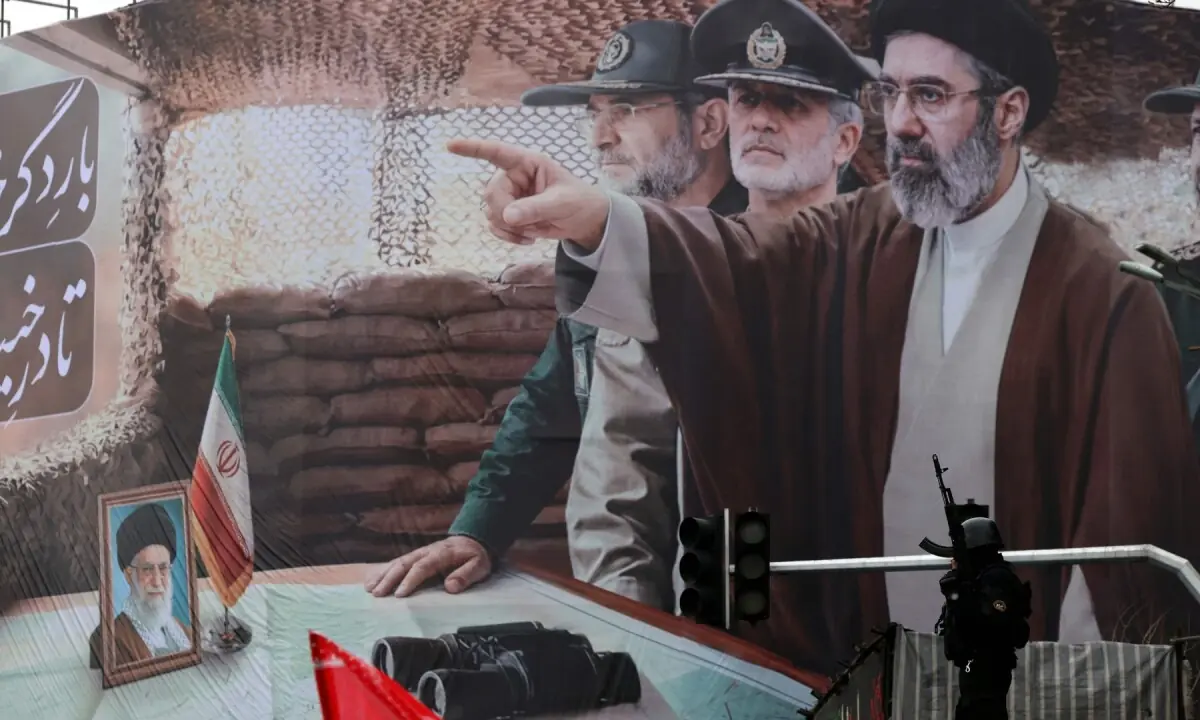
Inside Iran, the political system appears stable under the new Supreme Leader Ayatollah Mojtaba Khamenei. Large pro-government rallies have been reported in Tehran, while Basij security deployments targeted earlier in the war have been quickly reinforced. Similarly, Top Iranian leaders, including Ali Larijani, the key man running the war strategy, and President Masoud Pezeshkian and Foreign Minister Abbas Araghchi attended the Al-Quds rally in Tehran, the same time as where Israel bombed nearby Valiasr street.
In his first public remarks since assuming leadership, Ayatollah Mojtaba Khamenei reaffirmed Iran’s readiness to keep the Strait of Hormuz closed until what he described as compensation for the war is secured.
Iran’s regional allies have also intensified their involvement. Militias in Iraq, which had previously claimed the downing of at least two F-15 belonging to the US and the overnight downing of the air force refueller, have stepped up drone and missile attacks on US facilities in Erbil and Baghdad while warning that Western forces, including newly deployed French assets, would be targeted if they become engaged in the conflict. One French soldier was killed and six others were wounded after a drone attack in northern Iraq that President Emmanuel Macron said was “unacceptable” and unjustified. The militia groups were always expected to join the fray, but the ferocity with which they are carrying out attacks was unexpected, and this points to the risk of additional theatres becoming active as the war progresses.
At the political level, strains are beginning to emerge within the coalition backing the US-led campaign. Gulf states hosting American bases have themselves become targets of Iranian missiles and drones, while some European partners have started to voice unease about the conflict and the possibility of deeper military entanglement if the confrontation widens further.
Publicly, officials in Washington continue to project confidence about the progress of the campaign, with US President Donald Trump and other American figures asserting that sustained military pressure is steadily degrading Iran’s capabilities. Yet, behind these statements, there are also signs of quieter diplomatic contacts suggesting a more cautious calculation. In the latest move, US Secretary of State Marco Rubio has once again engaged the Omani government to relay messages to Tehran after an earlier Witkoff initiative failed to gain much traction. The US appears to be betting that prolonged pressure will eventually force Tehran to accept terms favourable to Washington for ending the war. Iranian leaders, however, are signalling the opposite, indicating that they are prepared for a prolonged confrontation and will not concede under pressure.
The conflict is now a strategic contest of endurance rather than a struggle for rapid battlefield gains. Therefore, Iran may not be winning the war in a conventional military sense, yet it is shaping the wider environment of the conflict by fracturing the coalition arrayed against it, trapping a significant portion of global oil supply behind a contested maritime chokepoint and steadily raising the political and economic costs of the campaign.
Unless there is a sudden diplomatic breakthrough or a shift in Washington’s willingness to tolerate disruption of the Strait of Hormuz, the war now appears headed toward a prolonged and economically punishing stalemate in which the decisive question will not be who strikes harder but who can withstand greater pressure for longer.
Header image: An Iranian security force officer stands guard next to a huge billboard of Iran’s newly nominated supreme leader Ayatollah Mojataba Khamenei (pointing) during Al-Quds day rally in Tehran on March 13, 2026. — AFP

