




As war in the Middle East convulses global oil markets, Pakistan faces a stark choice between shielding consumers from fuel price shocks and meeting its commitments to the IMF.
Oil has been on everyone’s lips since the start of the US and Israel’s war with Iran.
Global energy markets are on tenterhooks as traffic through the Strait of Hormuz, through which about one-fifth of the global oil supply transits, has nearly halted, while attacks on energy facilities across the Middle East have heightened uncertainty. The blockade means that some 15 million barrels of crude oil and 5mn barrels of other oil products are choked off from global markets every day.
The disruption has forced producers like Saudi Arabia, the United Arab Emirates, Kuwait and Iraq to cut production as shipments struggle to move out of the region, leading to a build-up of unsold barrels and mounting pressure on storage capacity. Nearly 1.9mn barrels per day of crude refining capacity in the Gulf has been shut in due to the US-Israeli war on Iran, consultancy IIR said.

With growing uncertainty over how long the war will last, the supply shock has sent global oil prices soaring. If the conflict is not resolved by the end of the month, analysts say it could push global oil prices above the recent 2022 peaks seen after Russia’s invasion of Ukraine. In some scenarios, analysts say the price could hit $150 per barrel.

How countries are responding to the price shock
Countries across Asia have moved swiftly to shield their economies from the energy shock. South Korea plans to cap domestic fuel prices for the first time in nearly three decades and may expand a $67 billion market-stabilisation programme while seeking alternative energy supplies beyond the Strait of Hormuz. Japan has instructed a national oil reserve site to prepare for a possible crude release. Vietnam intends to temporarily remove fuel import tariffs to secure supplies. Indonesia will increase energy subsidies and may revive its biodiesel plan to reduce reliance on conventional diesel. China has asked refiners to halt new fuel export contracts to protect domestic supply. Bangladesh has closed universities early for Eid holidays and imposed fuel rationing to curb panic buying and conserve energy.
Pakistan has also ordered sweeping emergency fuel conservation measures, including a four-day workweek for government employees and a two-week closure of educational institutions. Half of government staff will work from home on a rotating basis, while the private sector has been advised to adopt similar arrangements, with key sectors such as banking exempted.
These steps have, however, not shielded Pakistanis from the impact of surging oil prices. The shock began to hit home last Saturday when the government raised petrol and diesel prices by a steep Rs55 per litre, a move already straining low- and middle-income households. Consequently, the economic pain is spreading rapidly, pushing up the cost of transportation, food and other essentials. If the confrontation drags on — as increasingly appears likely — it could further test Pakistan’s economic resilience and raise the risk of a broader downturn.
The pricing regime
The decision to increase domestic petrol and diesel prices has drawn considerable public criticism, including from former finance minister Miftah Ismail, who argues that the move has effectively transferred roughly Rs19bn from struggling consumers to oil companies — an outcome that reflects either serious policy misjudgment or undue influence by the oil lobby.
Under the existing pricing mechanism, the government calculates petrol and diesel prices using the 15-day average of daily closing prices for Dubai and Oman crude published by Platts (now S&P Global Commodity Insights) to determine domestic prices of diesel, petrol and other products.
To this base price, the actual cost of importing the fuel, including freight, insurance and other charges incurred by the PSO, is added to determine the landed cost. The government then applies a 10 per cent customs duty and adds the margins for oil marketing companies and dealers, along with the petroleum levy. A freight equalisation cost calculated by Ogra is also included to ensure uniform fuel prices across the country. This combined formula determines the retail price of petroleum products for consumers.
The government defended the decision by pointing to the sharp spike in global oil prices after the attacks on Iran began. This sudden increase created a strong expectation in the market that domestic fuel prices would rise significantly in the second half of the month.
Authorities feared that this expectation could trigger hoarding by consumers, petrol pumps, dealers and oil marketing companies (OMCs), potentially leading to shortages in the market. There was also the concern that importers might slow or suspend imports to avoid potential losses if domestic prices were not adjusted in line with rising global prices.
To address these risks, the government decided to shorten the existing fuel price revision cycle from a fortnight to seven days. This change — which local refineries and OMCs had been demanding for a long time — was intended to allow domestic fuel prices to reflect global price movements more quickly, discourage hoarding, and ensure that imports and supply continued without disruption.
Miftah Ismail wrote that the government’s reasoning is understandable. However, he noted that domestic prices for petroleum products for March 1–15 had already been revised just a week earlier, on February 28, using the average import price for the second half of February. By changing prices in the middle of this already determined period on March 7, the government effectively handed oil companies and dealers a windfall gain, he maintained.
“The oil companies had already bought the petrol and diesel being sold now before Feb 28 at lower prices. And their costs plus profits were already being covered by the prices set originally for March 1 to 15. There was absolutely no reason to increase their prices and allow them excessive profits. This is just taking advantage of a crisis and allowing them excessive profits. If the government wanted to move to a seven-day pricing cycle, it should have done so at the end of the existing fortnightly pricing period.”
According to him, to discourage hoarding in the meantime, the government could simply have increased the petroleum levy instead of raising the base price of fuel. That approach would have discouraged stockpiling while allowing the government to collect the additional revenue itself rather than passing it on to oil companies.
However, he did not explain how this approach would have stabilised market sentiment at a time when global oil prices were swinging wildly. With international prices rising sharply, importers and dealers were expecting domestic rates to adjust accordingly. Simply raising the levy without changing the base price may not have prevented hoarding or ensured uninterrupted imports and supply. Importers and dealers still expected domestic prices to eventually reflect the higher international rates, and without that adjustment, the incentive to delay sales or imports could have persisted.
The forces at play
But Zahid Mir, an oil industry veteran and former managing director/chief executive officer of OGDCL and Pakistan Refinery Limited, argues that global market developments can rapidly alter these calculations.
“On February 28, following attacks by the US and Israel on Iran, international petroleum markets reacted sharply when trading resumed on March 2. Global prices of crude and refined fuels surged. Petrol and diesel prices are typically higher than crude oil because they are refined products, and their prices rarely move in tandem. Instead, they fluctuate according to their own demand-supply dynamics, which can cause a significant gap between the two,” he elaborated.
By that time, players across the supply chain — from petrol pump owners to oil marketing companies and refineries — were anticipating a steep increase in domestic prices. “Market expectations were that by March 15, when the government was scheduled to revise fuel prices for the next fortnight, the surge in average Platts rates could translate into an increase of up to Rs100 per litre,” Mir, who is currently managing director/CEO at Uch Power, explained.
When international prices surge, he says, refineries do not stop producing petrol and diesel, nor do importers halt shipments. Instead, importers begin bringing in fuel at the new, higher global prices while the existing stocks — estimated at around one billion litres across refineries, oil marketing companies and petrol pumps — were purchased earlier at lower rates. “No importer would willingly buy fuel at higher prices and sell it at lower domestic rates, especially when there is uncertainty about whether international prices might fall within the next 10–12 days. Selling below replacement cost could lead to significant losses.
“If retail prices are not adjusted in line with rising import costs, distortions begin to appear across the supply chain. Importers may slow down purchases, while pump owners and distributors may hold back supplies in anticipation of higher prices and potential inventory gains. Such behaviour can quickly lead to shortages at fuel stations.”
It was against this backdrop of rapidly rising international prices that the government chose not to wait for the usual 15-day price revision cycle. Instead, it shortened the pricing period to seven days to respond more quickly to market changes and to preempt potential shortages at the pump. This step helped ensure the continued flow and availability of fuel in the domestic market.
Based on prevailing international prices at the time, diesel prices should have increased by about Rs75 per litre, while petrol prices would have risen by roughly Rs25 per litre. To moderate the impact, the government reduced the petroleum levy on diesel by Rs20 per litre while increasing it by the same amount on petrol — resulting in an identical price rise for both fuels. This approach allowed the government to protect its petroleum levy revenues while easing some of the burden on diesel consumers, who are closely linked to the transport and agricultural sectors.
This approach also highlights a broader policy issue. In Pakistan, petroleum product prices are strictly regulated, with the government setting retail rates for consumers. Most countries have, however, moved to complete price deregulation, allowing markets to adjust fuel prices daily in line with international movements, while governments focus primarily on collecting taxes. Where authorities wish to cushion consumers from volatility, they typically adjust fuel taxes to stabilise retail prices.
Pakistan too had originally conceived the petroleum levy as a shock absorber, a tool that governments could use to cushion consumers during periods of sharp global price volatility, industry sources say. In practice, however, it has increasingly become a major revenue source. Rather than being deployed to stabilise consumer prices during crises such as the present one, the levy is largely being maintained to help the government meet its revenue commitments under the IMF programme.
Contradictory statements
Khawar Jillani, former CEO of Asia Petroleum, argues that the government should have offset the increase in product prices by cutting the petroleum levy by the same amount, shielding consumers from the additional burden while still discouraging hoarding.
“Faced with a sudden surge in global prices, the government opted to increase domestic fuel rates sharply in line with international trends to prevent shortages, queues at fuel stations and panic buying, while also protecting petroleum levy revenues. It is difficult to defend this kind of hike in petrol and diesel,” he told Dawn. “But the IMF would not have agreed to a reduction in the levy, as it would have widened the revenue shortfall.”
Jillani pointed out that a government announcement only days earlier had assured the public that the country had fuel stocks sufficient for about 28 days, while five local refineries were holding an additional 10 days of supply. The subsequent price hike therefore left many consumers baffled.
The earlier statement had been intended to prevent panic buying before the government raised domestic fuel prices. However, the sudden increase triggered criticism on both social and mainstream media, where many argued that the higher prices should have applied only to future cargoes rather than to existing stocks that had been imported at much lower rates.
Another concern frequently raised by consumers is the lack of confidence in regulatory authorities. Many believe that while fuel price increases are passed on immediately, regulators struggle to ensure that petrol pumps and oil marketing companies fully transfer the benefit to consumers when global prices fall.
“In reality, future cargoes are significantly more expensive due to higher freight charges, war-risk premiums and elevated insurance costs. Countries that rely on shipments passing through the Strait of Hormuz are facing similar challenges.
“Under such volatile conditions, maintaining fuel stocks has effectively become a day-to-day exercise. Securing cargoes to maintain the usual 15–20 days of inventory has become extremely difficult, and even meeting weekly supply requirements is increasingly challenging.
“In that context, the government’s decision to raise prices was understandable, though authorities have struggled to justify the Rs55 per litre increase when large volumes of lower-priced stock were still available in the system,” Jillani concluded.
What next
After rising steadily since the start of the conflict, global oil prices have begun swinging wildly as markets struggle to interpret fast-changing developments in the Middle East. Brent crude, for instance, climbed to around $120 a barrel on Monday before plunging to $88.69 the next day. It then rebounded to just under $100 a barrel on Wednesday.
Much of this volatility stems from mixed signals coming from Washington. President Donald Trump has repeatedly suggested that the war could end soon, easing fears of prolonged supply disruptions. Other members of his administration have been less optimistic about the prospects for de-escalation in the region. A phone call between Trump and Russian President Vladimir Putin proposing a quick settlement of the conflict, along with reports that the US might ease sanctions on Russian oil, initially calmed markets.
“Discussions around easing sanctions on Russian oil, comments from Donald Trump hinting that the conflict could eventually de-escalate, and the possibility of G7 countries tapping strategic oil reserves all pointed to the same message — that oil barrels will somehow continue to reach the market,” Priyanka Sachdeva, a Phillip Nova analyst, said in a note.
Prices later rebounded after Chris Wright, the US Energy Secretary, briefly posted on X — and then quickly deleted — a claim that the US Navy had escorted an oil tanker through the Strait of Hormuz, fuelling speculation that shipping through the key route might resume. Another factor that helped cool the rally was a decision by member countries of the International Energy Agency (IEA) to release 400mn barrels from their emergency reserves of 1.2bn barrels into the global market, the largest coordinated release of strategic oil stocks in history, in an effort to boost supplies and cap the surge in prices.
That said, swings in Brent crude oil have little relevance to Pakistan’s fuel pricing adjustments. Pakistan primarily relies on the Dubai crude oil and refined product prices assessed by S&P Global Platts for petrol and diesel.
A look at these benchmarks presents a far more alarming picture for Pakistani consumers. Dubai, or Platts crude, closed on Thursday at $134.4 per barrel, excluding additional freight and insurance costs and government taxes, compared with Brent’s closing price of about $106 per barrel. The refined product prices are even more alarming.
According to Platts assessments, petrol rose to $123.68 per barrel while diesel surged to $188.7 per barrel, highlighting the sharp increase in the import cost of fuels for Pakistan. “To put this in context, Plats diesel was trading at around $128 per barrel while petrol was just under $100 per barrel when Pakistan raised fuel prices last Saturday,“ Mir emphasised.
Pakistan meets around 70pc of its diesel requirements through local refineries, importing the remaining 30pc. In the case of petrol, the situation is the reverse, with a larger share being met through imports. Diesel supplies to Pakistan have already been affected. PSO is currently struggling to procure diesel, while the premium for supplies has shot up to nearly 50pc of the barrel rate.
“This implies the government may have to raise the domestic petrol and diesel price when it reprices these products on Saturday,” Mir says.
According to him, the recent downward swings show that market perceptions were influenced by political messaging, including statements by Trump and announcements to release 400mn strategic barrels by the G7 nations.
“However, these developments don’t change the underlying fundamentals of the market. The Strait of Hormuz is effectively closed to shipments. Refineries in the Middle East are already cutting operations due to disruptions in crude shipments, leading to shortages not only of crude but also refined products such as diesel and petrol. As long as this route remains disrupted, Asian economies will continue to face supply shortages and volatility will persist. Even if the war ends today and the Strait of Hormuz opens for shipping, it will take weeks for supplies to become normal and prices to fall.”
How the government navigates the next oil-price choke point on Saturday remains to be seen.
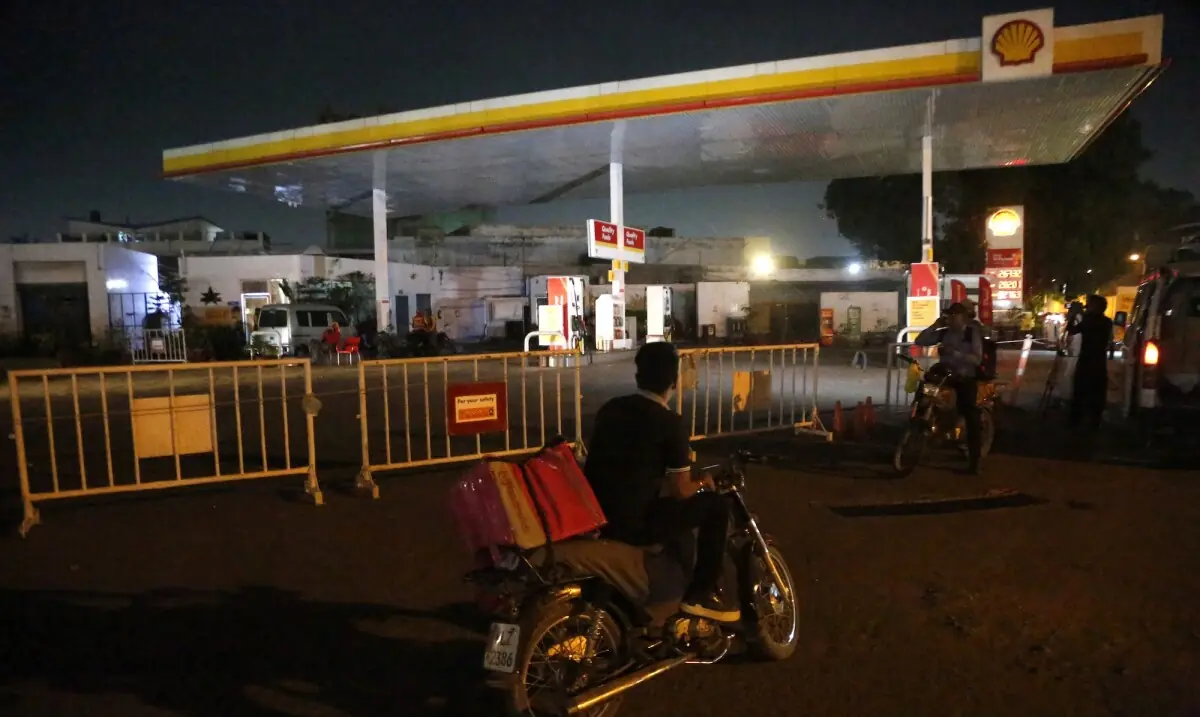
Header image: A petrol station at Karachi’s Lucky Star is shut on Friday, March 6, ahead of the government’s expected announcement to increase fuel prices. The government would later notify an increase of Rs55 per litre on petrol. — Shakeel Adil/ White Star

