



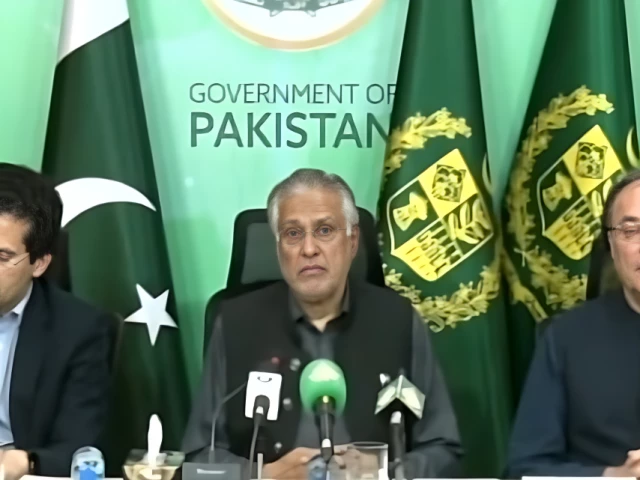

FM Dar, Finance Minister Muhammad Aurangzeb announce policy changes in light of Mideast conflict
The government on Friday sharply increased diesel and petrol prices by Rs55 per litre or 20% — marking the first increase in a series of similar surges in coming days due to the ongoing US-Israel and Iran war, which has disrupted supply chains and pushed crude oil prices to two years’ highest level.
Regional tensions escalated sharply after air strikes by the United States and Israel last week killed Ayatollah Ali Khamenei, Iran’s Supreme Leader, along with several senior officials. The strikes triggered retaliatory actions by Iran, widening the conflict across the region. In response, Iran launched attacks on US military bases in several Gulf countries, significantly expanding the confrontation. Iran has also closed the Strait of Hormuz, halting the movement of oil supplies to many countries. As a result, crude oil prices were set on Friday for their strongest weekly gain since the extreme volatility seen during the COVID-19 pandemic in spring 2020, with shipping and energy exports through the key waterway disrupted.
Amid the unfolding crisis, Pakistan is also facing pressure as much of its energy supply depends on international imports. The government has therefore begun reviewing its strategy as the situation in the region shows no immediate signs of easing.

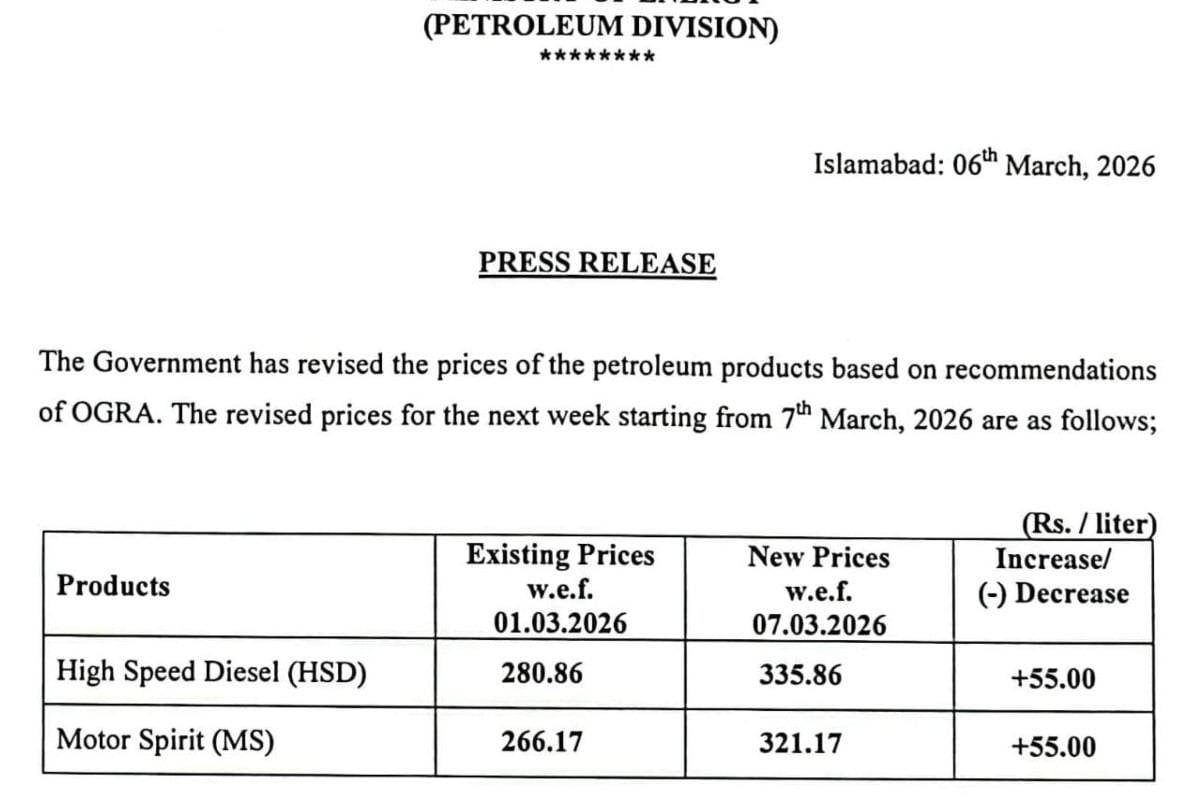

The increase in petrol prices was more than the surge in the international market, as the government chose to collect more than required money from motorcyclists and car owners to subsidise the use of diesel mostly by the public transport and the agriculture sector.
Petroleum Minister Ali Pervaiz Malik announced the new rates with immediate effect after Prime Minister Shehbaz Sharif decided to increase the petroleum products prices on a weekly basis.
The new price of high speed diesel will be Rs336 per litre and petrol Rs321 per litre, said Malik in a pre-recorded speech. He was accompanied by Deputy Prime Minister Ishaq Dar and Finance Minister Muhammad Aurangzeb.
The government also increased the petroleum levy on petrol to a record Rs105.4 per litre but reduced it to Rs55 per litre on diesel.
Kerosene oil price has been increased by Rs130 per litre to Rs319 while light diesel oil price has been increased by Rs68 to Rs235 per litre.
Adjustments in POL Prices Announced Amid Escalating Global Energy Crisis; Nation Assured of Adequate Energy Stocks
Federal Minister for Finance and Revenue Senator Muhammad Aurangzeb has stated that the Government of Pakistan has been closely monitoring the rapidly evolving… pic.twitter.com/r2Si821Hd9
— Ministry of Finance, Government of Pakistan (@Financegovpk) March 6, 2026
It is the second increase in prices in less than six days and another is coming in by the end of next week, exposing the people to brace the huge impact of the US-Israel’s war against Iran.
The government has increased the diesel prices by 19.5% and petrol by 20.5%, with a second increase likely coming on March 15th.
In just one week, the global oil prices have increased by 30% amid closure of some major oil and gas fields due to Iran’s decision to hurt American interests in the region and closing the Strait of Hormuz.
Malik said that the average Platts price of petrol in the past six days increased from $78 per barrel to $107 — an increase of 37%. The minister further added that the average Platts price of the diesel was increased from $88 to $150 per barrel — a surge of 70%.
Although the government did not have much choice except reducing the unduly high rates of petroleum levy, the increase will further crush the people who are witnessing the highest poverty level in 11 years and highest unemployment level in 21 years.
In June last year, the International Monetary Fund (IMF) had asked Pakistan to set aside about Rs400 billion for contingency needs. The money was set aside, which the government did not use and instead put more burden on the users of the petrol.
To compensate for the revenue shortfall of the Federal Board of Revenue (FBR), the government has already increased the petroleum levy rate on petrol to Rs82.
The decision to find a middle ground was taken after it emerged during Friday’s huddle based on the current global market trends.
The sources said that PM Shehbaz asked FM Dar to average out the increase and then also try to find avenues where cost could be reduced for end consumers, sources added.
The government’s choices were limited. It could spread out the increase over two weeks in a manner that the circular debt was not built. Due to its compulsions under the IMF programme, coupled with the FBR’s constant failure to meet its monthly targets, there were limited options to drastically reduce the petroleum levy rates.
The cost of the war will be paid by the ordinary consumers as the government functionaries and the bureaucrats get free transport facility. Despite so-called austerity measures, the federal government has recently bought new cars for its top bureaucrats.
The FBR’s administration is also using heavy-duty cars in breach of the transportation policy and the Punjab government recently bent the policy for its top provincial bureaucrats.
Before taking the decision, there were two points of views in the meeting chaired by the prime minister, according to the sources. One view was that the government should fully pass on the impact in one go, which would also work as a demand compression measure.
However, the sudden Rs55 per litre increase in prices would significantly push inflation up, particularly the cost of transportation of essential goods, food supplies, and the export and import cargoes.
The fuel supply lines have been disrupted due to the US-Israel war against Iran. The government was facing the dual challenge of ensuring supplies and recovering the full price from the end consumers. The Brent Crude oil prices jumped over $92 per barrel on Friday, the highest level in the past two years.
Qatar, the largest exporter of LNG, warned today that energy exports could vanish within days if the situation did not improve in the region. The US also announced some measures to ease pressure in the LNG supplies but these measures were not sufficient to stop the spiraling price increase.
Aurangzeb led a committee monitoring the prices of petroleum products during the war time on a daily basis and shared its recommendations with the premier for a decision on the price increase mechanism and implementing the energy conservation measures.
Because of a delay in taking the final decision, the government could not submit a summary before the Economic Coordination Committee today for enforcing these measures.
The officials said that the premier also did not take a decision on the energy conservation measures and instead directed to submit comprehensive proposals indicating the projected savings from these measures. There was no working of the anticipated savings from the proposed measures such as four-day work, 50% workforce mandatory working from home, reduction in fuel allowance of government officials and closing educational institutions.
Dar held two back to back meetings today to find a solution where the price increase was implemented without giving too much windfall gains to the oil marketing companies on their existing stocks.
Pakistan follows the Platts average price formula to determine the ex-refinery prices for petroleum products. The formula is based on an average of Arab Gulf Platts and the final price consists of the average Platts price, premiums of oil marketing companies and dealers, freight margins, incidental charges and exchange rate impact.
The existing per litre high speed diesel price was Rs281 and the petrol rate was Rs266, which tonight increased to Rs336 for diesel and Rs321 for petrol.
Due to concerns of shortages and hoarding, people started queuing outside the filling stations, requiring the government to take immediate price decisions to discourage the panic mode reaction by the consumers.
The oil marketing companies were looking for assurances that if they manage supplies, irrespective of the cost, their money and profits would be fully recovered, said a member of the federal cabinet.
No indication of how long crisis to persist: Malik
Praising the prime minister for his efforts and guidance to the petroleum ministry, Malik said there was no doubt that while the country was currently facing extraordinary circumstances, the “fire that began in a neighbouring country has now engulfed the entire region”.
“The fundamental issue we face is that we do not know how long this crisis will persist,” Malik said. However, he added that as the situation was developing, the government had built its reserves to a comfortable level, which is perhaps why no immediate crisis was apparent at present.
The minister further stated that there was no clear end date to this crisis, “I believe we all, as a state, a government and a nation, have a significant responsibility to manage the system proactively. As far as our reserves allow, we should utilise them to the fullest extent, and in this, price-setting plays a crucial role.”
Malik said the government had to acknowledge the reality of a global scramble for energy, which had led to unprecedented increases in fuel prices.
He noted that over the past six days, the average Platts price of petrol rose from $78 per barrel to $106.80, an increase of 37%, while the average Platts price of diesel surged from $88 to $150 per barrel, a 70% rise. Malik said this was the reason the government took the difficult decision to raise domestic fuel prices, ensuring uninterrupted availability.
“We have made slight changes in the levy and decided to increase prices by Rs55 for both petrol and diesel,” the minister said, adding that once the situation stabilised, prices would be revised again at the same pace.
Malik added that since availability was the foremost concern, price adjustments were frequent due to daily fluctuations.
FM Dar said the government had remained in continuous engagement with all relevant ministries and energy-sector stakeholders throughout the day in an effort to reduce the burden on the public.
He said that the situation in the Middle East has seen no respite. Over the past week, he said his counterparts had held dozens of calls with him. Dar said Pakistan remained in active contact with Central Asian states and all countries in the Middle East.
“Pakistan is making every effort, in coordination with its partners, to de-escalate the conflict that is currently underway and to bring under control what has virtually become a war situation,” he added, noting that how long this process will take was known only to God.
Aurangzeb said the country was currently in a stable position in terms of macroeconomic indicators, adding that “our reserves place us on a solid footing.”
However, he added that “hope is not a strategy”, emphasising that the entire government must come together to undertake scenario planning and analysis. “The whole of government must adopt a proactive approach in this regard,” he said.
In a statement before the press conference, Adviser to the Khyber-Pakhtunkhwa Chief Minister on Finance Muzammil Aslam commented on the anticipated increase in petroleum product prices and described the current situation as requiring “extraordinary measures for extraordinary circumstances”.
Aslam expressed hope that the government would balance the impact of price hikes and not pass the full burden onto consumers. “Already, people’s budgets are very limited,” he noted.
He criticised the handling of the ongoing petrol crisis, stating that it had once again been “poorly managed”, while highlighting that long queues at petrol pumps were observed recently during Iftar time.
Aslam claimed that the congestion at petrol pumps was not due to an actual shortage but largely fuelled by rumours and speculation about price increases.
Action against hoarders
Earlier today, the government directed provincial authorities to launch strict action against hoarders of petroleum products and ensure uninterrupted fuel supply, while confirming that adequate reserves were available to meet the country’s needs. Officials informed a high-level meeting’s members that Pakistan currently had sufficient stocks of petroleum products to fulfil domestic requirements despite the evolving regional situation.
On Thursday, Malik warned of a possible gas crisis after saying that QatarEnergy had issued Pakistan a force majeure notice due to the ongoing war situation, forcing the country to explore alternative arrangements.
Speaking in an interview with a private news outlet, the minister said the circumstances were extraordinary as a regional war had broken out affecting several countries.
“There are some choke points in our energy supply chain, such as the Strait of Hormuz, which is being fully congested and blocked by Iran, disrupting supplies,” he said.
Malik said it was not yet clear when the crisis would end, but indications suggested that it could last “weeks, not days”, meaning existing reserves would need to be stretched as much as possible.
Given the uncertain situation, the minister stressed the need for demand curtailment and said decisions would be taken after the prime minister reviewed all proposals. He added that the government might consider measures similar to those adopted during the COVID-19 pandemic, such as encouraging work-from-home arrangements and discouraging physical meetings or intercity travel.

